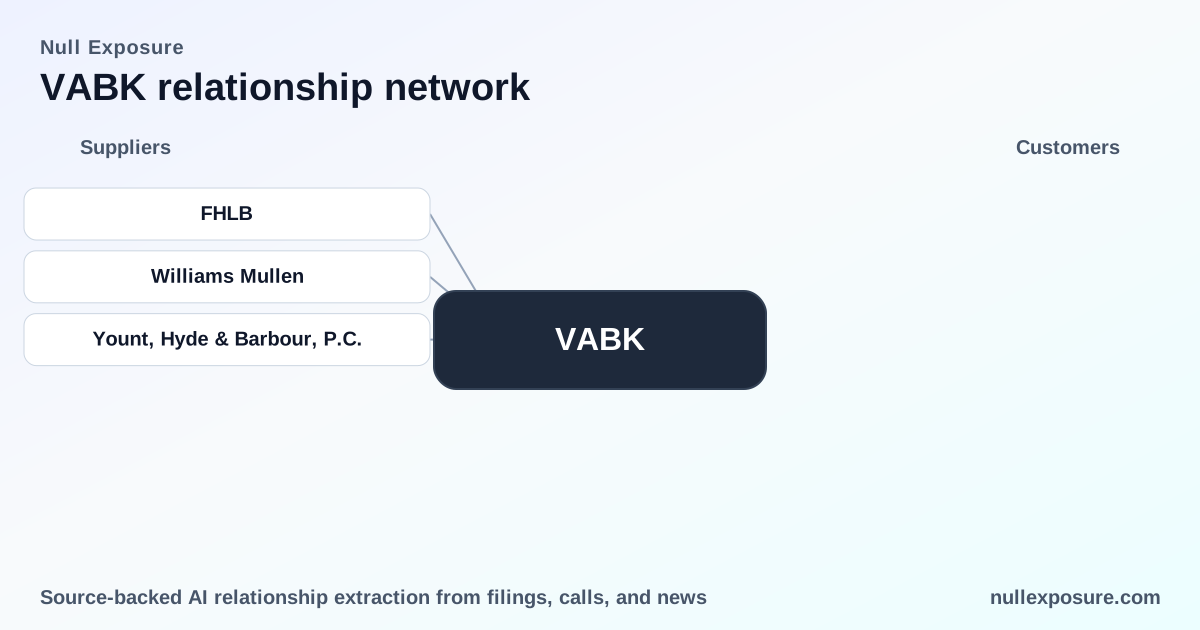
Virginia National Bankshares (VABK): Customer relationships, contract posture and what the Masonry Capital tie means for investors
Virginia National Bankshares is a community bank holding company that monetizes through traditional commercial banking and fee-based financial services: net interest income from a geographically concentrated loan book, deposit spreads, and noninterest income from trust, custody and asset-management activities. The business model blends short- and long-term lending with recurring service fees, and its customer relationships are concentrated in Virginia-area retail, small and mid-market commercial clients and not-for-profits. For deeper research and relationship mapping, visit https://nullexposure.com/.
The headline relationship: what happened with Masonry Capital
Masonry Capital was divested in April 2024, and the transaction included a multi‑year revenue‑share arrangement that preserves some fee flow to Virginia National even after the sale. According to a TradingView news summary of the company’s FY2026 disclosure, the divestiture was explicitly structured to retain recurring revenue via the revenue‑share agreement (TradingView, May 4, 2026). Company disclosures further describe Masonry Capital as an investment manager that historically generated management and incentive fees based on assets under management.
Why the Masonry divestiture matters to investors
The sale of Masonry Capital converts an operating unit that previously generated asset-management fees into a contractual revenue stream tied to a third party. That changes both revenue volatility and operational footprint: cash flows from management and incentive fees become governed by the revenue‑share schedule rather than internal AUM growth. The company’s FY2026 commentary confirms the transaction and the ongoing revenue‑share arrangement (TradingView, May 2026).
- Positive for capital and simplification: divesting an asset manager frees management attention and can improve capital efficiency for the bank franchise.
- Watch the revenue‑share horizon: multi‑year contracts preserve income but impose timebound cash flows and contractual counterparty risk.
Portfolio and counterparty mix — an operating model view
Virginia National runs a mixed lending and service franchise that balances short-term deposit and loan relationships with longer-duration commercial and real-estate lending. Company disclosures in FY2026 state the bank offers both short‑ and long‑term commercial, real estate and consumer loans, which produces a lending book with multiple maturity profiles and different interest‑rate sensitivities.
The bank targets a diverse counterparty set: retail individuals and households, small and mid‑sized businesses, and charitable/non‑profit organizations are core clients. This breadth supports stable deposit capture across segments, while credit concentration risk is tilted to community and mid‑market commercial borrowers. The company notes lending to small and mid‑sized businesses constitutes an important portion of the portfolio and is a source of incremental credit risk in the underwriting profile (FY2026 filings).
Geographic concentration is a feature, not a bug
Virginia National’s lending and deposit franchise is strongly regional, centered on Charlottesville, Winchester, Manassas, Richmond and surrounding counties. Most lending activity occurs within the Commonwealth of Virginia with selective exposure to adjacent Maryland, West Virginia and D.C. markets. Geographic concentration supports local market knowledge and cross‑selling efficiency, but it also means economic cycles in Virginia have outsized impact on asset quality and growth prospects.
Revenue mix: traditional bank spread plus fee income
Noninterest income is meaningful for the firm and includes service charges on deposit accounts, card and ATM fees, trust and estate administration, custody and asset‑management fees, and treasury services. The firm’s trust and VNB Trust & Estate Services business generates fees tied to assets under management and custody; historically, Masonry Capital contributed to the asset-management angle prior to its sale. Revenue recognition follows fee schedules as services are delivered, so recurring contractual fee streams complement loan spread income.
Materiality and risk signals investors should prioritize
Several company-level signals from FY2026 disclosures should shape investor diligence:
- Allowance for credit losses (ACL) is a material estimate for VABK. Loan loss provisioning materially impacts earnings volatility and capital if credit conditions shift.
- Contracting posture is mixed: the bank operates across short‑ and long‑term loan tenors, exposing net interest income to both repricing benefits and duration risk.
- Counterparty concentration to small and mid‑market businesses and regional borrowers increases sensitivity to local economic conditions.
- Service relationships and fee revenues are meaningful but have been reshaped by the Masonry divestiture; retained revenue is now contractual rather than driven purely by internal AUM growth.
- Regional concentration in Virginia improves customer intimacy and cross‑sell but amplifies exposure to regional economic cycles.
These characteristics position VABK as a classic community bank with supplemental fee businesses; investors should evaluate capital adequacy, ACL assumptions and the revenue‑share schedule for Masonry when forecasting forward income.
Relationship-by-relationship coverage
Masonry Capital — Masonry Capital was divested in April 2024 and the sale includes a multi‑year revenue‑share arrangement that preserves a contracted stream of asset-management fees to Virginia National following the divestiture. Company disclosures and a TradingView news summary of the FY2026 filings document the divestiture and the revenue‑share structure (TradingView news item, May 4, 2026). Company filings also describe Masonry Capital as an investment manager supplying separately managed accounts and a private fund, historically generating management and incentive fees (FY2026 filings).
Financial context and investor implications
VABK’s public metrics provide context for relationship-level impact: the bank trades at a moderate price‑to‑book, pays a dividend, and reports positive profitability metrics (profit margin and ROE consistent with a well‑managed regional bank). The divestiture of Masonry Capital is strategically significant because it converts an operating line into contractual income that will ramp down according to the revenue‑share schedule or evolve with the third party’s performance. Investors should model both the retained revenue profile and the ACL sensitivity when valuing future earnings and dividend sustainability.
For further relationship mapping and to track contract-level disclosures as they roll through filings and press coverage, visit https://nullexposure.com/ for structured summaries and source links.
Bottom line: what to watch next
- ACL trajectory and provisioning will be the primary lever for earnings volatility; it is a material estimate in FY2026 disclosures.
- Revenue‑share realization from the Masonry sale determines how much of prior asset‑management economics persist on the income statement.
- Local economic trends in Virginia and the health of small/mid‑market borrowers will drive credit outcomes and deposit behavior.
Bold, clear signals are available in the company’s FY2026 commentary: Virginia National runs a regionally concentrated bank with a hybrid income model of net interest and fee revenue, and the Masonry transaction shifts one fee stream from internal operations into a contractual form investors should model explicitly. For continued coverage and relationship intelligence, consult https://nullexposure.com/.