Marriott Vacations Worldwide (VAC): Customer relationships and what they signal for investors
Marriott Vacations Worldwide monetizes a dual business model: selling vacation ownership interests (VOIs) to individual buyers and capturing recurring revenue as a manager/operator for resorts and owners’ associations. The company finances a meaningful share of its retail sales through company-originated, collateralized consumer loans that amortize over ten to fifteen years, and it supplements transaction income with management and exchange fees tied to branded resort operations. For investors, the firm’s cash generation is therefore a mix of near-term sales cycles, long-duration receivables, and fee-based services tied to branded resort portfolios. Learn more at https://nullexposure.com/.
Key takeaways
- Primary monetization: VOI sales (upfront) + long-term consumer financing (interest and principal) + recurring management and exchange fees.
- Credit exposure: consumer loans secured by VOIs create long-duration credit risk to retail borrowers (weighted-average FICO ~725 at origination).
- Geographic concentration: the business is heavily North America–centric for sales, while operations remain globally branded.
- Asset management dynamics: the company both sells real estate assets and provides ongoing services, so asset sales (like the Westin Cancun transaction) are meaningful signals of capital redeployment.
Business model and contract posture: how cash and credit flow Marriott Vacations runs a vertically integrated model: it develops, markets and sells VOIs and then offers financing to qualifying buyers that the company retains on its balance sheet, with typical amortization terms of ten to fifteen years. These long-term, installment-style contracts create a predictable revenue stream from interest and principal repayment but also concentrate credit risk on individual retail borrowers—the latest public disclosures show a weighted-average FICO around 725 for the receivable pool at year-end 2024. At the same time, the company earns recurring, fee-based income by providing day-to-day resort management, reservation systems and owner-association services across its branded portfolio.
Financial context that matters to customers and operators Through the trailing twelve months ending the latest reported quarter (2025-12-31), the company reported about $3.33 billion in revenue and $601 million of EBITDA, with a market capitalization near $2.41 billion. Profitability is uneven—operating margins are positive but net results show pressure—so management is actively balancing near-term liquidity and long-term asset-backed receivables. High institutional ownership (over 90%) and near-20% insider ownership underline that the stock is closely held by active investors, which influences strategic decisions around asset sales and capital allocation.
What the company-level constraints tell investors and operators
- Contracting posture (long-term): Marriott Vacations structures consumer financing to amortize over 10–15 years, which locks up capital and ties balance-sheet health to retail credit performance. This is a company-level signal derived from public filings describing financing terms.
- Counterparty type (individual): The customer base for VOIs is predominantly individual retail buyers, exposing the company to borrower default risk rather than counterparty default from sophisticated institutional counterparties. Filings confirm outstanding receivables and associated credit risk from retail purchasers.
- Geographic concentration (North America first, global operations overall): In 2024, 91% of VOI contract sales originated in North America, while the company also operates in Europe and Asia Pacific and positions itself as a global brand across multiple franchise names.
- Relationship roles (seller and service provider): The firm is both the principal seller of VOIs and a fee-earning manager/operator of resorts—this dual role creates revenue diversification but also operational complexity and potential conflicts when monetizing property assets.
- Relationship stage (active) and segment (services): Membership and active owner counts underline ongoing, active customer relationships and a meaningful services segment tied to recurring fees.
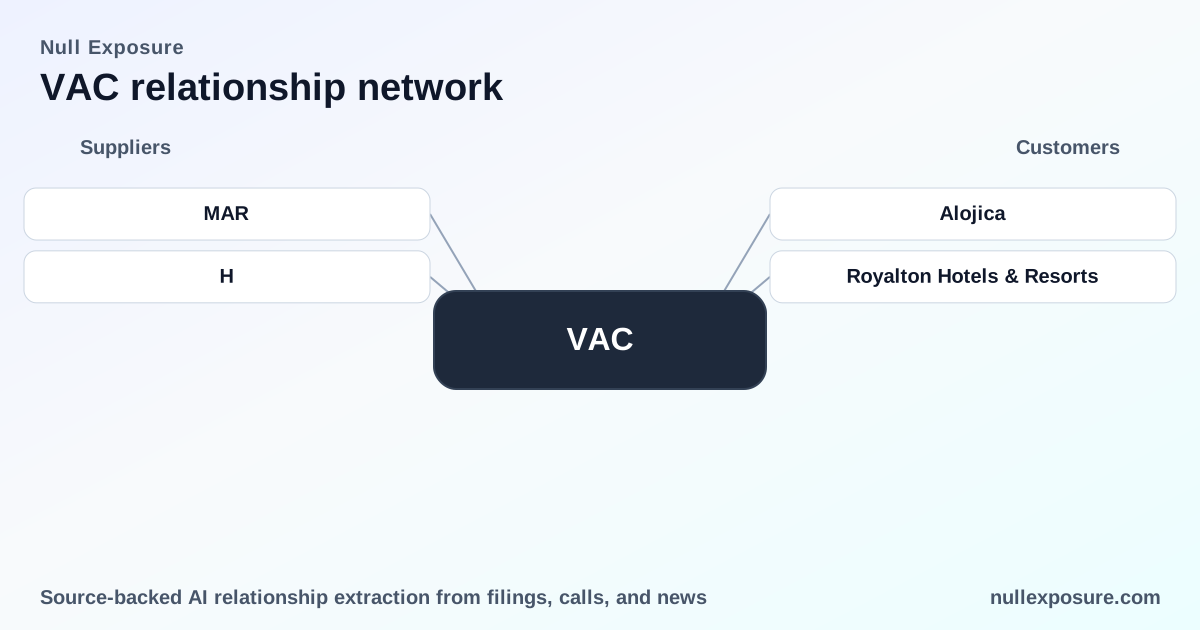
Recent customer/transaction relationships: two deal-level items Alojica — Alojica’s affiliates, part of a Black Creek Mexico-sponsored investment platform, completed an acquisition of The Westin Resort & Spa, Cancun from affiliates of Marriott Vacations Worldwide, indicating Marriott Vacations is actively monetizing select resort assets to third-party investors; this transaction was reported on March 10, 2026 by Hotel Management. (Hotel Management, March 10, 2026)
Royalton Hotels & Resorts — Royalton Hotels & Resorts partnered with the same Alojica/Black Creek vehicle to acquire The Westin Resort & Spa, Cancun from Marriott Vacations Worldwide affiliates, reflecting a joint-operating/ownership shift where Marriott is selling the underlying real estate while third parties assume ownership and potential operational roles; reported March 10, 2026 by Hotel Management. (Hotel Management, March 10, 2026)
How to read those two transactions for strategy and risk Both items describe the same asset sale from Marriott Vacations affiliates to a Black Creek–sponsored platform in partnership with Royalton Hotels & Resorts. Asset sales of branded resorts are a tactical lever: they raise cash, reduce operating capital tied to real estate, and can offload capital-intensive obligations while preserving management fee upside if Marriott retains operating roles under third-party agreements. For investors, these deals reduce fixed-asset exposure but can compress long-term fee growth unless replacement assets or management contracts are secured.
Operational implications for counterparties and operators
- Concentration risk: With sales heavily concentrated in North America, operators and partners in that region secure the bulk of commercial volume; international revenue is meaningful for diversification but smaller in scale.
- Credit and borrower management: The long-term consumer lending posture necessitates robust servicing and collections capability; borrower credit quality (FICO mid-700s at origination) is a critical metric for underwriting and loss provisioning. Company filings through 2024 provide those credit detail anchors.
- Revenue mix sensitivity: The mix between upfront VOI revenue and recurring management/exchange fees affects cyclicality; leisure cycles influence sales velocity while management fees smooth earnings.
Risks and catalysts to watch
- Credit losses and interest-rate sensitivity: Long-duration receivables amplify exposure to macroeconomic deterioration in consumer credit or higher financing costs.
- Portfolio rebalancing via asset sales: Continued dispositions like Westin Cancun will alter the earnings composition—reducing property-level revenues while potentially increasing fee income if management agreements persist. The March 2026 Hotel Management report documents the Cancun sale.
- Geographic and brand concentration: Despite global branding, near-term sales concentration in North America constrains growth optionality and leaves the company reliant on domestic leisure demand.
Conclusion and action points for investors and operators Marriott Vacations combines asset-backed retail lending with branded management services—a capital-intensive seller with a recurring-fee overlay. The recent Westin Cancun disposition demonstrates active portfolio management and balance-sheet reshaping. Investors should track consumer credit metrics, originations, and the cadence of asset sales; operators and partners should assess how each disposition affects management mandates and fee streams. For a focused, relationship-level view and ongoing monitoring of VAC counterparties and transactions, visit https://nullexposure.com/.