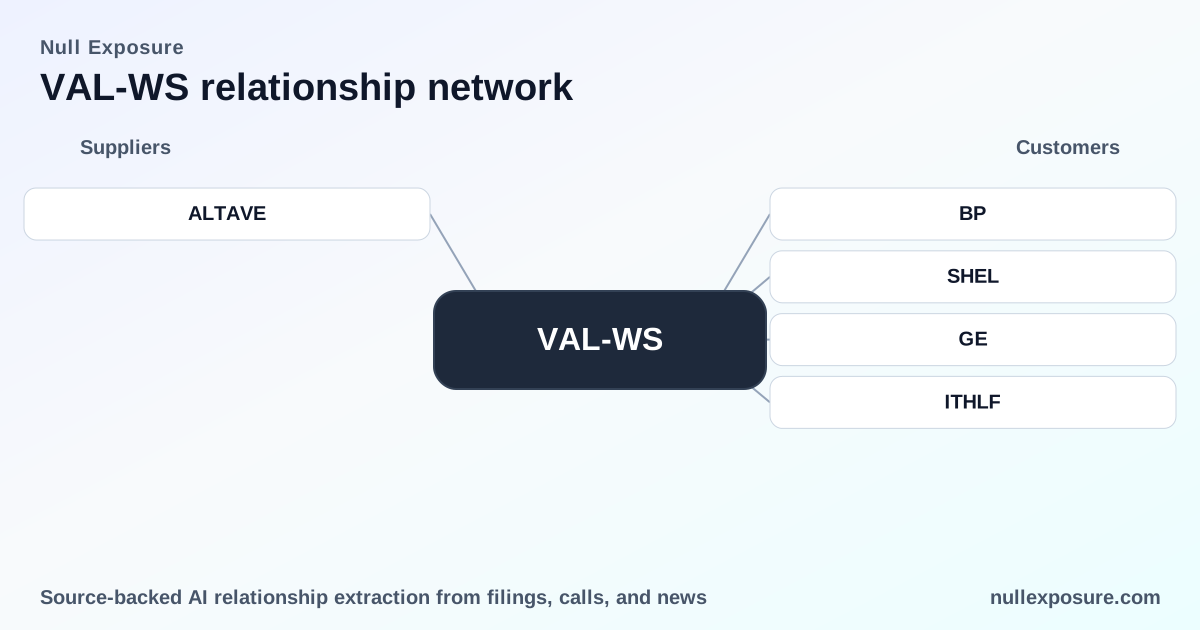
Valaris (VAL-WS) customer map: who’s booking the fleet and why it matters to investors
Valaris operates and monetizes as a global offshore drilling contractor: it deploys owned and managed drilling units (jackups, drillships, semisubmersibles) to energy operators on multi-well programs and shorter-term campaigns, collecting dayrates and contract revenues tied to rig utilization and specialized capability. The company’s commercial profile is driven by relationships with major oil & gas and energy engineering firms that book high-value, capital-intensive rigs for both oil & gas development and offshore wind support roles. For investors, the relevance is straightforward: contract mix, customer concentration, and fleet utilization determine cash flow visibility and risk exposure. Learn more at https://nullexposure.com/.
Immediate headline: major operators are contracting Valaris rigs
Recent coverage consolidates several high-profile customer bookings that illustrate Valaris’s go-to-market—large, creditworthy operators taking multi-rig and multi-well programs. Offshore-Energy’s March 2026 reporting is the primary public touchpoint for these relationships and shows the fleet being deployed across oil & gas and offshore wind assignments.
BP — multi-well Middle East gig
Valaris supplied a 2013-built drillship to BP for a multi-well campaign in the Middle East, demonstrating the company’s role as a provider of flagship drilling capacity for major international operators. According to Offshore-Energy (March 10, 2026), BP hired Valaris’ 2013-built drillship for a multi-well gig in the Middle East (https://www.offshore-energy.biz/valaris-emerges-from-chapter-11-free-of-7-1bn-of-debt/).
SHEL — Shell’s Brazilian project booking (ticker variant)
Shell (listed here as SHEL) contracted a Valaris drillship for drilling operations on a large oil & gas project in Brazilian waters, reflecting direct commercial ties for deepwater development programs. Offshore-Energy reported that Shell chose a Valaris drillship for drilling ops at a giant oil & gas project in Brazil (March 10, 2026; https://www.offshore-energy.biz/valaris-emerges-from-chapter-11-free-of-7-1bn-of-debt/).
Shell — Brazilian waters assignment (operator name)
Separately indexed as “Shell,” the same booking is reported: Valaris’s drillship is committed to a sizeable Brazilian development for Shell, underscoring the operator’s reliance on modern deepwater assets. Offshore-Energy’s March 2026 article notes the Shell booking for Brazilian operations (https://www.offshore-energy.biz/valaris-emerges-from-chapter-11-free-of-7-1bn-of-debt/).
GE Vernova — cross-sector booking for energy projects
GE Vernova is listed among companies that booked Valaris rigs for a mix of oil & gas and offshore wind jobs, indicating Valaris’s commercial reach into energy-transition activity where drilling and heavy marine services intersect. Offshore-Energy (March 10, 2026) names GE Vernova in a group of customers booking five Valaris rigs for oil & gas and offshore wind jobs (https://www.offshore-energy.biz/valaris-emerges-from-chapter-11-free-of-7-1bn-of-debt/).
Ithaca — strategic operator booking included in a multi-rig batch
Ithaca appears in coverage alongside majors as a booker of Valaris capacity, part of a packet of five rigs that span hydrocarbon and emerging offshore energy tasks. The March 2026 Offshore-Energy report lists Ithaca among customers booking Valaris rigs for oil & gas and offshore wind work (https://www.offshore-energy.biz/valaris-emerges-from-chapter-11-free-of-7-1bn-of-debt/).
ITHLF — alternate listing for Ithaca
An additional indexing as ITHLF reiterates Ithaca’s inclusion in the same multi-rig bookings, highlighting how source aggregation can create parallel identifiers for the same operator relationship. The Offshore-Energy article (March 10, 2026) records this booking in the same item that grouped Shell, BP, Ithaca and GE Vernova (https://www.offshore-energy.biz/valaris-emerges-from-chapter-11-free-of-7-1bn-of-debt/).
What the relationship set reveals about Valaris’s commercial posture
The customer list and the nature of the reported bookings provide clear company-level signals about Valaris’s operating and business model characteristics:
-
Contracting posture — project and term mix: The cited bookings are a combination of multi-well programs and campaign-type assignments, indicating a commercial model that blends longer-term, multi-well engagements with discrete project hires. This structure supports revenue lumpiness tied to mobilizations but offers pockets of predictable cash flow when rigs are contracted for multi-well campaigns.
-
Customer concentration — large, creditworthy counterparties: The presence of BP, Shell, GE Vernova and other operators demonstrates concentration toward a small set of large, institutional customers. That concentration improves counterparty credit quality but raises exposure to sectoral demand cycles among a handful of decision-makers.
-
Criticality — mission-critical capital equipment: Drillships and other deepwater assets are mission-critical to offshore development, giving Valaris leverage on pricing for specialized units but also exposing the company to high capital-recovery risk if utilization falls.
-
Fleet maturity and capability mix: The explicit reference to a 2013-built drillship signals a mixed-age fleet profile where mid-decade vessels remain commercially central; fleet age and capability will directly affect dayrates, maintenance capex, and redeployment flexibility.
Risk and upside for investors
Valaris’s fortunes hinge on utilization and contract tenor. The upside is clear: securing multi-well, high-dayrate bookings with majors provides immediate revenue and asset coverage. The risk is structural: customer concentration and the capital intensity of rigs mean value is fragile if offshore activity softens.
Key operational watchpoints:
- Contract tenor and backlog disclosure: Monitor public filings and operator announcements for confirmed contract lengths and backlog additions.
- Utilization and reactivation cadence: Observe how quickly warm rigs are re-contracted into campaigns versus remaining idle.
- Customer diversification into wind: The inclusion of offshore wind work with GE Vernova signals incremental diversification, which could lengthen utilization windows but will require operational adaptation.
Learn more about tracking commercial exposures and counterparty mappings at https://nullexposure.com/.
Practical investor takeaways
- Major operators are booking Valaris capacity: BP, Shell (SHEL/Shell), GE Vernova, and Ithaca (ITHLF) all feature in recent reporting as customers booking Valaris rigs (Offshore-Energy, March 10, 2026).
- Contracts span oil & gas and offshore wind: The bookings cover both hydrocarbon development and offshore wind support, reflecting commercial flexibility.
- Concentration and asset intensity are central risk drivers: Large customers and high-cost assets create both revenue upside and downside vulnerability when demand shifts.
- Fleet composition matters: References to a 2013-built drillship highlight the importance of vessel age and capability in sustaining dayrates.
This collection of public bookings establishes that Valaris is executing on an asset-leasing model to blue-chip energy operators, with both the upside of secured engagements and the cyclical risk that defines offshore drilling. Investors should follow contract confirmations and fleet utilization metrics as the primary drivers of near-term value.