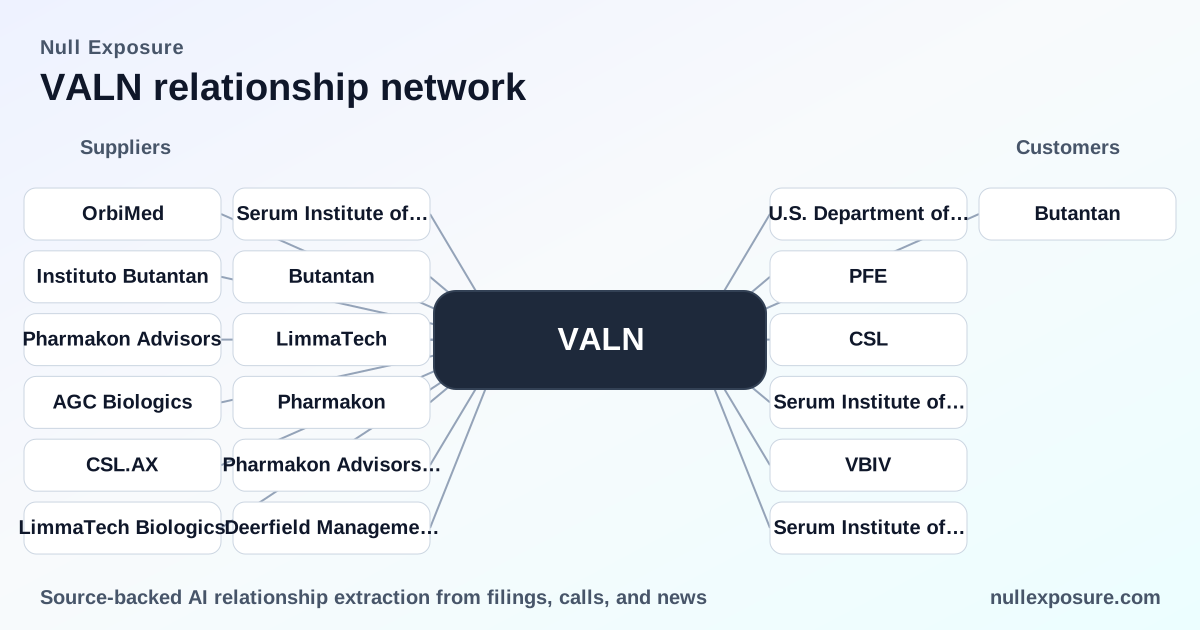
Valneva (VALN) — customer relationships that shape near-term revenue and strategic optionality
Valneva is a specialty vaccines company that monetizes through a mix of product sales, government contracts, licensing deals and strategic pharma collaborations. Commercialized franchises such as IXIARO® and partnership-originated programs (notably the Lyme vaccine VLA15 developed with Pfizer) provide current revenue and milestone potential, while distribution and licensing agreements transfer commercialization risk and create stepped cash inflows. For a focused, investor-oriented read on how customer relationships affect revenue concentration, contract maturity and execution risk, see Null Exposure’s coverage: https://nullexposure.com/.
Why these customer ties matter to investors now
Valneva’s business model is hybrid: it is a commercial vaccine seller for established products, a licensor for select clinical assets, and a collaborator for late‑stage development programs. That combination produces a contracting posture where government and large pharmaceutical partners are critical counterparties, concentration is meaningful, and cash flow profiles are lumpy (product sales + milestone/license receipts). The firm sits between steady public‑sector demand for travel/tick vaccines and binary regulatory outcomes for partnered candidates — a profile that elevates execution and partner alignment as primary valuation drivers.
A second perspective: the public record shows active re‑shaping of distribution networks (regional marketing agreements) and selective licensing moves that transfer late‑stage R&D risk to partners while securing future revenue streams. These are not one-off items; they reflect a deliberate commercialization strategy that balances cash generation with risk transfer. You can read more analysis and ongoing updates at https://nullexposure.com/.
Relationship breakdown — what the filings and press actually disclose
Below I cover each relationship mention in the public record sample and cite the document or news item that disclosed it.
U.S. Department of Defense (earnings call, Q3 2025)
Valneva reported it finalized a new IXIARO U.S. Department of Defense contract, underscoring government demand for its Japanese encephalitis vaccine and providing direct commercial support for the established IXIARO franchise. Source: Q3 2025 earnings call transcript referenced March 2026.
PFE (6‑K filing / FY2026)
Valneva’s public filing reiterated that VLA15, the only Lyme disease vaccine candidate in advanced development, is partnered with Pfizer, tying regulatory and commercial upside to a large pharma partner. Source: Valneva 6‑K filing summarized via StockTitan (March 2026).
Pfizer (6‑K filing / FY2026)
The same 6‑K filing explicitly references the Pfizer partnership on the Lyme vaccine, confirming corporate-level disclosure that Pfizer is responsible for development and commercialization phases. Source: Valneva 6‑K filing via StockTitan (March 2026).
CSL Seqirus (earnings call transcript / FY2025)
Valneva announced an exclusive marketing and distribution agreement for Germany with CSL Seqirus, replacing a prior distributor and beginning distribution of IXCHIQ in Germany, indicating regional reallocation of commercial responsibilities. Source: Q3 2025 earnings call transcript published on InsiderMonkey (March 2026).
Elaris FlexCo (Ad‑Hoc News / FY2026)
Valneva licensed the antigen technology behind its C. difficile candidate VLA84 to Elaris FlexCo under an exclusive global license, generating a near‑term revenue stream and future milestone upside while transferring development burden. Source: Ad‑Hoc News coverage of the March 18, 2026 license (May 2026).
CSL (InsiderMonkey / FY2025)
A second earnings‑call mention clarifies that CSL (Seqirus) has already started distributing IXCHIQ in Germany, confirming immediate operational handoff and revenue channel continuity in a significant European market. Source: Q3 2025 earnings call transcript on InsiderMonkey (March 2026).
Serum Institute of India (IndianPharmPost / FY2026)
Valneva and the Serum Institute of India mutually agreed to discontinue their license agreement for IXCHIQ (single‑shot chikungunya vaccine), a reversal that centralizes distribution control and alters earlier commercialization plans in Asia. Source: IndianPharmPost report (March 2026).
Pfizer (SahmCapital / FY2025)
SahmCapital noted that Pfizer and Valneva entered a collaboration in April 2020 for development and commercialization of VLA15, reiterating the long‑standing development partnership and Pfizer’s commercial role. Source: SahmCapital coverage of vaccine booster results and partnership context (Nov 26, 2025).
Pfizer Inc. (SahmCapital / FY2025)
A separate mention in the same piece reiterates Pfizer’s contractual role in VLA15 development and commercialization, reinforcing that regulatory milestones and filings will be managed in partnership. Source: SahmCapital (Nov 26, 2025).
Elaris FlexCo (Ad‑Hoc News – legal coverage / FY2026)
Ad‑Hoc News also framed the Elaris license as securing future milestone payments by licensing global rights for the C. difficile antigen technology, emphasizing revenue protection amid other legal and operational headwinds. Source: Ad‑Hoc News legal coverage (May 2026).
VBI Vaccines (StockTitan 6‑K / FY2026)
Valneva announced a European marketing and distribution partnership for PreHevbri® with VBI Vaccines, expanding commercialization routes for that product through a pharma partner focused on the region. Source: Valneva 6‑K filing summary via StockTitan (March 2026).
VBI Vaccines (StockTitan 6‑K duplicate / FY2026)
The duplicate filing entry reiterates the European distribution partnership with VBI Vaccines, confirming the arrangement in the same corporate filing. Source: Valneva 6‑K via StockTitan (March 2026).
Serum Institute of India (vax‑before‑travel / FY2025)
An earlier report noted that Valneva and Serum regained distribution control after mutually agreeing to discontinue the license for IXCHIQ, signaling operational consolidation after the partnership unwind. Source: vax‑before‑travel report (Dec 31, 2025).
Pfizer (InsiderMonkey – analyst note / FY2026)
Analyst commentary referenced by InsiderMonkey discussed anticipated regulatory submissions managed by Pfizer, tying near‑term approval cadence to Pfizer’s program timeline for the Lyme vaccine. Source: InsiderMonkey analyst coverage (May 2026).
Serum Institute of India Pvt. Ltd. (Citeline / FY2026)
Citeline reported the termination of the chikungunya vaccine licensing deal with Serum, documenting the formal end of that distribution agreement and clarifying the regulatory/commercial map for Asia. Source: Citeline Insights analysis (March 2026).
Serum Institute / Butantan (InsiderMonkey Q3 transcript / FY2025)
During the Q3 2025 earnings call Valneva noted existing regional partners: Butantan for Brazil/South America and Serum Institute of India for Asia, a disclosure that mapped prior geography‑based licensing approaches for the chikungunya program. Source: Q3 2025 earnings call transcript on InsiderMonkey (March 2026).
Butantan (InsiderMonkey Q3 transcript / FY2025)
The same earnings transcript specifically names Butantan as Valneva’s partner for Brazil and South America, confirming regional commercialization strategies for certain vaccine assets. Source: Q3 2025 earnings call transcript on InsiderMonkey (March 2026).
What the public constraints (or lack of them) reveal
There are no explicit constraint entries attached to this customer relationship dataset. That absence is itself a signal: public disclosures focus on high‑level commercial and licensing moves rather than granular contracting terms (pricing, volume commitments, or exclusivity windows). For investors, that means counterparty importance and timing risk are visible, but financial terms and concentration outside headline partners remain opaque — valuation must therefore place weight on observable milestones, known distribution arrangements, and historical product sales cadence instead of undisclosed contractual metrics.
Investor takeaways — clean checklist
- Partner concentration is material: Pfizer and government customers (e.g., U.S. DoD) drive regulatory and product sales risk/reward.
- Commercial risk transfer is active: licensing to Elaris and distribution deals with CSL/Seqirus and VBI reduce Valneva’s capital burden while securing milestone and distribution receipts.
- Geography matters: recent terminations and reassignments (Serum, Butantan) shift regional commercialization responsibility and revenue recognition timing.
- Visibility is limited on pricing/volumes: absence of disclosed contract economics increases dependency on announced milestones and product sales for near‑term forecasts.
For up‑to‑date intelligence and tranche‑level relationship tracking, visit Null Exposure: https://nullexposure.com/.
Bold relationships, explicit sources and the contract types above should help you calibrate revenue modeling and partner‑execution risk for Valneva’s near‑term horizon.