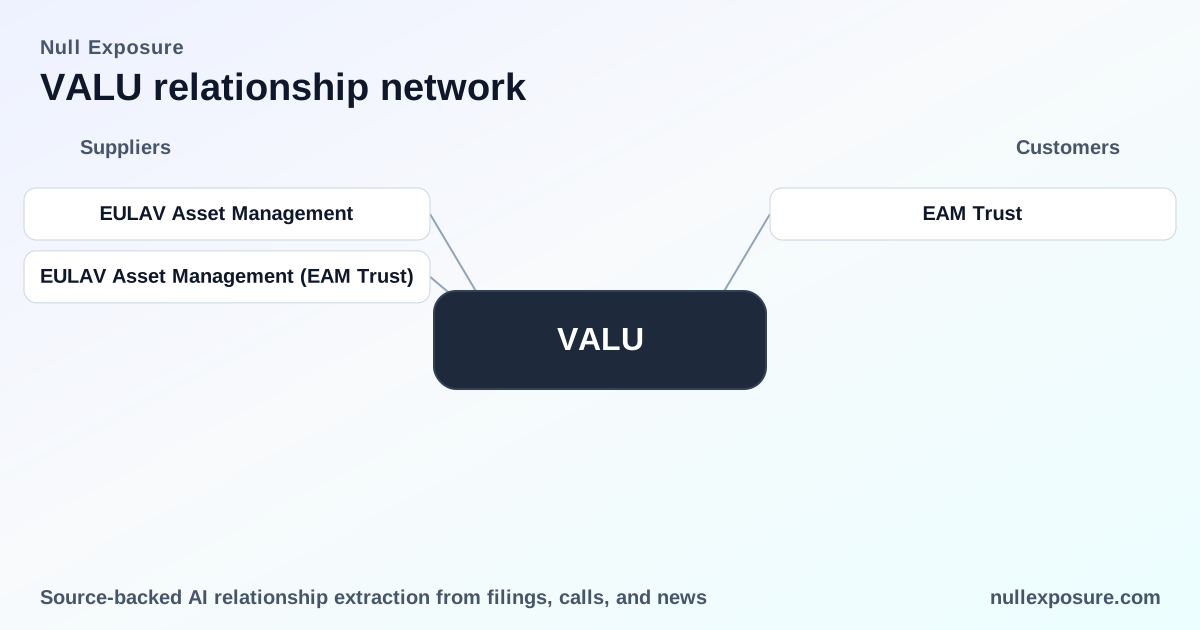
Value Line Inc. (VALU): Customer Relationships and Revenue Reliance — an investor brief
Value Line is a small-cap financial information publisher that monetizes through two principal channels: subscription sales of print and digital investment periodicals and licensing of proprietary intellectual property (trademarked ranks and research) to third‑party investment products. The company collects advance subscription fees recognized ratably and asset‑based copyright/licensing fees tied to the market value of assets managed or sponsored by counterparties. For investors, the key commercial reality is a U.S.-centric, renewal-driven revenue model with meaningful customer concentration and material related‑party revenue streams. For a concise partner and counterparty map, visit https://nullexposure.com/.
Why the customer map matters to valuation
Value Line’s operating leverage flows from high renewal rates and licensing economics: subscriptions offer predictability through advance payments and straight‑line recognition, while licenses produce asset‑linked, scalable royalty income. That mix creates a revenue base that is both sticky (85.9% renewal sales) and sensitive to market valuations (copyright fees scale with assets under management in third‑party products). At the same time, concentration and related‑party flows introduce single‑counterparty risk and potential governance scrutiny, which should factor into any multiple applied to current earnings and EBITDA.
The full set of customer relationships disclosed
Below I cover every relationship referenced in the available results and the specific public filings and press reports that reported them.
Eulav Asset Management (EAM) — related‑party revenue contributor
EAM contributed a meaningful share of quarterly profitability, with revenues and profits from EAM totaling $4.8 million in the referenced quarter (FY2026), down slightly from $4.9 million the prior year. According to a May 4, 2026 press release reported by The Globe and Mail, EAM is a material earnings contributor and is treated in public disclosures as a significant related party. (Source: The Globe and Mail press release, May 4, 2026.)
EAM Trust — non‑voting revenues and profit interests
EAM Trust generated non‑voting revenue and non‑voting profit interests that totaled approximately $10.275 million in FY2025, a year‑over‑year increase of 15.8% and a significant contributor to net income in that period. TradingView’s coverage of Value Line’s SEC 10‑Q summarized these figures in March 2026, highlighting the scale of trust‑related receipts in the company’s P&L. (Source: TradingView analysis of Value Line SEC 10‑Q, March 2026.)
What the contractual and counterparty signals tell investors
Value Line’s public filings and reporting provide multiple signals about how it contracts, who it serves, and where risk congregates:
-
Contracting posture — licensing and subscription mix. The company explicitly sells annual subscriptions (paid largely in advance and recognized ratably) and licenses proprietary rankings and trademarks to product sponsors, earning asset‑based copyright fees upon delivery. This dual model blends recurring subscription cash flow with variable, market‑linked licensing revenue.
-
Renewal and maturity profile. With Renewal Sales at 85.9%, the subscription base is mature and renewal‑driven, supporting predictable near‑term revenue while limiting customer acquisition cost volatility.
-
Customer concentration and materiality. Value Line reports that a single customer accounted for 29.6% of total publishing revenues in the twelve months ended April 30, 2025; note disclosures also call out EAM and the Value Line Funds in related‑party commentary. This is a material concentration that compresses diversification and elevates counterparty risk.
-
Counterparty composition and geography. Customers include individuals, institutions, municipal and university libraries, and investment firms (and thus government/non‑profit endpoints); revenue is overwhelmingly U.S.-centric (about 98% domestic), concentrating economic exposure to the U.S. market and to domestic market valuations that influence asset‑based fees.
-
Role and spend scale. The company functions as a seller of content and a licensor of its proprietary ranks; copyright fee mechanics make many institutional counterparties effectively licensees of Value Line’s intellectual property. The disclosed customer concentration places the largest customer in the $10M–$100M annual revenue impact band for publishing revenues.
Taken together, those constraints describe a company with predictable subscription cash flow, cyclical royalty upside tied to equity markets, and material customer concentration that requires active monitoring by boards and investors.
Investment implications: what to watch and why it affects valuation
-
Earnings quality and related‑party exposure. A non‑trivial portion of Value Line’s net income is driven by EAM/EAM Trust receipts; investors should treat these flows as both operational and related‑party financial events, scrutinizing governance disclosures and transfer pricing in the SEC notes. The presence of substantial related‑party revenue compresses the informational value of headline margins unless adjusted.
-
Market sensitivity through licensing. Because licensing revenue is asset‑based, a passive investor thesis should incorporate equity market cycles: down markets reduce license royalties even when subscription churn remains low, leading to higher operating leverage in corrections.
-
Concentration risk pricing. With nearly 30% of publishing revenues tied to one customer, a conservative valuation incorporates a concentration discount or explicitly models the sensitivity of revenues to the retention or loss of that counterparty.
-
Geographic and customer mix limiting international growth optionality. With roughly 98% of revenues U.S.-based and a customer set dominated by domestic investors and institutions, upside from geographic diversification is limited until management pursues strategic expansion.
Risk factors to monitor
-
Related‑party governance. Public filings already reference EAM in related‑party notes; investors should monitor future SEC filings for the terms and persistence of these arrangements.
-
Asset‑value volatility. Licensing income will move with AUM valuations at counterparties; monitor market indexes and the composition of licensed products (e.g., ETFs or annuity wrappers).
-
Concentration creep or attrition. Any shift in the single largest customer’s strategy or assets under management would have outsized P&L impact.
Bottom line and next steps
Value Line’s revenue model combines sticky subscription economics with scalable asset‑based licensing, producing a mix of predictable cash flow and market‑sensitive upside. However, material customer concentration and related‑party revenue must be incorporated into any valuation—both as a risk and as a lever that can amplify returns when counterparties’ AUM expands. For a strategic audit of customer and counterparty exposures, and to see how these signals fit with broader small‑cap data providers, visit https://nullexposure.com/.
If you want a tailored briefing that models downside scenarios for the EAM/EAM Trust flows against subscription retention, I can prepare a scenario analysis focused on revenue sensitivity and adjusted EBITDA impacts.