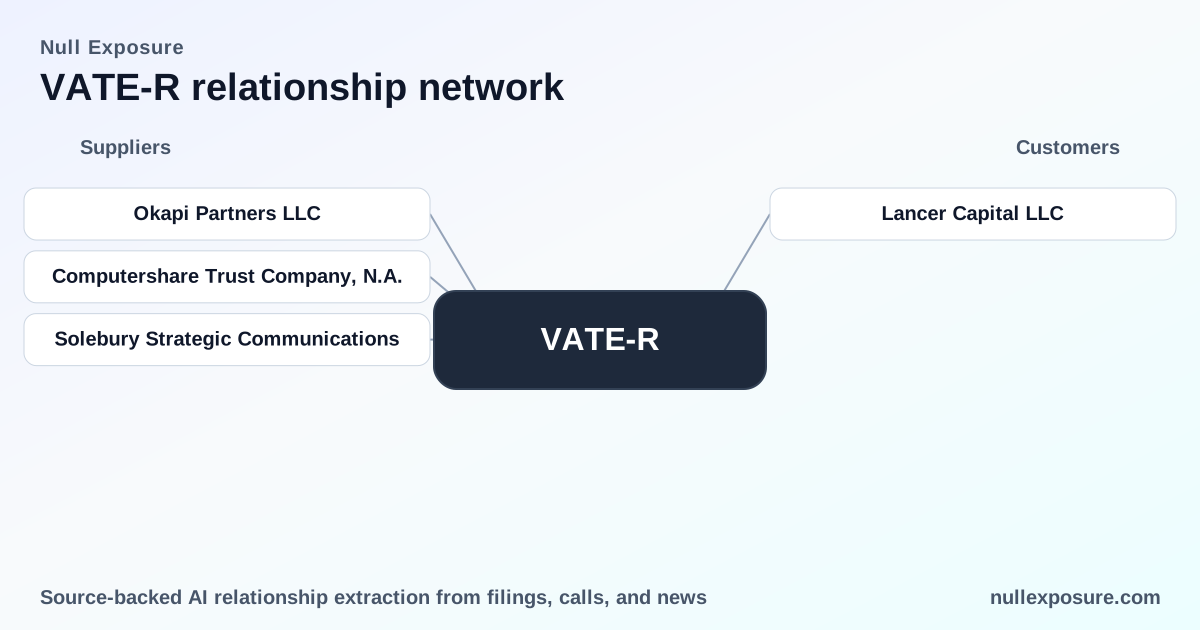
VATE-R: Investor thesis on capital relationships and what the Lancer Capital deal reveals
VATE-R operates as a capital-intensive issuer that funds its operations and strategic initiatives through equity financing events, including rights offerings and issuance of convertible preferred instruments. The company monetizes by accessing private and public capital markets rather than through high-margin product sales, making investor relationships and financing mechanics central to valuation, dilution risk, and governance outcomes.
If you want a concise registry of documents and monitoring tools for issuer-investor events, visit https://nullexposure.com/ for structured coverage and alerts.
Why this single financing relationship matters more than a typical customer win
This relationship is not a customer contract in the commercial-sales sense; it is a financing arrangement that functions like a strategic revenue stream. A large, concentrated investor willing to take preferred equity instead of common stock directly affects cash runway, capital structure, and shareholder dilution. From an operator perspective, the terms of such an instrument constrain future capital decisions; from an investor perspective, they alter expected returns and governance dynamics.
There are no explicit third‑party contractual constraints disclosed alongside the relationship data, which signals that public filings and news are the primary sources for assessing the company’s contracting posture and funding dependencies. In plain terms: external funding commitments and investor concentration drive VATE-R’s short- and medium-term operational flexibility.
The Lancer Capital relationship, explained in plain English
Lancer Capital LLC agreed to purchase up to $19.0 million of VATE-R’s newly issued Series C Non‑Voting Participating Convertible Preferred Stock at $1,000 per share, electing that purchase in lieu of exercising subscription rights available under a rights offering. According to the public notice covering the FY2024 rights offering, this step enabled Lancer to increase its economic exposure while respecting limits on common stock acquisition. (Source: StockTitan news release covering the rights offering, March 10, 2026.)
What the instrument’s structure implies for control and returns
- Non‑voting preferred: Lancer strengthens economic claims without adding voting power. That reduces governance risk to incumbent common shareholders while still funneling capital to the issuer.
- Participating and convertible features: Participation grants upside alongside fixed-preference benefits; convertibility creates a pathway to common equity that will dilute existing holders when exercised. Together, these features balance downside protection for the investor with future upside potential.
- Subscription-right substitution: Opting for preferred stock "in lieu of" exercising subscription rights signals either a regulatory/ownership limit on common stock for Lancer or a deliberate choice to obtain a preferred claim instead of immediate voting equity. This is economically significant for modeling dilution scenarios and control outcomes.
Contracting posture, concentration, criticality, and maturity — a practical read
Without explicit contractual constraints disclosed in the relationship record, treat the following as company-level signals:
- Contracting posture: VATE-R is comfortable using bespoke equity instruments to attract large investors; this indicates a flexible, market-facing funding approach rather than reliance on bank debt or long-term commercial contracts.
- Concentration: A single, sizable investor commitment of $19 million concentrates funding risk; the company’s near-term runway and strategic initiatives are more sensitive to the actions or intentions of a few large participants than to a diversified commercial customers base.
- Criticality: The invested capital is critical capital — it directly influences liquidity and capital structure rather than incremental revenue. That elevates the importance of tracking investor covenants, conversion triggers, and payout mechanics.
- Maturity: The instrument’s convertible preferred form implies staged capital sophistication: immediate preference treatment with a built-in maturity toward common-equity outcomes. Modelers should treat the preferred as a bridge instrument that can convert into long-term equity when conversion conditions are met.
Tactical implications for investors and corporate operators
- Model dilution scenarios: Incorporate the full $19M preferred issuance at $1,000 per share and test conversion into common stock under several price and trigger scenarios. Preferred conversion will materially change cap table outcomes.
- Track voting vs economic exposure: Because the instrument is non‑voting, governance risk is not transferred, but economic risk is; assess who holds voting control separately from who holds economic upside.
- Monitor investor concentration: If additional capital is similarly concentrated, VATE-R’s valuation will be sensitive to a small set of investor decisions.
- Engage investor relations proactively: Operators should clarify conversion mechanics, participation rates, and any redemption or anti‑dilution provisions that can reshape cash flow and equity claims.
If you want ongoing signals and document tracking for issuer financing events like this one, explore https://nullexposure.com/ for continuous monitoring and archival access.
Closing takeaway
The Lancer Capital transaction is a classic example of funding via convertible preferred equity: it supplies near-term capital while deferring governance transfer and creating potential future dilution. For investors and operators, the relationship is important because it simultaneously stabilizes the balance sheet and complicates forecasting — cash is secured now, but the cap table and investor economics will change when participation and conversion mechanics play out. Tracking conversion triggers, participation mechanics, and any additional concentrated commitments is essential for accurate valuation and risk management.