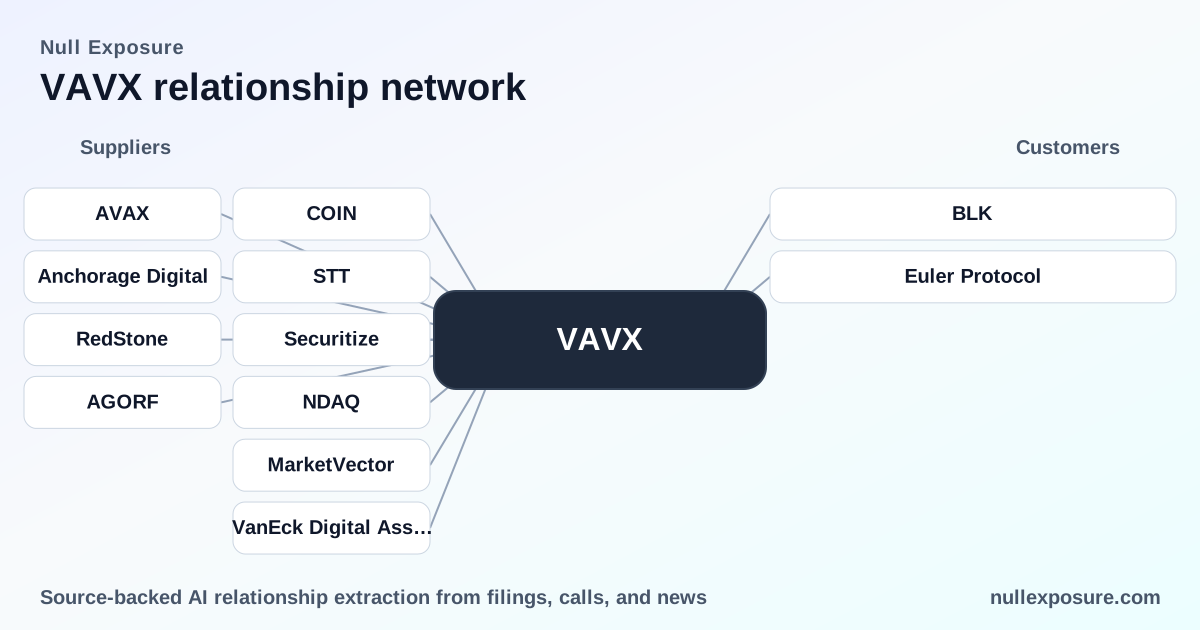
VAVX customer map: institutional ETF and tokenization counterparties that drive revenue
VAVX operates as a business-to-business premium finance and access provider to institutional asset managers and crypto-native protocols; it monetizes by selling custody, settlement, and financing solutions to ETF issuers and tokenization platforms and collecting recurring fees tied to assets under service and transaction volumes. The customer set evident in recent signals is heavily concentrated among ETF issuers and market infrastructure participants, which makes revenue predictable but sensitive to flows into crypto and tokenized products. For direct access to the underlying relationship data, visit https://nullexposure.com/.
Key takeaway up front: VAVX’s commercial footprint is anchored to a small number of institutional product sponsors and DeFi integrations — a high-value, high-concentration customer strategy that amplifies upside in inflow periods and amplifies operational risk during market drawdowns.
What the relationship mix tells investors about the business model
VAVX’s customer list consolidates around two commercial themes: traditional asset managers launching crypto or tokenized ETFs, and decentralized finance plumbing that converts on-chain collateral into institutional-grade exposures. That combination defines the company’s operating posture:
- Contracting posture: Deals with sophisticated counterparties and large issuers, implying multi-year service agreements, strict SLAs, and pricing tied to assets under management and transaction throughput.
- Concentration: A relatively small number of large customers dominate revenue potential; this concentrates revenue risk but enables premium pricing and operational efficiency.
- Criticality: Services to custodians, ETF issuers, and tokenization protocols are operationally critical to clients — interruptions would produce immediate commercial pressure and reputational risk.
- Maturity and scaling: Customer mix includes both established ETF issuers and emerging tokenization protocols, indicating a hybrid maturity profile: core revenues from mature ETF relationships and growth exposure from nascent on-chain integrations.
Because no contract-level constraints were captured in the signal set, these characteristics are presented as company-level signals inferred from the customer roster rather than contract excerpts.
Direct relationship notes — who’s on the roster and what they mean
Below I cover every customer relationship surfaced in the results with one or two sentence plain-English summaries and source references.
-
BlackRock (BLK)
BlackRock’s sBUIDL integration uses AVAX as collateral to support tokenized Treasuries, which anchors institutional demand for chain-native collateral and creates plumbing needs for custody and settlement services. According to CoinMarketCap Academy’s coverage (March 10, 2026), the sBUIDL/Euler arrangement explicitly uses AVAX in collateralized tokenization workflows (FY2025 source). -
Euler Protocol
Euler Protocol is referenced as the on-chain integration partner enabling BlackRock’s sBUIDL use of AVAX collateral, representing the kind of DeFi counterparty that requires institutional bridge services. The same CoinMarketCap Academy article documents the interaction between Euler and BlackRock’s sBUIDL (March 10, 2026; FY2025). -
TRUC (VanEck Communication Services TruSector ETF)
TRUC is a VanEck sector ETF cited in market coverage; its presence reflects VAVX’s commercial exposure to VanEck-managed products and the regular fund operations that drive custody and settlement volume. The reference comes from equity analysis and market commentary on Meyka (March 10, 2026; FY2026). -
EMBX (VanEck Emerging Markets Bond ETF)
EMBX appears tied to distribution and corporate action activity (ex-dividend notices), indicating routine operational work that generates recurring fees for service providers. Ex-dividend reporting in December 2025 and January 2026 was noted in market posts on Futunn (sources dated Dec 26, 2025 and Jan 30, 2026; FY2025–FY2026). -
VSOL (proposed VanEck spot Solana ETF)
VanEck’s proposed spot Solana ETF (ticker VSOL) being added to the DTCC’s pre-launch roster signals product pipeline expansion from an existing issuer — a source of new onboarding and custody demand. The Defiant reported the DTCC listing (March 10, 2026; FY2025). -
HODL (VanEck Bitcoin Trust)
VanEck’s HODL product is a material recurring client: coverage shows HODL as a single-asset Bitcoin trust with fee arrangements and custody links to Gemini Trust (including a minority interest disclosure). Market reports and filings note fee waivers, holdings, and flows (CNBC, July 7, 2025; CoinGecko listing; VanEck 10‑K disclosure dated Dec 31, 2024; FY2024–FY2026).
Why these relationships matter for valuation and downside risk
- Revenue visibility is high but concentrated. Institutional ETF sponsors like VanEck and systemically important managers such as BlackRock create stable, fee-bearing revenue streams when AUM is growing; however, a few large clients control much of that revenue base. Concentration increases single-counterparty risk.
- Operational criticality elevates switching costs and regulatory scrutiny. Serving custody and settlement for ETFs and tokenized Treasuries requires compliance, insurance, and uptime guarantees; that supports premium pricing but also demands capital and process investment.
- Product pipeline drives optionality. New ETF launches (for example, VanEck’s VSOL and other sector products) create incremental onboarding revenue and cross-sell opportunities into financing and settlement services.
- Exposure to crypto flow volatility. Relationships anchored to crypto-native collateral and Bitcoin trusts link revenue to market cycles; inflows drive fees and product activity, outflows compress revenue and test operational leverage.
Risk checklist for investors
- Customer concentration: A small number of ETF issuers and institutional managers dominate activity. Loss or material reduction in activity from any major issuer would have an outsized impact.
- Regulatory and custody risk: Custody of tokenized Treasuries or crypto assets exposes VAVX to evolving regulation and counterparty operational risk, including custodian partnerships referenced in filings.
- Market-cycle sensitivity: Products like HODL and tokenized Treasuries generate fees that scale with asset values and flows, making top-line performance cyclical.
Concluding read for research analysts
VAVX’s customer map is dominated by institutional ETF issuers (VanEck-related products) and a direct linkage into DeFi integrations (BlackRock via Euler). That client mix supports a premium-fee business with predictable core cash flow in stable markets and asymmetric downside in crypto drawdowns. For active diligence, prioritize contract tenure and termination terms with the major ETF sponsors and the specifics of custody counterparty arrangements (for example, the Gemini linkage referenced in VanEck filings).
If you want a concise export of these client signals for modeling or board-level summaries, see the primary customer portal at https://nullexposure.com/ — it’s the fastest way to pull structured relationship data into your diligence workflow.