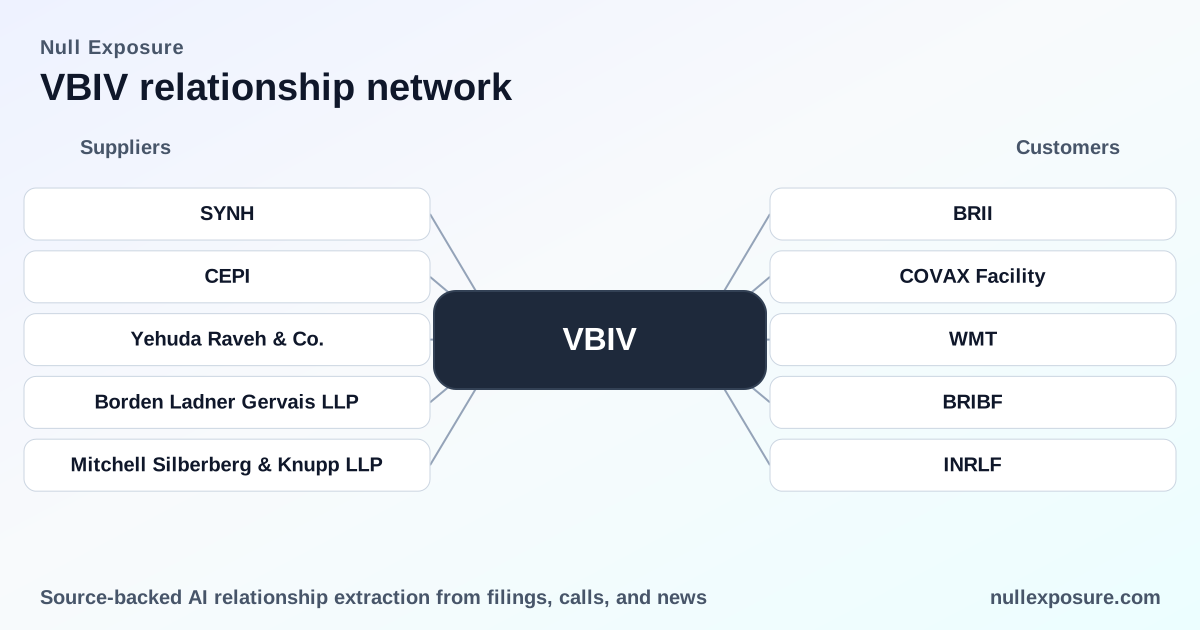
VBI Vaccines (VBIV): Customer Relationships, Revenue Drivers, and Operating Constraints
VBI Vaccines develops and commercializes vaccines and immunotherapies, monetizing through direct product sales (notably PreHevbrio/PreHevbri), exclusive regional licensing, manufacturing and technology-transfer deals, and funded R&D collaborations. Revenue stems from a mix of U.S. retail product sales, partner royalties and license fees, and milestone/technology-transfer receipts; operational leverage depends on converting clinical assets into licenseable or commercial products and on a small set of strategic partners for distribution and manufacturing. For an integrated view of VBI’s commercial relationships and partner risk, see NullExposure’s project hub: https://nullexposure.com/.
Executive summary: why partner footprint matters
VBI’s commercial footprint is concentrated and partnership-driven. A handful of collaborators—Brii Biosciences, Valneva, CEPI/COVAX and large U.S. retail channels such as Walmart—drive near-term revenue and distribution, while recent IP and manufacturing transfers indicate a shift toward monetizing assets through licensing and services rather than sole direct commercialization. The company’s financial profile (negative EBITDA, modest revenue base) amplifies the importance of non-dilutive partner funding and licensing receipts as stabilizing cashflow components.
The customer and partner ledger (each result item covered)
Coalition for Epidemic Preparedness Innovations (CEPI) — renewed collaboration (FY2022)
CEPI expanded a prior collaboration and committed up to US$33 million to VBI to develop an eVLP vaccine candidate targeting the Beta (B.1.351) COVID‑19 variant, under a renewal that broadened the project scope. This is a material development/ R&D funding channel that underwrites variant-specific vaccine work. Source: CEPI announcement (FY2022), https://cepi.net/cepi-boosts-coronavirus-x-vaccine-search-expanded-vbi-vaccines-deal.
Brii Biosciences Limited — licensing of BRII‑179 (PR Newswire, FY2026)
Brii Bio licensed BRII‑179 from VBI in December 2018, taking commercial rights for China, Hong Kong, Macau and Taiwan; the arrangement represents a territorial commercialization carve‑out from VBI’s asset base. Source: PR Newswire release (FY2026), https://www.prnewswire.com/news-releases/brii-biosciences-announces-agreement-to-acquire-vbis-ip-rights-in-brii-179-vbi-2601-and-plans-to-initiate-technology-transfer-to-expand-clinical-and-commercial-supplies-302061229.html.
Valneva SE — Ex‑US PreHevbri distribution (Q1 2024 press release, FY2024)
VBI partners with Valneva to make PreHevbri available in certain European countries, establishing Valneva as VBI’s European distribution partner for the product. This creates a bilateral revenue stream tied to product shipments to Valneva. Source: VBI Q1 2024 results press release (FY2024), https://www.vbivaccines.com/press-releases/vbi-vaccines-reports-first-quarter-2024-financial-results/.
Brii Biosciences (Brii Bio) — exclusive APAC PreHevbri license (full‑year 2023 release, FY2026)
VBI announced an exclusive licensing deal with Brii Bio for development and commercialization of PreHevbri in the Asia‑Pacific region (excluding Japan), positioning Brii as the primary APAC commercial partner and a source of license revenue and potential milestones. Source: VBI full‑year 2023 press release (FY2026), https://www.vbivaccines.com/press-releases/vbi-vaccines-reports-full-year-2023-financial-results/.
BRII (listing duplicate of Brii entry) — same APAC license (full‑year 2023 release, FY2026)
The company filing reiterates the exclusive APAC commercial arrangement with Brii (ticker referenced as BRII), reinforcing that the APAC commercialization pathway is partner‑led rather than VBI direct sales. Source: VBI full‑year 2023 press release (FY2026), https://www.vbivaccines.com/press-releases/vbi-vaccines-reports-full-year-2023-financial-results/.
WMT — retail ordering support (full‑year 2023 release, FY2026)
VBI reports that retail usage of its product is supported by strong ordering from national chains, including Walmart, indicating meaningful downstream demand and retail channel penetration for U.S. product sales. Source: VBI full‑year 2023 press release (FY2026), https://www.vbivaccines.com/press-releases/vbi-vaccines-reports-full-year-2023-financial-results/.
Walmart — confirmation of national chain ordering (full‑year 2023 release, FY2026)
The company specifically names Walmart as a national chain participant supporting retail product uptake, highlighting a high‑visibility U.S. distribution partner for PreHevbrio. Source: VBI full‑year 2023 press release (FY2026), https://www.vbivaccines.com/press-releases/vbi-vaccines-reports-full-year-2023-financial-results/.
COVAX Facility — CEPI agreement on allocation (FY2021)
CEPI and VBI agreed that CEPI‑supported vaccine candidates would be made available to the COVAX Facility for procurement and allocation, if proven safe and effective, signaling potential public‑health procurement channels should candidates succeed. Source: CEPI and VBI collaboration announcement (FY2021), https://cepi.net/cepi-and-vbi-vaccines-collaborate-advance-vaccine-candidates-against-covid-19-variants.
BRIBF — FiercePharma coverage of VBI‑2601 transfer (FY2024)
Industry coverage notes that earlier in the year VBI‑2601 moved to Brii Biosciences under an IP and manufacturing deal worth up to $33 million, reflecting a tactical monetization of an asset via transfer and partner manufacturing capacity. Source: FiercePharma report (FY2024), https://www.fiercepharma.com/pharma/vbi-vaccines-pulls-hepatitis-b-vaccine-prehevbrio-shelves-after-filing-bankruptcy.
Brii Biosciences — Q1 2024 agreements and consideration (Q1 2024 results, FY2024)
VBI’s Q1 2024 disclosure details a series of agreements with Brii whereby VBI would receive up to $33 million for manufacturing capabilities, IP for VBI‑2601, and an APAC license for VBI‑1901, contingent on specified activities—an explicit example of VBI converting assets and capacity into near‑term cash consideration. Source: VBI Q1 2024 results press release (FY2024), https://www.vbivaccines.com/press-releases/vbi-vaccines-reports-first-quarter-2024-financial-results/.
Brii Biosciences (repeat of FiercePharma) — VBI‑2601 transfer noted (FY2024)
FiercePharma reiterated that the IP and manufacturing arrangements involving VBI‑2601 were structured as a multi‑million dollar deal with Brii, underscoring industry recognition of the scope and valuation of the transaction. Source: FiercePharma report (FY2024), https://www.fiercepharma.com/pharma/vbi-vaccines-pulls-hepatitis-b-vaccine-prehevbrio-shelves-after-filing-bankruptcy.
INRLF / Valneva — revenue composition and service income (full‑year 2023 release, FY2026)
VBI attributes its revenue increase to U.S. product sales of PreHevbrio, product shipments of PreHevbri to Valneva in Europe, plus license revenue and R&D services tied to Brii agreements, demonstrating a blended revenue mix from products, partner product transfers, licensing and services. Source: VBI full‑year 2023 press release (FY2026), https://www.vbivaccines.com/press-releases/vbi-vaccines-reports-full-year-2023-financial-results/.
Valneva (repeat entry) — confirmation of partner shipments (full‑year 2023 release, FY2026)
The company’s full‑year statement confirms that Valneva‑related shipments contributed to the revenue uplift and that the Valneva partnership is a recurring element of VBI’s European commercial channel. Source: VBI full‑year 2023 press release (FY2026), https://www.vbivaccines.com/press-releases/vbi-vaccines-reports-full-year-2023-financial-results/.
Operational constraints and company‑level signals
With no separate constraints document, the observable operating model and business signals are evident from partner activity and public filings:
- Contracting posture: VBI pursues license‑and‑transfer agreements and co‑commercialization deals rather than sole global commercialization for late‑stage assets, indicating a pragmatic, partner‑centric contracting posture that trades future upside for immediate non‑dilutive consideration.
- Concentration: Commercial and near‑term revenue flows are concentrated among a small number of partners (Brii, Valneva, large U.S. retailers), increasing partner counterparty risk but enabling deeper, region‑specific market access.
- Criticality: Manufacturing capability and IP transfers (Rehovot facility assets, VBI‑2601 IP) are being monetized, suggesting manufacturing and tech‑transfer arrangements are critical levers for liquidity and value realization.
- Maturity: The company has a commercial product in the U.S. (PreHevbrio) generating product sales, but overall scale remains modest (RevenueTTM approx. $9.4m and negative EBITDA of ~$45.6m), so licensing and partner payments act as essential near‑term cash inflections.
Investment implications and takeaways
- Positive: partner monetization reduces cash burn risk. The up‑to‑$33m Brii deal and CEPI funding provide concrete, non‑equity capitalization channels to fund development and operations.
- Risk: high concentration and execution dependency. VBI’s revenue profile depends on a few counterparties for distribution and license receipts; any partner disruption or underperformance would disproportionately affect results.
- Commercial traction exists but scale is limited. U.S. retail orders (including Walmart) validate demand, yet overall financials remain loss‑making, making further licensing and successful commercialization essential to move the company toward profitability.
For a deeper read on counterparty exposure and partner‑driven revenue scenarios, visit NullExposure’s research hub: https://nullexposure.com/.
Bold takeaway: VBI’s path to de‑risking sits squarely in converting clinical and manufacturing assets into partner deals and sustaining retail product momentum—partners provide revenue and distribution, but concentration elevates counterparty risk.