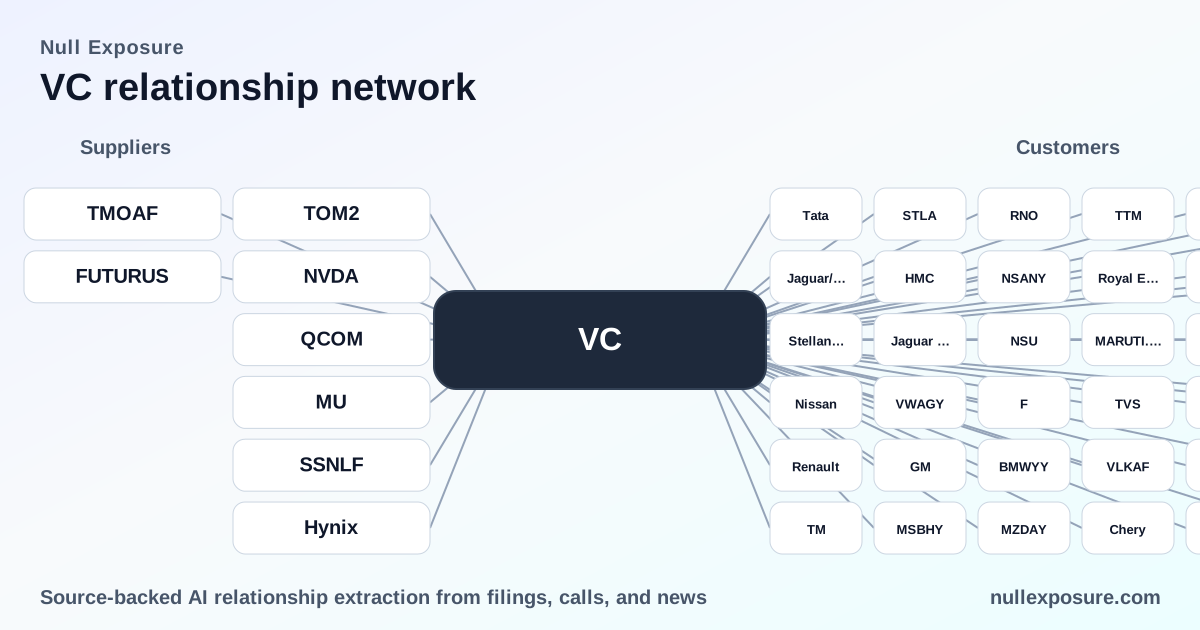
Visteon (VC): Customer Map and What It Means for Investors
Visteon sells cockpit electronics — instrument clusters, large displays, infotainment and domain controllers — to global original equipment manufacturers (OEMs) and two‑wheeler makers, monetizing through production contracts and recurring program revenues tied to new vehicle launches and ramp schedules. Revenue is driven by program wins and production ramps with large OEMs; gross margin expansion follows scale from large displays and domain controllers. For a concise catalog of the source documents behind this analysis, visit https://nullexposure.com/.
Executive thesis: a platform business tied to OEM cycles
Visteon operates as a specialized automotive electronics supplier that wins multi‑year programs with large manufacturers and converts those wins into ramping production revenue. The investment case rests on program win momentum (notably Toyota and Honda wins disclosed in 2025–2026) and customer concentration with Ford and General Motors representing the largest single‑customer sales percentages in FY2024. Investors should value Visteon as a cyclical, program‑driven supplier whose upside is concentrated in successful product launches and cross‑OEM adoption of its SmartCore™ cockpit architecture.
How Visteon contracts, sells and scales
- Visteon sells as a seller to large enterprise OEMs, operating under a mix of long‑term supply agreements (3–5 years) and purchase‑order governed arrangements where volumes are ultimately determined by OEM release schedules.
- Contracts combine program‑level commitments and spot purchase orders; long‑term deals provide program continuity but do not always guarantee minimum volumes, while purchase orders allow rapid scaling or decline with OEM production.
- The business is global across Europe, North America, China and India; program maturity varies by region and customer.
For deeper company-level detail and document references, see https://nullexposure.com/.
Operating constraints that matter to valuation
- Contracting posture: Evidence supports both long‑term program agreements and short‑term PO fulfillment — investors must model revenue volatility from OEM production cycles rather than stable recurring revenue.
- Concentration risk: Ford and General Motors are material customers (each >10% of sales in FY2024), so production swings at either materially affect results (10‑K, FY2024).
- Criticality and maturity: Product portfolio is core hardware (instrument clusters, displays) and software-enabled domain controllers, with program wins indicating maturation toward larger system revenues.
- Spend scale: Multiple entries indicate program lifetime values in the hundreds of millions to billions (publicly quoted new business wins), supporting the classification of many counterparty relationships as high‑value.
Sources for the constraint signals include Visteon’s FY2024 10‑K and FY2025/FY2026 earnings disclosures (see below).
Catalog: every customer relationship found in source results
The following one‑ to two‑sentence notes summarize each counterparty referenced in Visteon’s filings, calls and news items. Each line includes a concise source reference.
- Jaguar/Land Rover — Visteon lists Jaguar/Land Rover among global OEM customers and notes a temporary production suspension in Europe tied to a cybersecurity disruption; source: FY2024 10‑K and 2026 news reports (TradingView/Finviz commentary on FY2025–FY2026).
- Nissan — Visteon attributes strong growth in digital clusters and infotainment to Nissan programs such as the Murano and Qashqai; source: Q4 2025 earnings call transcript (2026).
- Tata — Visteon cites launches with Tata and instrument clusters for Tata Sierra in India as part of regional rollout; source: Q4 2025 earnings call and FY2026 news summaries (InsiderMonkey/Finviz, March 2026).
- Stellantis — Mentioned as a global customer and as part of EV production dynamics that impacted Visteon, including a noted steep drop in EV production; source: FY2024 10‑K and Q4 2025 earnings call (March 2026).
- Renault — Ramp‑up of large displays and digital clusters with Renault contributed to double‑digit growth in certain regions; source: Q4 2025 earnings call (March 2026).
- Volkswagen / VWAGY — VW programs (including panoramic/cockpit displays) drove growth in digital clusters and infotainment; source: Q4 2025 earnings call and FY2024 10‑K.
- Toyota / TM / Lexus — Visteon disclosed a $500 million new business win with Toyota in 2025 and its first launch with Lexus (Lexus ES); source: Q4 2025 earnings call and Q1 2026 transcripts (March–May 2026).
- Mitsubishi / MSBHY — A newly launched digital cluster program with Mitsubishi is going on multiple car lines and contributing to revenue; source: Q4 2025 earnings call (March 2026).
- Ford / F / FOVSY — Ford represents the largest customer by percentage of net sales (~23% in 2024) and recent product launches include hybrid clusters for the F‑150 and Bronco driver displays; source: FY2024 10‑K and Q1 2026 call/news (2026).
- General Motors / GM — GM accounted for ~15% of net sales in FY2024 and recent GM display programs contributed to ramp activity; source: FY2024 10‑K and Q1 2026 earnings commentary (2026).
- Honda / HMC — Visteon won approximately $400 million of lifetime revenue for the largest digital program in the two‑wheeler industry with Honda and expanded two‑wheeler cluster programs; source: Q4 2025 and Q1 2026 earnings remarks (March–May 2026).
- BMW / BMWKY — BMW is listed among Visteon’s OEM customers supporting platform adoption; source: FY2024 10‑K and FY2026 news summaries (March 2026).
- Mazda / MZDAF — Visteon launched a center display on the Mazda CX‑5 in China and referenced program roll‑offs offset by new digital cluster launches; source: Finviz/InsiderMonkey summaries and Q1 2026 transcript (March–May 2026).
- Mahindra / MAHMF — Key launches included a SmartCore and multi‑display system for Mahindra’s XUV7XO in India; source: stock PR/Finviz and Q4 2025 earnings call (March 2026).
- Mercedes‑Benz / DMLRY — Listed among global OEM customers; Visteon’s platforms target Mercedes‑class cockpit solutions; source: FY2024 10‑K and FY2026 press summaries (March 2026).
- Geely / GELYF — Visteon secured follow‑on business as Geely expands architectures into Lynk & Co and builds on prior Zeekr wins; source: Q4 2025 earnings commentary and March 2026 news.
- Audi / AUDC — Large displays and a 25‑inch panoramic display on an Audi Q3 platform were cited as key launches; source: PR Newswire and Q4 2025 materials (2025–2026).
- Infiniti — Visteon launched a digital cluster for the first‑ever Infiniti QX65 and supported Infiniti vehicle launches; source: Investing.com and Q1 2026 transcript (May 2026).
- Polestar — SmartCore domain controller programs include Polestar 5 among referenced launches; source: PR Newswire (2025).
- Volvo — SmartCore domain controller programs were noted for the Volvo EX30 and construction vehicle segment; source: PR Newswire (2025).
- Zeekr / ZK — Visteon supplied a SmartCore for the Zeekr 7 electric SUV in China and referenced Zeekr wins as strategic; source: Finviz and StockTitan (March 2026).
- Chery — Early 2025 win in China with Chery was noted as part of local market expansion; source: InsiderMonkey Q4 2025 earnings coverage (March 2026).
- SAIC Motor — Visteon secured SAIC as a third AI‑capable cockpit customer in China for the IM brand; source: Q1 2026 earnings transcript (May 2026).
- Maruti Suzuki — New product launches with Maruti Suzuki were included in Asia rollout commentary; source: Q4 2025 earnings call (March 2026).
- Royal Enfield — Two‑wheeler program activity with Royal Enfield contributed to market outperformance in India; source: Q4 2025 earnings remarks (March 2026).
- TVS — A digital cluster for TVS was cited among two‑wheeler wins in India; source: Q1 2026 transcript (May 2026).
- Hyundai — Launched a digital cluster in India as part of Q1 2026 regional product introductions; source: Q1 2026 earnings transcript (May 2026).
- Infineon / related Tier references — Visteon also references Tier‑1 and OEM‑direct supply relationships in filings; source: FY2024 10‑K discussion of OEM/Tier supply model.
- Additional OEM mentions (generic list) — Visteon’s FY2024 10‑K lists several large OEMs including Mitsubishi, Mazda, Tata, Mahindra, Stellantis, Nissan, Renault and Volkswagen as active customers supporting the global footprint; source: FY2024 10‑K (filed Feb 2026).
Bottom line for investors
- Customer concentration is real and measurable: Ford and GM together represented a material share of FY2024 net sales and should be modeled explicitly in scenario analyses (FY2024 10‑K).
- Program wins are the primary growth engine: Public disclosures cite a $500m Toyota win and ~$400m Honda two‑wheeler program, plus multi‑customer SmartCore placements — these wins drive multi‑year revenue visibility and margin leverage (Q4 2025 and Q1 2026 calls).
- Contract mix creates revenue volatility: The combination of long‑term program agreements and PO‑driven fulfillment implies upside from ramps but downside when OEM production falls or cyber/production shocks occur (10‑K and earnings calls).
For a concise, sortable view of Visteon’s customer evidence and source documents used in this note, visit https://nullexposure.com/.
Investors should weigh the upside from recent program wins against concentration and OEM production cyclicality when positioning around Visteon’s multiple expansion potential.