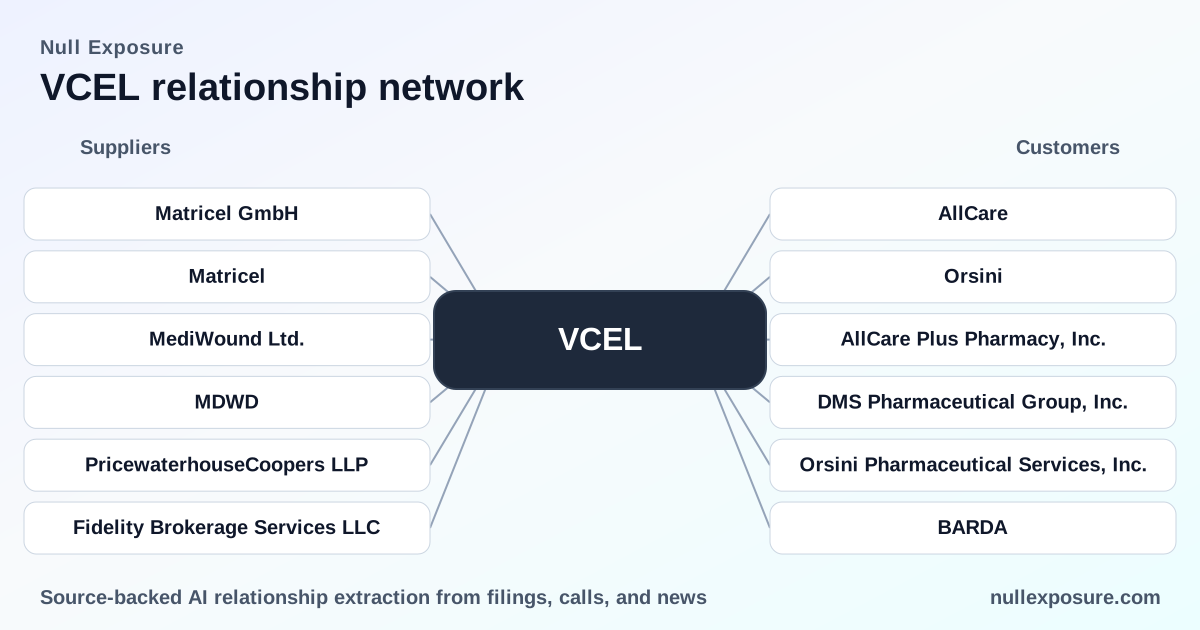
Vericel (VCEL): Customer relationships that drive commercial cell-therapy revenue
Vericel sells autologous and specialty cell therapies—most notably MACI (autologous cartilage repair), Epicel (severe burn care), and NexoBrid (eschar removal)—into the U.S. market through a mix of direct hospital and burn-center contracts, specialty pharmacy distributors, and government channels. The company monetizes by contracted product sales (direct to facilities and via specialty pharmacies or distributors) and recognizes revenue on delivery or resale terms, with NexoBrid sales recorded net of distributor allowances. For faster access to the underlying document signals that inform these customer links, visit https://nullexposure.com/.
How Vericel sells: contracts, channels, and the commercial posture
Vericel operates a hybrid contracting posture. MACI and Epicel are sold directly to hospitals and ambulatory surgical centers at contracted rates, with revenue recognized when the customer takes control of biopsy kits or product shipments. At the same time, specialty pharmacies and distributors handle resales of some products, creating a two-tier channel where Vericel records product revenue net of distributor fees, payment terms and return allowances. These arrangements produce predictable unit economics for routine commercial orders but introduce counterparty and reimbursement complexity tied to payers and specialty pharmacy contracting.
- Geographic concentration is domestic: the company’s revenues and manufacturing are U.S.-focused, which reduces international regulatory execution risk but concentrates reimbursement and payer exposure in one market.
- Channel criticality is high: specialty pharmacies and a small set of distribution partners are operationally critical to reach many hospital and burn-center customers.
- Commercial maturity is evident: Vericel reports meaningful recurring revenue (LTM revenue approximately $276M) and positive operating margins (operating margin ~24% TTM), consistent with a commercial-stage biopharma that has graduated from development to routine product fulfillment.
Documented customer and partner relationships (what the filings show)
The following relationships are drawn from Vericel’s FY2024 public filings and relevant investor commentary; each entry includes the plain-English role and a concise source citation.
AllCare
AllCare is cited as one of the specialty pharmacies through which Vericel’s implants are sold; some contracts between specialty pharmacies and underlying payers are direct while others require third-party reimbursement handling. According to Vericel’s FY2024 Form 10‑K, AllCare participates in distributing implants and is part of the firm’s specialty pharmacy network (FY2024 10‑K filing).
Orsini
Orsini is identified as the other named specialty pharmacy partner that distributes Vericel’s implants, similarly bound by either direct payer contracts or third-party reimbursement arrangements. Vericel’s FY2024 Form 10‑K lists Orsini as a contracted specialty pharmacy for MACI distribution (FY2024 10‑K filing).
AllCare Plus Pharmacy, Inc.
Vericel explicitly states it contracts with AllCare Plus Pharmacy, Inc. to distribute MACI, making this entity a named channel partner for cartilage-implant distribution. The FY2024 Form 10‑K notes that Vericel “contracts with two specialty pharmacies, Orsini Pharmaceutical Services, Inc. (Orsini) and AllCare Plus Pharmacy, Inc. (AllCare) to distribute MACI” (FY2024 10‑K filing).
Orsini Pharmaceutical Services, Inc.
Orsini Pharmaceutical Services, Inc. is listed by name in Vericel’s disclosure as a contracted specialty pharmacy for MACI distribution, confirming its formal role in the company’s commercial supply chain. This naming appears directly in the FY2024 Form 10‑K (FY2024 10‑K filing).
DMS Pharmaceutical Group, Inc.
Vericel sells MACI to DMS Pharmaceutical Group at contracted rates for treatment of patients at military facilities across the U.S., positioning DMS as a distributor that services government healthcare sites. The FY2024 Form 10‑K states Vericel “sell[s] MACI…to a distributor, DMS Pharmaceutical Group, Inc. (DMS) at a contracted rate for the treatment of patients at military facilities throughout the U.S.” (FY2024 10‑K filing).
BARDA
Management cited the potential for BARDA-related NexoBrid revenue but did not assume incremental BARDA awards in initial guidance; the company flagged a reasonable possibility for incremental NexoBrid BARDA revenue during the year. This was discussed in the Q4/2025 earnings call transcript reported on InsiderMonkey in March 2026, where management framed BARDA as a potential but not-yet-assumed revenue source (Q4 2025 earnings call transcript, reported March 2026).
Operating-model constraints and business-model signals investors should weight
The relationship data and excerpted constraints point to several actionable operating characteristics:
- US-centric revenue and manufacturing: All cited excerpts and company disclosures place operations and sales firmly in the U.S., so payer dynamics and domestic policy materially drive growth and risk.
- Channel complexity and mixed contracting posture: Vericel executes both direct sales (hospitals, burn centers) and channel sales (specialty pharmacies and distributors), which creates mixed revenue recognition profiles and dependence on third-party contract terms.
- Government exposure as a strategic channel: The filing references sales for treatment at military facilities and management has discussed BARDA in public remarks; both signal government healthcare as a complementary customer class that can add episodic volume.
- Concentration and critical counterparties: A small roster of named specialty pharmacies and distributors plays a disproportionate role in distribution for MACI and NexoBrid, introducing concentration risk if contract dynamics shift.
These signals are supported by the company’s financial profile—LTM revenue roughly $276M, gross profit ~$206M, and a positive operating margin, consistent with a commercially scaled specialty-biologics operator with concentrated channel partners.
What this means for investors
- Upside pathways: Expanded specialty-pharmacy coverage, additional government contracts (e.g., BARDA awards), or deeper hospital contracting can lift utilization and revenue per procedure without requiring new product approvals.
- Key risks: Reimbursement denial or adverse contract renegotiations with specialty pharmacies or a major distributor would have outsized operational impact given channel concentration; the domestic-only footprint places reimbursement and policy changes front and center.
- Monitoring priorities: Watch updates to specialty pharmacy contracts, announced BARDA awards or government agreements, and quarterly revenue mix disclosures showing the share of direct hospital vs. distributor/specialty pharmacy sales.
For a practical companion to these relationship signals and to track new filings or transcripts that flesh out counterparty dynamics, see https://nullexposure.com/.
Bottom line
Vericel has built a repeatable commercial model that monetizes autologous and specialty cell therapies through a blend of direct hospital contracts and named specialty-pharmacy/distributor partners. Investor focus should center on channel stability (specialty pharmacy and distributor contracts), U.S. reimbursement dynamics, and the evolution of government-related sales, all of which will materially influence revenue cadence and margin durability.