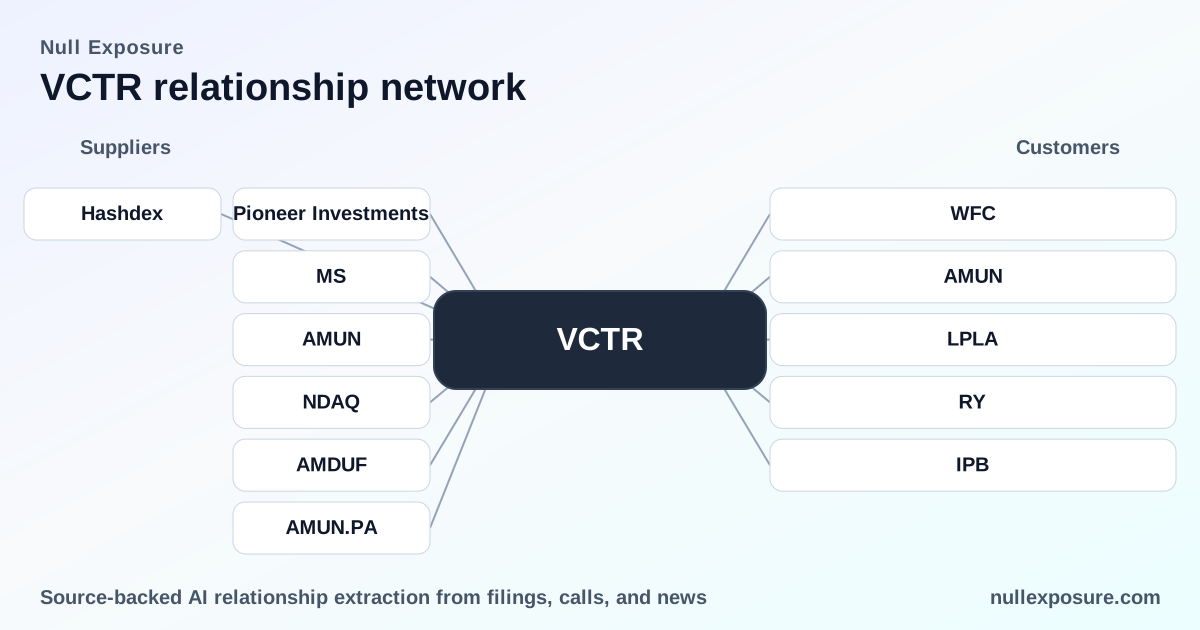
Victory Capital (VCTR) — Customer Map and Commercial Implications
Victory Capital is a fee-driven global asset manager that monetizes primarily through investment management, fund administration and distribution fees tied to assets under management (AUM). The firm sells strategies across institutional, intermediary, retirement and retail channels and recently executed a strategic capital-and-distribution partnership that materially expands its distribution footprint while diluting equity via preferred issuance. For investors and operators evaluating counterparty exposure and go-to-market durability, the commercial reality is simple: revenue scales with AUM and distribution reach; contractual tenure is short and customer concentration is concentrated in investment companies and intermediated channels. Learn more at https://nullexposure.com/.
Executive takeaways for investors
Victory Capital operates as a services business with the following operating model characteristics:
- Contracting posture — short-term: Investment advisory agreements for registered funds are generally terminable on relatively short notice (not more than 60 days), which places revenue at risk if flows reverse or distribution relationships break.
- Counterparty mix — broad but intermediated: Clients include individual investors, institutional and non-profit entities, and intermediated channels; distribution partners and intermediaries are critical conduits to scale.
- Geography — US-centric with growing global reach: Substantially all identifiable assets and revenue are derived from the United States, although recent strategic moves increase global distribution exposure.
- Materiality and revenue sensitivity — high: A large majority of revenue is generated from mutual funds and ETFs, making AUM movements a first-order driver of top-line performance.
- Role and segment — service provider in asset management: Victory functions as an investment manager and distributor, not a traditional product manufacturer; its economics derive from fee schedules and placement on intermediary platforms.
These signals should frame underwriting assumptions and scenario analysis for flows, fee pressure and counterparty concentration risk.
How Victory’s recent partner moves rewire distribution and capital
Victory Capital executed a strategic partnership with Amundi in 2025 that combines capital investment with expanded distribution access. The arrangement included issuance of preferred stock and integration of Victory strategies into Amundi’s global distribution network; the transaction both capitalizes Victory and materially expands the addressable market for existing strategies. According to a company press release dated April 1, 2025, Victory Capital’s strategies “will soon be available for distribution throughout the Amundi global distribution network,” and a subsequent disclosure noted the issuance of 5.4 million shares of preferred stock to Amundi on May 23, 2025 that increased fully diluted shares to roughly 88.3 million. These are company disclosures in 2025 describing the strategic partnership and financing.
If you want a consolidated intelligence brief and operating risk profile for underwriting or vendor management, visit https://nullexposure.com/ for detailed signals.
Customer relationships: what the record shows
The source material lists a small set of high-value distribution and intermediary connections. Below are plain-English summaries of each named relationship found in Victory’s disclosure and earnings commentary.
Amundi S.A. — strategic partner and preferred-stock investor
Victory issued 5.4 million shares of preferred stock to Amundi S.A. as part of a strategic partnership, and Victory strategies will be distributed through Amundi’s global distribution network, expanding Victory’s footprint outside the U.S. and bringing a capital partner on the cap table. This is from Victory’s April 1, 2025 press release and follow-on disclosure reported in June 2025 regarding the preferred issuance.
Source: Victory press release and transaction disclosure reported April–June 2025 on the company’s announcement of the Amundi strategic partnership and preferred share issuance.
Wells Fargo — intermediary placement and recommended list status
Wells Fargo has granted recommended list status to Victory’s product USTB, signaling favorable platform treatment and potential incremental retail and advisor-sourced flows through Wells Fargo channels. This detail comes from Victory’s Q4 2025 earnings commentary where platform placements were discussed.
Source: Victory Capital Q4 2025 earnings call commentary.
RBC — platform recommendation and distribution access
RBC placed Victory’s USTB on its recommended list, which improves visibility to RBC advisors and clients and supports potential net inflows through that channel, as highlighted on the Q4 2025 earnings call.
Source: Victory Capital Q4 2025 earnings call commentary.
LPL Financial — recommended list inclusion for USTB
LPL’s recommended list designation for USTB positions Victory to capture flows from one of the largest independent broker-dealers in the U.S., a meaningful channel for ETF and mutual fund distribution referenced during the Q4 2025 earnings call.
Source: Victory Capital Q4 2025 earnings call commentary.
Merrill (IPB) — platform recognition for VFLO ETF
Victory’s VictoryShares Free Cash Flow ETF (ticker VFLO) is highlighted as a top-rated single-factor quality ETF on Merrill’s platform, an important marketing and placement signal that supports retail and advised-channel asset gathering. This recognition was called out on the Q4 2025 earnings call.
Source: Victory Capital Q4 2025 earnings call commentary.
Operational and commercial risk implications
- Fee and flow sensitivity is elevated. Given that 78% of revenue in 2024 derived from registered funds and ETFs, AUM fluctuations drive near-term revenue variability; platform delistings or loss of recommended-list status have immediate revenue implications.
- Contract tenors are short. Advisory agreements for funds can be terminated with limited notice; Victory’s revenue stream for registered products is therefore operationally elastic and requires continuous distribution success to maintain scale.
- Distribution partnerships are both an asset and a governance vector. The Amundi capital-and-distribution arrangement increases global reach and reduces pure U.S. concentration, but it also introduces a strategic partner with economic and governance claims via preferred stock.
- Channel concentration matters. High placement across major intermediaries (Wells Fargo, RBC, LPL, Merrill) reduces reliance on any single channel and boosts access to advised flows, but platform dynamics and advisor sentiment create cyclicality.
What investors and operators should watch next
- Net flows reported each quarter and segmentation by channel (institutional vs intermediary vs retail) will directly move revenue and profit margins.
- Traction in Amundi’s global distribution network will determine whether the partnership converts into material non-U.S. inflows or is mainly a diversification of channels.
- Platform status changes at large intermediaries have outsized effects, so monitor recommended-list positioning and any platform-level rebalancing.
Conclusion
Victory Capital’s commercial model is fee-for-service, distribution-dependent and short-contract in nature, with a newly deepened strategic relationship with Amundi that materially extends distribution while adjusting capital structure. Platform placements at Wells Fargo, RBC, LPL and Merrill are positive distribution signals that support AUM growth, but the short-tenor contractual environment and concentration in registered funds make flows the primary risk vector for near-term earnings. For a tailored summary of customer relationships and operating risk for due diligence or vendor oversight, visit https://nullexposure.com/.