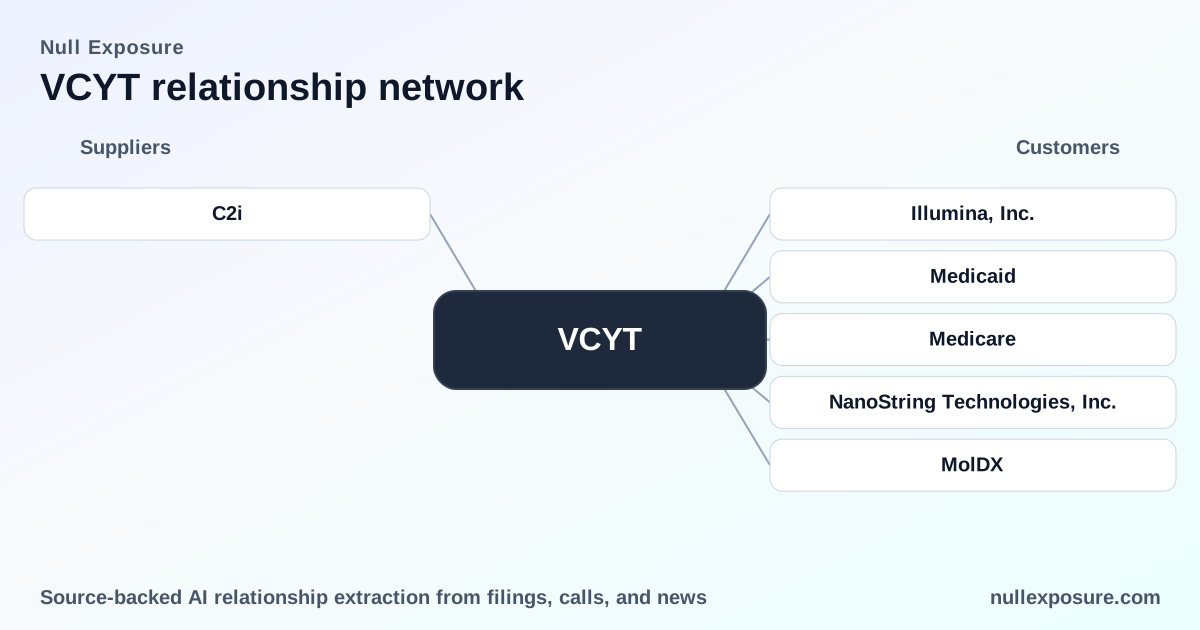
Veracyte (VCYT) — Customer relationships that underpin test-volume economics and payor exposure
Veracyte operates a two-pronged diagnostics business that sells laboratory-developed genomic tests directly to clinicians and secures reimbursement through payors and coverage pathways. The company monetizes primarily on a per-test basis — recognized when results are delivered — and complements test sales with licensing and co-development agreements that extend market reach and technology access. Testing revenue scale is material (roughly $517m TTM) and is concentrated through Medicare reimbursement and selected commercial partnerships, which together shape margin durability and growth cadence. For deeper relationship analytics, explore https://nullexposure.com/.
What the headline relationships are and why they matter
Veracyte’s public filings and recent earnings commentary highlight a compact set of partners and payor channels that drive current revenues and near-term launches. Below I summarize each disclosed relationship and the direct implication for revenue, commercialization or technology access.
Illumina, Inc.
Veracyte signed a multi-year agreement with Illumina in 2023 to develop and offer select molecular tests, signaling a strategic channeling of some assays onto Illumina platforms and distribution pathways. According to the company’s FY2024 Form 10‑K, this agreement is intended to broaden Veracyte’s molecular test offering and commercial footprint. (Source: Veracyte FY2024 Form 10‑K)
Medicare
Medicare represents a dominant revenue source for Veracyte’s testing business, accounting for roughly one-third of testing revenue in recent years (33%, 35% and 36% across the referenced periods). That concentration makes reimbursement policy and price-setting by CMS a primary determinant of cash flow and unit economics. (Source: Veracyte FY2024 Form 10‑K)
Medicaid
Medicaid contributes a small but non‑trivial share of testing revenue — historically around 1% to 3% in the periods disclosed — and represents a lower-margin, state‑by‑state reimbursement exposure compared with Medicare and commercial payors. (Source: Veracyte FY2024 Form 10‑K)
NanoString Technologies, Inc. (now part of Bruker Corporation)
Veracyte uses NanoString’s nCounter technology under license, and the filing notes that nCounter is a registered trademark of NanoString, which was acquired by Bruker as part of an asset acquisition. This licensing relationship provides Veracyte access to a specific platform for certain assays and ties part of its technological supply chain to Bruker’s ownership of NanoString assets. (Source: Veracyte FY2024 Form 10‑K)
MolDX (reimbursement pathway)
Veracyte reported completion of a technology assessment with MolDX and indicated reimbursement progress for its MIBC (muscle invasive bladder cancer) indication with a launch targeted in the first half of the year. Management discussed MolDX progress on a Q4 2025 earnings call transcript reported by InsiderMonkey, which frames MolDX as a critical approval path for commercial uptake of new indications. (Source: Q4 2025 earnings call transcript, as reported by InsiderMonkey)
For additional context on Veracyte’s relationships and signals, see https://nullexposure.com/.
How these relationships shape the operating model and commercial constraints
Veracyte’s commercial profile is defined by a mix of per-test sales, platform licensing and payor-dependent reimbursement:
-
Spot, physician-initiated revenue model: Most tests are sold on the basis of physician requisition forms with implied contracts, and the company recognizes testing revenue upon delivery of results. This operating posture produces transactional, usage-driven cash flow rather than multi-year recurring billing from customers. (Company signal: FY2024 10‑K)
-
Global reach with concentrated U.S. payor exposure: The company serves global markets with two complementary models (centralized LDT labs in the U.S. and partnered approaches internationally). Despite that global posture, U.S. payors — especially Medicare — drive a disproportionate share of testing revenue, introducing national-policy risk. (Company signal: FY2024 10‑K)
-
Dual relationship roles — buyer and service provider: Veracyte functions as a service provider (lab operator delivering results) while also acting as a buyer in certain contexts (purchasing platform licenses and consumables, and selling tests to physicians). This duality concentrates commercial execution risk on lab operations and supply relationships. (Company signal: FY2024 10‑K)
-
Active commercial stage with expanding volume: Management reports accelerated testing volumes — Decipher tests grew meaningfully and Afirma volumes increased — indicating active market traction that supports revenue growth but also increases operational throughput demands. (Company signal: FY2024 10‑K)
-
Services-led revenue: The core business is services (clinical testing) run through CLIA-certified labs with centralized pathology support, which frames capital intensity (lab capacity, staffing, instrumentation) and margin leverage. (Company signal: FY2024 10‑K)
Investment implications — where revenue resilience and risk concentrate
-
Medicare concentration is the key single-point risk: With Medicare responsible for roughly one-third of testing revenue, reimbursement changes or coverage reversals would have immediate P&L implications. Investors should track CMS guidance and MolDX decisions closely. (Source: Veracyte FY2024 Form 10‑K)
-
Partnerships expand addressable market but introduce counterparty risk: The Illumina multi-year agreement and the NanoString/Bruker licensing relationship extend Veracyte’s distribution and platform access, but they swap some product control for broadened reach. Evaluate contract terms and co-development scope in future filings. (Source: Veracyte FY2024 Form 10‑K)
-
Reimbursement milestones drive valuation inflection points: The MolDX assessment and imminent MIBC launch are concrete examples of how payer decisions create step-changes in commercial adoption and revenue ramp. Successful MolDX reimbursement will materially de‑risk the MIBC pathway. (Source: Q4 2025 earnings call transcript, reported by InsiderMonkey)
-
Per-test recognition limits revenue visibility: The spot, physician-requisition model means revenue scales with clinician ordering behavior and referral patterns rather than with long-term contracted volumes; growth requires continued clinician engagement and expansion of covered indications. (Source: Veracyte FY2024 Form 10‑K)
Tactical items to watch over the next 12 months
- MolDX reimbursement decision timing and coverage language for MIBC.
- Any expansion of the Illumina agreement into additional indications or distribution commitments.
- Changes to Medicare coverage or pricing that would affect unit economics.
- Volume cadence for Afirma and Decipher tests and lab capacity metrics that could constrain margins.
Bottom line
Veracyte’s economics rest on service‑led, per‑test revenue that scales with clinical adoption and payer coverage, with Medicare concentration and a small set of strategic partnerships (Illumina; NanoString/Bruker) as principal levers and risks. Near-term valuation upside is tied to successful payer milestones (MolDX for MIBC) and continued volume growth across Afirma and Decipher, while downside is concentrated in reimbursement shifts and execution on lab capacity. For a structured breakdown of customer relationships and their quantified exposures, visit https://nullexposure.com/.