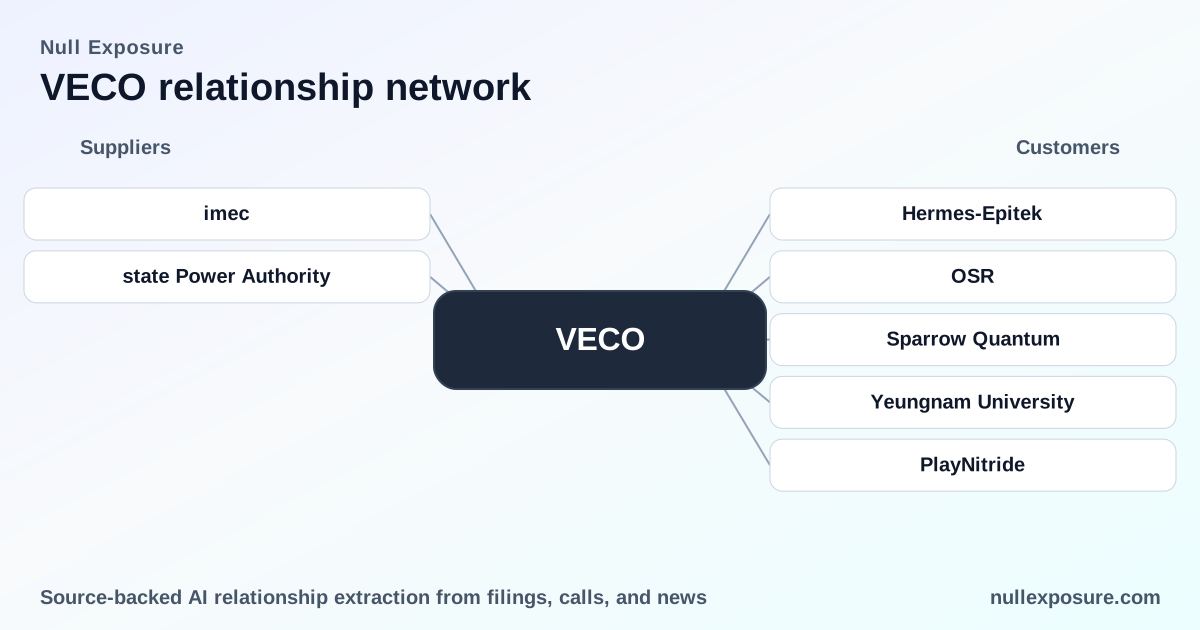
Veeco’s customer map: who’s buying MOCVD, MBE and why it matters for investors
Veeco Instruments sells and supports advanced semiconductor and thin‑film process equipment — principally MOCVD and MBE systems — to chipmakers, photonics firms, universities and research institutes. The company monetizes through hardware sales, service contracts and performance‑based revenue recognition on multi‑year system orders, with a customer base that is global but heavily concentrated in APAC and among large fabs and IDMs. For investors, Veeco is a capital‑equipment play exposed to fab investment cycles, qualification timelines and a concentrated counterparty set. Learn more at https://nullexposure.com/.
How Veeco’s commercial model actually operates
Veeco is fundamentally a hardware OEM that also captures aftermarket service economics. The firm manufactures capital equipment (MOCVD, MBE, laser annealing and related tools) and recognizes revenue across a mix of short‑term transactions (system deliveries and advance payments recognized within a year) and longer‑duration contracts (performance obligations stretching up to three years). The company sells to a mix of large enterprise IDMs, foundries, photonics firms, research centers and universities, and supports global deployments with regional sales and service operations across APAC, EMEA and North America.
- Contracting posture: a balanced portfolio of short and long contract tenures; advanced payments are common for system transactions while meaningful remaining performance obligations extend across multiple years.
- Concentration: the business is concentrated — Veeco’s ten largest customers accounted for ~63% of net accounts receivable at year‑end 2024 — which amplifies credit and order timing risk.
- Geography and demand drivers: APAC is the dominant market, supported by large fabs and photonics manufacturers; subsidies and domestic fab builds in the U.S. and Taiwan generate indirect tailwinds for Veeco’s order book.
- Criticality and maturity: customers range from production‑qualified buyers to early pilots, so revenue visibility depends on product qualification cycles and successful scale‑up.
- Business segment: product‑centric manufacturing with ongoing service revenue and customer support commitments.
If you want a structured view of customer relationships and how they translate into revenue risk and upside, visit https://nullexposure.com/ for additional company‑level intelligence.
The customer list, in plain English (every relationship in the record)
Below are the relationships recorded in the source feed, with a concise plain‑English summary and a source note for each.
Hermes‑Epitek
Veeco shipped a GEN20‑Q MBE system to Hermes‑Epitek, indicating ongoing MBE demand from Taiwanese photonics suppliers. A Semiconductor‑Today item reported the shipment (news item referencing ongoing activity in 2024). Source: Semiconductor‑Today report on Veeco shipping GEN20‑Q to Hermes‑Epitek.
Genesis Photonics Inc. (GPI)
Veeco received orders historically for multiple TurboDisc K465i GaN MOCVD systems from Genesis Photonics, reflecting legacy GaN tooling relationships that underpin continued product demand. This order history was noted in an LEDInside item referencing past GPI orders. Source: LEDInside coverage (archival order detail).
Taiwan Semiconductor Research Institute / National Applied Research Laboratories (TSRI, Narlabs)
TSRI selected Veeco’s Propel R&D MOCVD system for advanced GaN power and RF device development, signaling institutional partnerships and R&D‑led adoption of Veeco tooling in Taiwan’s research ecosystem. Source: LEDInside announcement of TSRI selecting Veeco’s Propel R&D MOCVD (FY2026 item).
OSR (Osram Opto Semiconductors) — entry 1
Osram qualified Veeco’s Lumina MOCVD system for production of high‑end LEDs, demonstrating production‑level acceptance of Veeco’s Lumina platform for photonics manufacturing. Source: LEDInside news item referencing OSRAM qualification (FY2020 context).
Osram Opto Semiconductors — entry 2
A GlobeNewswire release in October 2020 confirmed that OSRAM Opto Semiconductors qualified Veeco’s Lumina system for high‑end LED production, corroborating production qualification and commercial deployment. Source: GlobeNewswire press release (Oct 2020).
Intel
Industry commentary highlights that Veeco benefits indirectly from large fab investments by Intel, as U.S. subsidies and domestic capex programs drive demand among tool suppliers serving leading‑edge logic fabs. Source: FinancialContent / Finterra research piece (Mar 2026).
Micron
Analysts and industry coverage note Micron as an indirect demand driver for Veeco because memory fabs’ capital expenditures increase orders for process equipment across suppliers. Source: FinancialContent / Finterra research (Mar 2026).
TSMC
Veeco’s end markets include leading foundries like TSMC, and coverage emphasizes that TSMC’s fab expansions (including subsidy‑driven investments) create indirect demand for Veeco’s tools. Source: FinancialContent / Finterra research (Mar 2026).
Sparrow Quantum
Sparrow Quantum selected Veeco’s GENxcel R&D MBE system to support quantum‑photonic device development, demonstrating traction in the quantum photonics niche and R&D‑to‑production pipeline potential. Source: The Quantum Insider coverage of new MBE deployments (Dec 2025).
Yeungnam University
Yeungnam University is deploying Veeco’s GEN10 MBE technology for university research in quantum dots and nanostructures, indicating academic adoption that can convert into commercial collaborations. Source: The Quantum Insider article on MBE deployments (Dec 2025).
Seoul Optodevice
Seoul Optodevice selected Veeco MOCVD tools for capacity expansion, reflecting continued demand from Korean LED and photonics manufacturers for Veeco’s production equipment. Source: LEDInside report on MOCVD tools selected for Seoul Optodevice (FY2026).
PlayNitride
PlayNitride qualified Veeco’s Lumina MOCVD system for micro‑LED production, suggesting Veeco’s positioning in the emerging micro‑LED supply chain and production qualification success. Source: Semiconductor‑Today report on PlayNitride qualification (Mar 2025).
What the relationship mix signals to investors
- Revenue drivers are bifurcated: production‑qualified customers like OSRAM, PlayNitride and Seoul Optodevice produce near‑term revenue when capacity expansions occur, while research partners (TSRI, universities, Sparrow) drive longer qualification cycles that convert into orders over multiple years.
- High counterparty concentration increases idiosyncratic risk: with the top ten customers representing the majority of net receivables, order timing from a handful of large enterprises materially affects quarterly results.
- Geographic exposure is APAC‑heavy but global in scope: most deployments and qualifications are in APAC, yet the company supports global fabs and research labs — this creates correlated regional cyclical risk but diversified service touchpoints.
- Contracting is mixed‑tenor: the presence of both advanced payments/short‑term revenue recognition and multi‑year performance obligations implies revenue smoothing but also deferred delivery and execution risk.
- Pipeline composition matters: a mix of active production customers and pilot evaluations (next‑gen laser annealing, R&D MOCVD systems) signals both current cash flow and an opportunity set dependent on successful qualification.
Conclusion: how to read the risk/reward
Veeco’s customer roster combines production‑qualified wins and R&D/academic pilots, delivering a revenue profile that benefits from fab capex cycles and strategic subsidies to domestic semiconductor ecosystems. Key investor considerations are order concentration, APAC exposure, and the company’s ability to convert R&D pilots into production orders. For a concise, investor‑oriented dossier on supplier–customer dynamics in capital equipment, consult the company overview and relationship snapshots at https://nullexposure.com/.