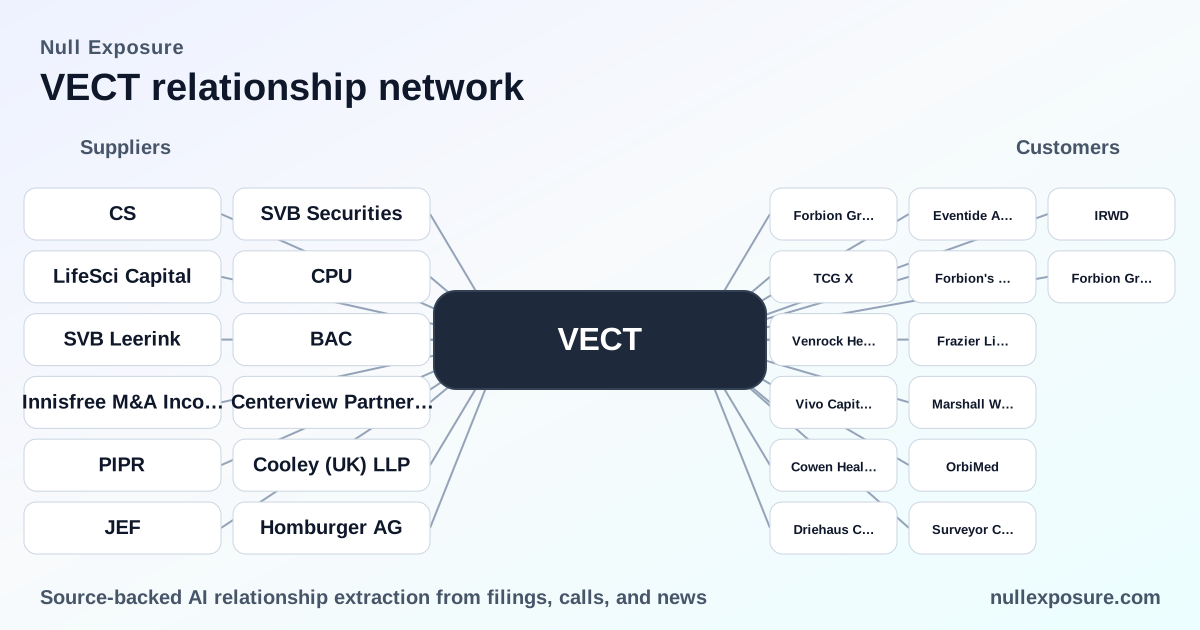
VectivBio (VECT): Investor thesis and partner map after a strategic sale
VectivBio is a clinical-stage biopharmaceutical company focused on developing treatments for rare gastrointestinal conditions; it monetized its asset value through equity financings to fund clinical programs and ultimately through a strategic cash sale to Ironwood Pharmaceuticals that transfers commercial and regulatory risk to a larger GI-focused operator. Key revenue drivers historically were financing rounds and the value of its lead GLP-2 analogue (apraglutide); liquidity events from institutional investors and the Ironwood acquisition are the near-term source of shareholder value. For a quick executive view of relationship intelligence and how we source this coverage, visit https://nullexposure.com/.
How the strategic picture changed: Ironwood closes the deal
Ironwood Pharmaceuticals executed a cash acquisition strategy to add VectivBio’s lead compound to its GI portfolio. According to multiple press accounts, Ironwood launched a $17-per-share all-cash offer and completed the tender offer, folding VectivBio’s clinical programs into Ironwood’s commercial franchise (press coverage May–June 2023). A Boston Globe report and BioCentury both documented the $1 billion purchase narrative, and an Ironwood/VectivBio release confirms completion of the tender offer (news coverage May–June 2023). A securities-focused notice also flagged investor scrutiny of the sale process and price as part of post-transaction litigation and review (investor alert filed June 2023).
- Ironwood Pharmaceuticals / IRWD — Ironwood announced a $17 per-share all-cash offer to acquire VectivBio and subsequently completed the tender offer, taking VectivBio’s assets and programs under Ironwood’s GI-focused strategy (Boston Globe; BioCentury; company tender-offer announcement, May–June 2023).
Sources: Boston Globe (May 22, 2023); BioCentury quick-take (May 22, 2023); Ironwood/VectivBio tender-offer completion notice (June 29, 2023). - Investor litigation/alert — A law-firm investor alert and related filings arose challenging the adequacy of the sale price and process after the Ironwood offer was announced (investor alert, 2023).
Source: investor alert reported on markets.financialcontent (June 2023).
Who provided the financing that underpinned VectivBio’s runway
VectivBio raised capital through both an underwritten public offering and a concurrent private placement; a cohort of specialist biotech investors and institutional funds participated. The list of purchasers and participants is consistently reported in corporate press releases and law-firm announcements from late 2022 and consolidated legal advisory notes.
- Forbion Growth Opportunities Fund II Coöperatief U.A. — Forbion agreed to buy 3.48 million ordinary shares at $5.75 per share in a concurrent private placement that delivered roughly $20 million in gross proceeds to VectivBio (RTTNews, FY2022).
Source: RTTNews coverage of the combined public offering and private sale (FY2022). - Forbion Growth II Management B.V. — Identified in company disclosures as the representative manager for Forbion’s placement activity that backed the private purchase of ordinary shares (FY2022 disclosures).
Source: RTTNews and company offering materials (FY2022). - Forbion’s Growth Opportunities Fund — Named among the institutional investors who participated in VectivBio’s underwritten offering that priced in October 2022 (company press release, Oct 2022).
Source: GlobeNewswire press release announcing the underwritten offering (Oct 13, 2022). - Cowen Healthcare Investments — Listed as a participating investor in the company’s underwritten offering, representing specialist healthcare capital support for the financing (Oct 2022 offering announcement).
Source: GlobeNewswire press release and law-firm advisory (Oct 2022). - Driehaus Capital Management — Named among the institutional buyers in the underwritten offering that broadened VectivBio’s investor base (Oct 2022).
Source: GlobeNewswire press release and Latham advisory note (Oct 2022). - Eventide Asset Management, LLC — Participated in the October 2022 underwritten offering, showing interest from thematic healthcare investors (Oct 2022 offering disclosure).
Source: GlobeNewswire press release (Oct 13, 2022). - Frazier Life Sciences — Identified as a purchaser in the underwritten offering, reflecting life-sciences-specialist investor demand in that financing round (Oct 2022).
Source: GlobeNewswire press release (Oct 13, 2022). - Marshall Wace — Listed among the hedge and asset-manager participants in the underwritten offering that supplemented VectivBio’s cash runway (Oct 2022).
Source: GlobeNewswire press release (Oct 13, 2022). - OrbiMed — A named investor in the underwritten offering, representing a large dedicated healthcare asset manager on the cap table post-offering (Oct 2022 disclosures).
Source: GlobeNewswire press release and Latham advisory note (Oct 2022). - Surveyor Capital (a Citadel company) — Participated in the underwritten offering, bringing an alternative-investment buyer to the transaction syndicate (Oct 2022).
Source: GlobeNewswire press release (Oct 13, 2022). - TCG X — Included among specialist biotech investors that purchased shares in the offering and private placements (Oct 2022).
Source: GlobeNewswire press release (Oct 13, 2022). - Venrock Healthcare Capital Partners — Named purchaser in the underwritten offering, indicating support from long-tenured healthcare venture capital arms (Oct 2022).
Source: GlobeNewswire press release (Oct 13, 2022). - Vivo Capital — Identified as one of the specialist biotech investors that joined the underwritten offering (Oct 2022).
Source: GlobeNewswire press release (Oct 13, 2022).
Collectively, these financing participants provide evidence of concentrated institutional backing from healthcare-specialist managers during VectivBio’s final independent financing phase.
What these relationships imply about VectivBio’s operating posture
The relationship map and capital events produce several company-level operating signals that investors and operators should weigh:
- Contracting posture — transactional and financing-driven. VectivBio’s public life was financed through discrete underwritten offerings and targeted private placements rather than long-term commercial contracts, which positions the company as reliant on capital markets and strategic M&A exits to realize asset value.
- Concentration — institutional investor-heavy cap table. The roll-up of specialist healthcare investors indicates concentrated ownership among experienced biotech allocators, which supports negotiated exits but concentrates governance and influence.
- Criticality — single-asset economics. VectivBio’s strategic value was tied to its lead GLP-2 analogue (apraglutide); this single-asset focus made the company an acquisition target for a GI specialist and increased the sensitivity of valuation to clinical and regulatory outcomes.
- Maturity — clinical-stage with limited commercial revenue. Financial statements and reported metrics reflect a clinical-stage business model with operating losses and financing as the primary source of cash, not products or recurring revenue.
No explicit operational or contractual constraints were reported in the relationship signals we reviewed; the data set provided contains financing and M&A activity rather than long-term supply, distribution, or co-development contracts.
Bottom line for investors and operators
- The Ironwood acquisition is the dominant event that converts VectivBio’s development risk into an M&A outcome and alters counterparty and operational risk for partners and suppliers. (See Ironwood press coverage and tender-offer completion notices, May–June 2023.)
- Institutional financing from a narrow group of healthcare-specialist investors funded VectivBio’s runway, and those investors played a central role in enabling the company to reach an exit event (underwritten offering and private placement, Oct 2022; RTTNews FY2022).
- Ongoing considerations for buyers and operators include integration of the asset into Ironwood’s commercial strategy, potential post-closing litigation or governance scrutiny tied to the sale process, and the shift of commercial and regulatory execution risk to Ironwood.
For a consolidated view of counterparty and investor relationships across small-cap biotech transactions, explore our coverage at https://nullexposure.com/.
Key takeaway: VectivBio converted institutional financing support and a single high-value clinical asset into a cash exit for shareholders; post-acquisition performance and value realization now rest with Ironwood’s execution of the integrated GI strategy.