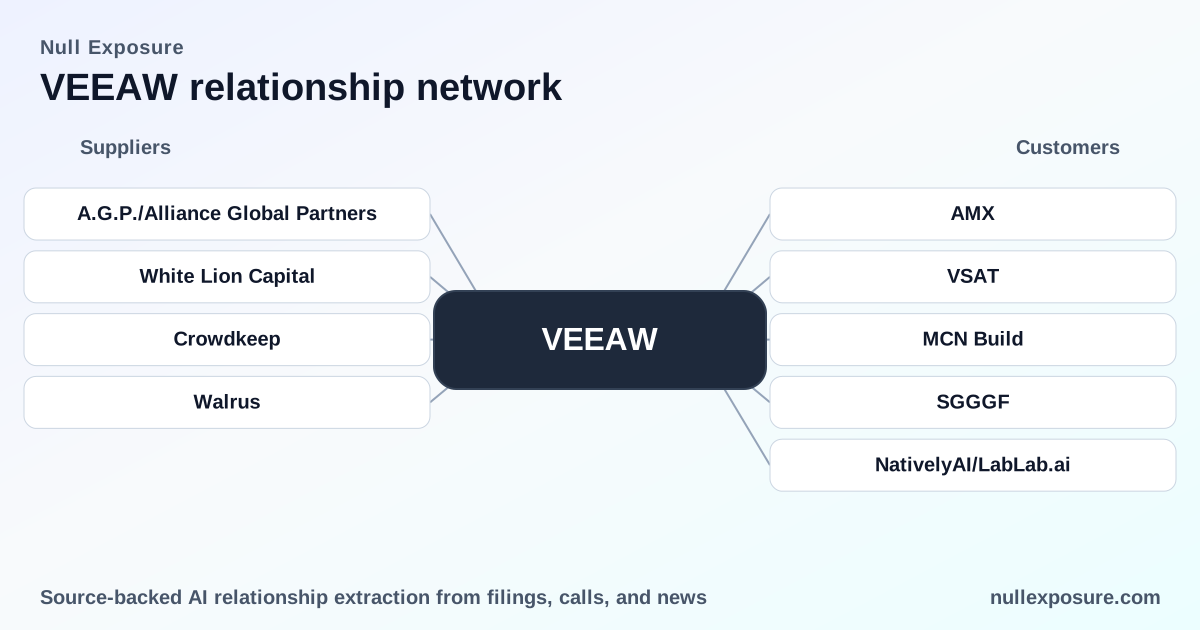
Veea Inc (VEEAW) — Customer and partner relationships that shape near‑term revenue
Veea Inc builds and sells edge computing hardware (VeeaHub®), software licenses and subscription services that enable managed Wi‑Fi, 5G fixed wireless access and localized AI/edge processing. The firm monetizes through a mix of point‑in‑time hardware sales and recurring subscription and licensing revenue, while pursuing channel and telco partnerships to scale deployments in underserved markets. For investors, the key question is whether paid pilots and framework supply agreements convert into predictable subscription streams and larger, repeatable procurement schedules. Learn more about how this analysis was constructed at https://nullexposure.com/.
How Veea’s commercial model drives both upside and risk
Veea operates a hybrid monetization model with three revenue levers: hardware sales (recognized at shipment), licensing of software and technology, and subscription/managed service fees for connectivity and edge services. Public filings and commentary show the company targets fixed wireless, managed Wi‑Fi and ePaaS offerings—segments that produce a mix of spot and recurring cash flows. The company discloses that revenue recognition for hardware is point‑in‑time, while subscriptions and license revenues are explicit recurring lines, which positions the firm to improve margin stability once subscriptions scale.
Contracting posture is biased toward non‑cancellable master purchase agreements and paid pilots. The business is currently pilot‑driven—the company reported most 2024 revenue coming from paid pilots—so short‑term growth relies on conversion of pilots into larger orders and multi‑year supply agreements. Customer concentration is meaningful: four customers made up roughly 15%, 20%, 15% and 15% of revenue for FY2024, signaling material concentration risk until broader diversification is achieved.
Geographically, Veea is globally oriented with operational footprints in the Americas, EMEA and APAC, and an explicit business development emphasis on Latin America. The corporate model also relies on channel partners and resellers to expand distribution; contractual language indicates reseller participation under master agreements. Taken together, these signals create an operating profile where scalability depends on converting channel pilots into subscription revenue while managing concentration and execution risk.
Read a concise company customer profile at https://nullexposure.com/ for further diligence.
Catalogue of named customer and partner relationships
Below are every company relationship reported in the available results, with a plain‑English summary and the contemporary source.
Telcel
VeeaSystems (a Veea subsidiary) signed a three‑year supply agreement with Telcel for 5G‑based fixed wireless access, positioning Telcel as a strategic distribution partner for VeeaHub STAX‑5G devices in Mexico. According to multiple press reports, this agreement was disclosed in connection with Veea’s 2026 public offering announcements and product launches at Mobile World Congress (Investing.com, May 2026; StockTitan, March 2026).
AMX
Media and press coverage maps Telcel’s parent corporation to the AMX ticker, describing Veea’s framework supply arrangement and the launch of Veea SecureConnect with Telcel/América Móvil in Mexico. StockTitan referenced the AMX relationship during the March 2026 product rollout (StockTitan, March 10, 2026).
MCN Build
Veea deployed an edge‑based construction site monitoring system for MCN Build that processes safety, compliance and asset tracking data locally, eliminating the need for continuous cloud connectivity. This deployment was announced as a commercial rollout tied to Veea’s edge offerings (Investing.com, March–May 2026).
Viasat Mexico
Veea announced a collaboration with Viasat Mexico to expand managed Wi‑Fi and edge applications across underserved Mexican communities, indicating a managed services and access expansion strategy. The collaboration was disclosed in December 2025 and referenced in company press compilations (StockTitan, December 10, 2025).
VSAT
VSAT is referenced interchangeably with Viasat Mexico in the company’s press coverage; reports describe joint efforts to extend managed Wi‑Fi and edge solutions into underserved regions of Mexico. The December 2025 announcement ties VSAT to the company’s managed service outreach (StockTitan, December 2025).
StarGroup
Veea formed a strategic partnership with StarGroup to address digital inequality in rural Mexico, leveraging Veea’s edge platform to enable virtual Trusted Broadband Access and rural connectivity. This strategic channel relationship was publicized as part of Veea’s Latin America market push (StockTitan, March 2026).
SGGGF
SGGGF appears in the results as the cross‑listed symbol for StarGroup and is cited in press that described the same rural connectivity partnership in early 2026 (StockTitan, March 2026).
Vapor IO
Press summaries list Vapor IO as a partner in turnkey AI‑as‑a‑Service initiatives, indicating Veea’s integration into broader edge compute ecosystems for hosted AI services. The mention appears in company press roundups describing ecosystem partners (StockTitan, March 2026).
Walrus
Walrus was cited alongside other partners for decentralized storage and edge NVMe infrastructure integration, highlighting a technical partnership aimed at local data persistence for edge applications (StockTitan, March 2026).
Mysten Labs
Mysten Labs is listed in press material as a partner for decentralized storage infrastructure, suggesting Veea’s strategy includes blockchain/decentralized storage vendors for edge data use cases (StockTitan, March 2026).
Genesys Impact
Veea and Genesys Impact announced a joint AI‑powered safety and asset intelligence platform for MCN Build, indicating a solution‑level partnership combining Veea hardware and third‑party AI for vertical deployments (StockTitan, March 2026).
White Lion Capital, LLC
Veea entered into a Note Purchase Agreement with White Lion Capital for up to $2.5 million in convertible promissory notes (original issue discount produced gross proceeds of $2,137,500) and accompanying warrants in January 2026, representing short‑term financing support rather than a commercialization relationship (MarketScreener, May 2026).
NativelyAI
Veea partnered with NativelyAI to package the Lobster Trap security tool within Native.Builder, bringing policy‑enforced AI agent deployment to NativelyAI’s developer platform and embedding Veea capabilities into AI production workflows (SahmCapital, March 2026).
NativelyAI/LabLab.ai
Press notes indicate Veea packaged Lobster Trap into TerraFabric and partnered with NativelyAI and LabLab.ai to distribute the tool through a 250,000+ developer ecosystem and Native.Builder workflows, signaling developer‑ecosystem penetration as a go‑to‑market tactic (StockTitan, March 2026).
Nlabs
Veea entered into a note conversion agreement with Nlabs on March 30, 2026, reflecting capital structure activity and creditor conversion dynamics rather than a customer sale (MarketScreener, May 2026).
Investment takeaways and what to monitor next
- Conversion of pilots to recurring revenue is the critical catalyst. With 2024 largely pilot‑driven and subscription/licensing explicitly part of the revenue mix, investor upside materializes when pilots scale into multi‑year subscription contracts.
- Commercial concentration is a material risk. Four customers accounted for large shares of FY2024 revenue; expanding the customer base or expanding existing contracts with Telcel/StarGroup/Viasat are priority levers to reduce single‑customer exposure.
- Latin America is a strategic growth corridor. Multiple partner and supply agreements in Mexico (Telcel, StarGroup, Viasat) show a deliberate regional focus that could produce substantive recurring managed‑service revenues if framework agreements convert to steady deployments.
- Short‑term liquidity is being managed via convertible notes and warrants. Financing from White Lion and conversions with Nlabs are operationally relevant for runway and execution.
For investors and operators evaluating Veea’s customer relationships, track three indicators: pilot conversion rates into recurring contracts, ramp schedules under the Telcel and StarGroup agreements, and quarterly disclosure of subscription versus hardware revenue. For a succinct portfolio‑level view of these commercial relationships and to follow subsequent updates, visit https://nullexposure.com/.