Twin Vee Powercats (VEEE): Dealer-led growth with concentrated counterparty risk
Twin Vee Powercats designs, manufactures and markets recreational and commercial power catamarans and monetizes primarily through unit sales to a network of independent boat dealers across North America and the Caribbean, supplemented by occasional services (logistics and transition fees). The company’s commercial model is distribution-heavy: Twin Vee manufactures product, sells to dealers under short-term commercial arrangements and relies on regional dealers to convert inventory into retail customers — an approach that drives scalable top-line growth but creates concentration and contract-duration risk for investors. Learn more at https://nullexposure.com/.
Dealer expansion is the near-term growth lever
Twin Vee’s latest public communications emphasize deployment of authorized dealers to lift regional coverage and order flow. In early May 2026 the company announced an exclusive Broward County, Florida dealer appointment and earlier in March 2026 it authorized The Boat Yard in Louisiana — both moves that increase local sales capacity and speed order-to-production conversion. These dealer placements are operationally meaningful for a manufacturer that sells nearly all boats through third-party resellers and where a small number of dealers already account for a large share of revenue.
Customer relationships: the public record, relationship by relationship
-
Nautical Ventures Group — Twin Vee named Nautical Ventures Group, a subsidiary of Vision Marine Technologies, as its exclusive authorized dealer in Broward County, Florida, a strategic South Florida market that should improve sales coverage and local inventory turnover; this was announced by Twin Vee on May 4, 2026 (press distribution via Bitget and AccessWire).
Source: Twin Vee press release distributed May 4, 2026 via Bitget and AccessWire. -
Nautical Ventures — Coverage from industry and investor outlets reiterated that Vision Marine’s subsidiary Nautical Ventures secured exclusive Twin Vee distribution rights for Broward County, a step Vision Marine framed as expanding its retail execution and brand portfolio in FY2026; this reporting ran on Intellectia and Marketscreener.
Source: Intellectia.ai report on Vision Marine expansion (FY2026); MarketScreener summary (FY2026). -
Vision Marine Technologies (VMAR) — The dealer arrangement with Nautical Ventures is tied to Vision Marine Technologies through its subsidiary relationship; MarketScreener captured this linkage while reporting on Vision Marine’s corporate filings and retail expansion activities in FY2026. This positions Vision Marine as a strategic distribution partner via its retail platform rather than as an end customer.
Source: MarketScreener coverage of Vision Marine and Nautical Ventures (FY2026). -
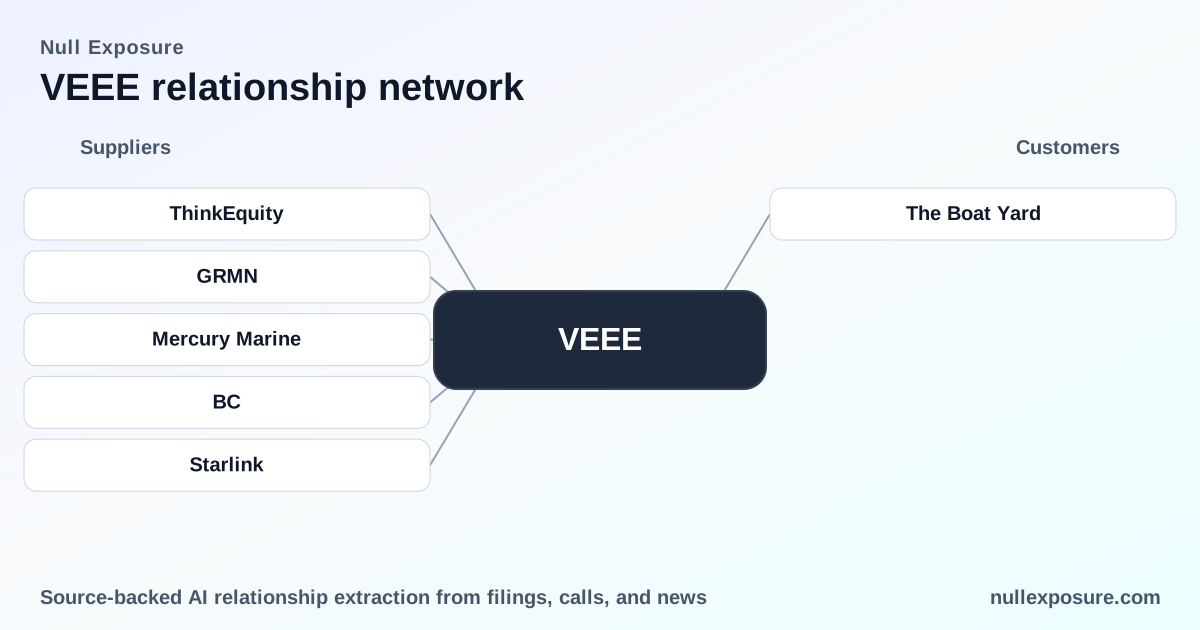
The Boat Yard — Twin Vee confirmed The Boat Yard as an authorized dealer in Louisiana and released an initial order into production after state approvals, signaling an immediate revenue conversion event; this was reported on March 10, 2026 by Yahoo Finance and covered in Marine Industry News.
Source: Yahoo Finance (March 10, 2026) and MarineIndustryNews.co.uk (March 10, 2026).
Each of the above relationships is recorded in public press and media channels during FY2026 and reflects Twin Vee’s ongoing strategy of expanding its authorized dealer footprint to convert latent demand into production orders.
How the disclosed constraints shape the business model
Twin Vee’s filings and public disclosures provide several operating signals that investors must factor into valuation and risk assessment:
-
Short-term contracting posture. Repurchase commitments and certain service agreements are structured on short tenors — for example, repurchase commitments typically run to the financing term not exceeding 30 months, and some transition services were month-to-month. Short-tenor relationships reduce long-term revenue visibility and increase churn risk across dealer partners.
Source: Company disclosure on repurchase commitments and Transition Services Agreement (year ended Dec 31, 2024). -
Usage-based and episodic service revenue. Historical transition services generated variable monthly fees (for instance, $41,593 per month for services provided until the November 26, 2024 merger date), indicating service income is non-recurring and tied to discrete events rather than a stable annuity. This reinforces the core reliance on unit sales as the primary monetization path.
Source: Company disclosure on transition services fees (period Jan 1–Nov 26, 2024). -
North American distribution concentration. The company sells mainly through a dealer network across North America and the Caribbean; growth therefore depends on dealer placement density and local market execution rather than direct retail channels. Geographic concentration increases sensitivity to regional demand cycles.
Source: Company disclosure on dealer network coverage (FY2024–FY2025). -
Material counterparty concentration. Twin Vee reported that three individual dealers represented over 10% each of sales and in aggregate accounted for roughly 40% of total sales in the year ended Dec 31, 2024. That level of concentration is a top-line vulnerability: lost volume from a single major dealer could materially depress revenue.
Source: Company disclosure for year ended Dec 31, 2024. -
Active seller relationships with some provider roles. The company operates primarily as a seller through independent dealers but has also acted as a service provider (procurement, shipping, storage) under transition agreements, indicating a hybrid capability that can be monetized opportunistically. These service roles, however, are typically short-lived and operationally costly.
Source: Transition Services Agreement disclosures (2022–2024).
Taken together, these constraints indicate a distribution-centric, short-duration contracting model with meaningful revenue concentration. That structure creates higher operational leverage to dealer execution and a need for rigorous dealer credit and inventory management.
Investment implications: upside, valuation context and risks
-
Upside: Dealer rollouts in Florida and Louisiana directly address commercial availability, accelerating order flow and utilization of manufacturing capacity. For a small-cap manufacturer (market cap near $3.2M) with limited float, successful regional dealer scale could produce outsized near-term revenue gains and rerate if unit margins and production cadence improve.
Source: Dealer announcements (March–May 2026). -
Valuation context: Twin Vee shows negative operating margins and net losses, and the balance of growth vs. profitability will determine whether the stock’s low EV/revenue multiples lift meaningfully. Management must convert dealer activity into consistent unit sales to justify any revaluation.
Source: Company financials (latest quarter FY2025 metrics). -
Risks: Concentration risk, short contract tenors, and dependence on independent dealers create a failure mode where distribution capability or dealer financing constraints choke demand even if product-market fit is solid. Additionally, service revenue is episodic and provides limited buffering against cyclical weakness.
Source: Company filings and FY2024 disclosures.
Key takeaway: Twin Vee’s commercial expansions are real and targeted, but the company’s economics are tightly coupled to a few large dealers and short-duration commercial arrangements; investors should value upside from dealer network growth against the concrete counterparty concentration and transient service revenue profile.
If you want a concise, mapped view of Twin Vee’s dealer relationships and the operational constraints that matter to credit and equity evaluation, visit https://nullexposure.com/ for our investor-oriented coverage and relationship dashboards.