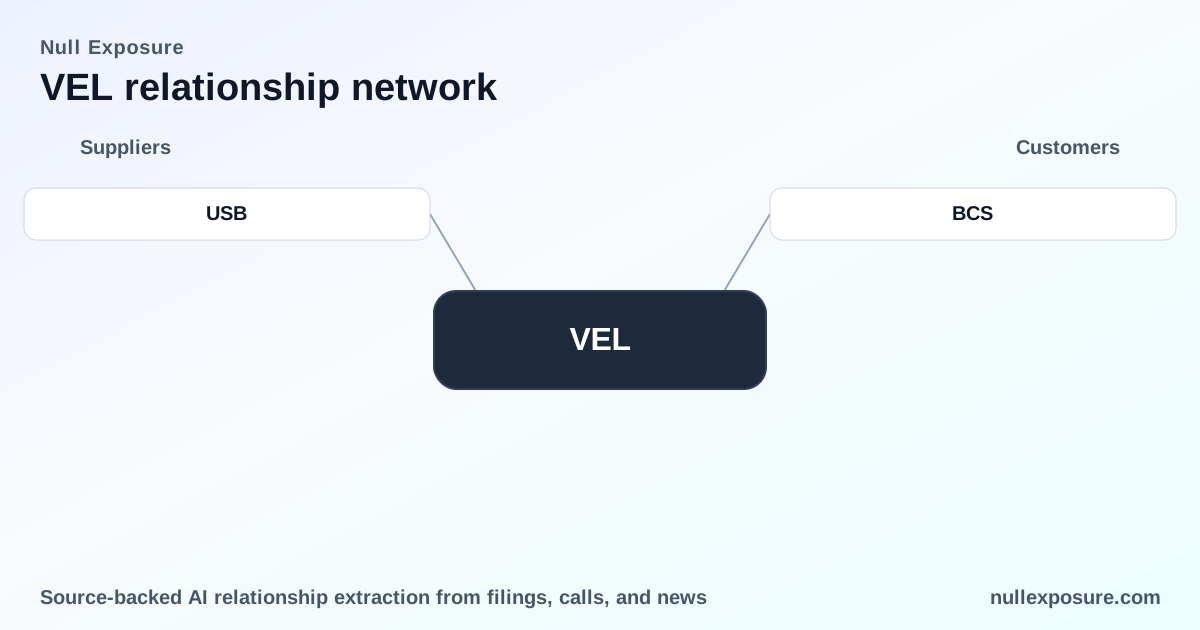
Velocity Financial (VEL) — customer relationships and capital-market counterparties that drive funding and risk
Velocity Financial operates as a U.S.-focused mortgage finance company that originates, securitizes and services loans secured by 1–4 unit residential investment properties. The business monetizes through interest spread on held loans, origination and servicing fees, and access to capital markets for balance-sheet funding—issuing debt and securitizations to fund growth and manage duration risk. For investor due diligence, the recent $500 million senior note transaction shows how Velocity sources liquidity beyond warehouse and securitization channels. Visit https://nullexposure.com/ for additional intelligence on counterparty footprints.
How Velocity’s business model shapes counterparties and contracts
Velocity’s operating model is a hybrid of stable, long-duration lending and tactical short-term financing. 30-year fixed-rate amortizing loans dominate originations, while a portfolio of short-term, interest-only loans supports value-add acquisitions and repositionings. That dual posture creates diverse counterparty needs—from buy-and-hold SFR landlords serviced over decades, to short-term rehab borrowers that require rapid capital turnover.
Company-level signals from filings show a predominantly U.S. footprint: Velocity conducts all origination and servicing activity within the United States, with state concentration in California, New York, Florida, New Jersey and Texas. The firm services loans both on its balance sheet and for third parties via an in-house servicing platform, which reinforces critical dependency on servicing operations for retention and recurring fee income. Originations scale is material—Velocity originated $1.8 billion of loans in 2024—so counterparty spend and funding needs regularly cross the high-$100 millions threshold.
- Contracting posture: Long-term fixed-rate loans are core (30-year amortizing product) while short-term IO loans (1–2 year maturity) are used for acquisition/repositioning business. This mix supports predictable cash margins but requires active funding management.
- Counterparty profile: The borrower base skews toward individual investors who typically own ten or fewer properties, creating many small relationships rather than a few large institutional borrowers.
- Geographic concentration and criticality: All operations are U.S.-centric with top-state concentrations that elevate regional housing and regulatory risk.
- Maturity and role: In-house servicing capability suggests mature client-retention mechanics and recurring revenue through servicing fees.
- Scale signal: Originations in 2024 imply a spend band above $100 million annually, signaling material capital funding needs.
For further context on how these structural features interact with counterparty choice, see our coverage at https://nullexposure.com/.
Public financing counterparty: Barclays Capital
Velocity Financial entered a Purchase Agreement with Barclays Capital, acting for the initial purchasers, to issue and sell $500 million of 9.375% Senior Notes due 2031. This is a straightforward capital-markets financing that expands Velocity’s unsecured funding sources and transfers some duration and liquidity risk to public debt investors. (TradingView reported this transaction on March 10, 2026, referencing the Purchase Agreement.)
BCS (duplicate entry in public reporting)
The same transaction is also reported under the shorthand BCS (Barclays’ trading symbol), noting Barclays as the initial purchaser agent on the $500 million 9.375% senior notes due 2031. The duplicate listing reflects public reporting conventions rather than an additional counterparty relationship; it confirms Barclays’ role as lead arranger in this issuance. (TradingView coverage, March 10, 2026.)
Why the Barclays transaction matters for investors
The issuance of 9.375% senior notes at $500 million is a clear signal that Velocity is actively diversifying funding beyond securitizations and deposit-like facilities. A coupon at 9.375% reflects either opportunistic leverage to accelerate growth or a need to attract capital at a premium to cover spread compression on originated loans. Compare this to company-scale: Velocity’s market capitalization is approximately $750.6 million and trailing revenue for the latest period is $225.6 million, so this issuance is a material financing move relative to public equity.
Key implications:
- Funding diversification: Public notes reduce reliance on warehouse lines or RMBS issuance timing, but they increase fixed interest expense and call for careful liquidity planning.
- Refinancing and covenant visibility: Investors should review note covenants and amortization triggers; public senior notes often change the firm’s capital structure and can introduce mismatch risk against long-duration assets.
- Cost of capital pressure: A near-9.4% coupon is a meaningful funding cost that compresses net interest margin unless originations or spreads are adjusted.
Operational constraints that inform counterparty risk
Company filings and disclosures provide specific operating constraints that shape how Velocity contracts and with whom it works:
- Long-term core product: 30-year fixed-rate amortizing loans comprised 85.2% of originations in 2024, indicating the balance sheet is concentrated in longer-duration assets and dependent on stable funding.
- Short-term product line: Velocity originated short-term interest-only loans with 1–2 year maturities for acquisition/repositioning business, introducing turnover-driven funding needs.
- Client profile: The company targets individual investors who own relatively few properties, creating broad but small ticket counterparty exposures.
- In-house servicing and service provider role: Velocity services loans for others, increasing operational criticality of its servicing platform and strengthening long-term client ties.
- Geographic concentration: The business operates exclusively in the U.S., with notable concentrations in several states that can drive regional sensitivity.
These constraints are company-level signals; they contextualize counterparty selection and capital-raising choices without assigning them to any single counterparty unless explicitly named.
Investment takeaways and actionable next steps
- Key takeaway: Velocity’s issuance of $500 million in senior notes through Barclays (BCS) underscores active capital-market engagement to fund a predominantly long-duration lending book; this materially affects leverage and interest expense profiles.
- Risks to monitor: coupon and covenant terms on new notes, geographic concentration risk in top states, retention and performance of the servicing platform, and execution of short-term loan pipelines without funding friction.
- Analyst context: Public metrics through the latest quarter (2025-12-31) show Velocity with a trailing P/E around 7.1 and robust profit margin, but funding moves can materially alter financial leverage and free cash flow.
For investors and operators evaluating VEL’s counterparty relationships, the immediate focus should be on note covenant detail, funding tenor alignment with asset duration, and servicing platform resilience. For a deeper counterparty map and ongoing monitoring, visit https://nullexposure.com/ for tailored intelligence and relationship analytics.