Velo3D (VELO) — Customer Map, Revenue Drivers, and Strategic Constraints
Velo3D sells and leases precision metal additive manufacturing systems and monetizes through hardware sales, short-term operating leases, usage fees, licensing, subscription software, support services, and parts/powder sales. The company combines an integrated hardware-software product with recurring revenue components and targeted licensing deals; this hybrid model delivers upside from large strategic customers while concentrating near-term revenue risk. For investors evaluating customer durability, the mix of short-term leases, usage-based economics, and a small set of materially large customers defines both growth leverage and earnings volatility. For further context on Velo3D’s coverage and relationship analytics, visit https://nullexposure.com/.
What matters first: customer concentration and contract posture
Velo3D’s customer base is intentionally narrow at scale. Top customers accounted for 47% of revenue in 2024, and the company explicitly warns it expects to rely on a limited number of customers for near-term sales, making each major account a material economic driver. Contractually, Velo3D structures a high proportion of engagements as 12‑month operating leases and usage-based arrangements, supplemented by support agreements, time-based subscriptions and standalone licensing. These characteristics create high revenue cyclicality tied to a few large program purchases and to utilization patterns, rather than a broad fan of recurring SaaS-like contracts.
Key customer relationships — who drives the business today
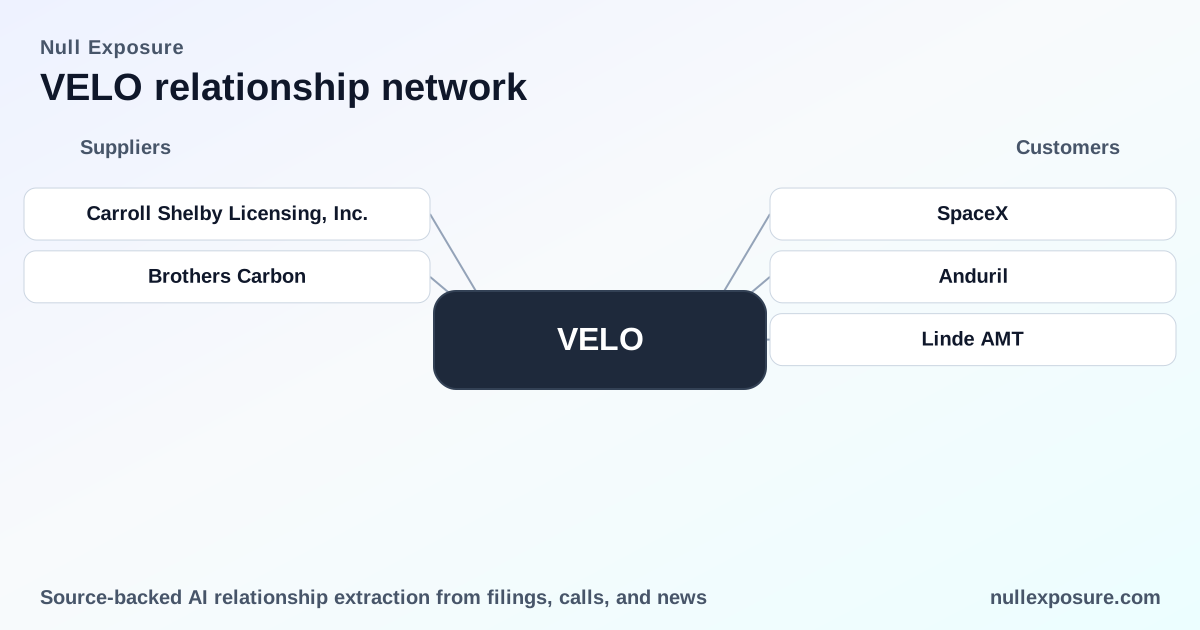
SpaceX — the largest single commercial relationship and licensor/licensee activity
SpaceX is identified in Velo3D’s 2024 Form 10‑K as the company’s largest customer, with revenue trends driven by the timing of SpaceX’s major orders and shipments of printers. Velo3D also disclosed a September 2024 non‑exclusive licensing agreement with SpaceX for internal use of certain patents and technologies, reflecting a deeper, multi‑dimensional commercial relationship that includes printer deployments, parts production, and intellectual property monetization. (Source: Velo3D 2024 Form 10‑K; licensing disclosure September 2024.)
Several press reports in late 2025 reinforce SpaceX’s operational dependency on Velo3D hardware: Velo3D’s CEO confirmed the firm already hosts 25 machines at SpaceX and that multiple Raptor engine parts are qualified for Velo3D’s platform, with discussions ongoing about incremental machine orders. This combination of manufacturing footprint and an explicit license positions SpaceX as both a high-volume customer and an IP counterparty. (Source: SahmCapital coverage, December 10–11, 2025.)
Anduril — defense OEM customer with program relevance
Velo3D’s CEO publicly stated that Anduril is a current customer, and commentary tied Anduril to Velo3D’s broader defense supply chain positioning alongside SpaceX work. The confirmation signals Velo3D’s traction within defense-oriented prime contractors and systems integrators that require qualified metal additive components. (Source: SahmCapital reporting, December 10, 2025.)
Momentus (MNTS) — five‑year services and parts master services agreement
In March 2026 Velo3D announced a five‑year Master Service Agreement with Momentus valued at $15 million, where Velo3D will deliver consulting and parts production through its Rapid Production Solutions (RPS) offering; Momentus compensated part of the arrangement with a mix of common stock and convertible preferred stock. This deal is structured as multi‑year services and parts supply rather than capital equipment sales, illustrating the company’s strategy to monetize expertise and production capacity beyond printers themselves. (Source: PR Newswire release, March 10, 2026.)
Linde AMT — materials partnership announced alongside U.S. defense engagements
Velo3D disclosed partnerships with the U.S. Navy, the U.S. Army and Linde AMT, an Indiana‑based materials company, as part of its commercial progress highlighted in Q3 2025 commentary. The Linde AMT relationship emphasizes the upstream materials and supply chain axis of Velo3D’s offering—critical given the company sells powder and consumables in addition to printers. (Source: Q3 2025 earnings highlights reported by SahmCapital, November 11, 2025.)
HYZN (Hyzon Motors) — a historical mention indicating a regional partnership reference
A 2021 Fleet Equipment article quoted Hyzon referencing work with a company called “Velocity” in Southern California and noting experience with battery electrical work; this mention appears in the results attributed to HYZN and is logged as FY2021. The excerpt is included in the record, though its precise mapping to Velo3D’s customer base is a historical note in the relationship dataset. (Source: Fleet Equipment, 2021.)
Operating constraints that shape revenue quality and downside
- Short-term contracting posture with usage exposure. Most of Velo3D’s leases have an initial 12‑month term and are structured as operating leases with a base rent and variable usage payments. This design improves customer flexibility but increases revenue lability and sensitivity to utilization declines. (Company disclosures on lease and recurring payment terms.)
- Multiple monetization channels, including licensing and subscriptions. In addition to hardware and leases, Velo3D recognizes revenue from licensing agreements, time‑based subscription licenses, and maintenance/parts sales, diversifying cash flows but not eliminating concentration risk. The licensing agreement with SpaceX in September 2024 is an explicit example of IP monetization. (Company revenue recognition disclosures; SpaceX licensing disclosure, Sep 2024.)
- High customer concentration is material to near-term performance. Top customers contributed a material share of revenue (top three customers totaled 47% in 2024), creating operational and financial concentration risk that amplifies the impact of order timing and renewals. (Customer concentration table in FY2024 disclosures.)
- Segment integration increases customer stickiness but requires technical support. Velo3D sells an integrated hardware + software + services solution; bundled support and field engineering accompany equipment sales, which raises barriers for customers shifting to competitors but also imposes ongoing service delivery obligations. (Support services and bundled contract descriptions.)
- Geography skew and regulatory exposure. Revenue is heavily Americas‑centric, with Europe and other regions contributing materially less in the 2024 disclosure; Velo3D must maintain compliance with U.S. and EU privacy and export controls as it scales internationally. (Revenue by geographic area; privacy/regulatory disclosures.)
Investment implications and risk/reward calibration
Velo3D’s model delivers asymmetric upside if large strategic customers like SpaceX expand printer fleets or migrate additional parts production to the platform, and if multi‑year services contracts (for example with Momentus) scale. Conversely, the combination of short lease terms, usage‑based economics and concentrated buyers creates near‑term volatility in revenue and cash flow. Investors should treat headline wins (licensing deals, defense confirmations, and materials partnerships) as credible signals of product-market fit while stressing scenario analyses for order timing and utilization.
For institutional subscribers seeking deeper customer wiring and contract‑level exposure analysis, visit https://nullexposure.com/ to request a tailored relationship brief.
Final takeaways for operators and researchers
- SpaceX is simultaneously a large customer and an IP licensee—this dual relationship is the single largest commercial lever for Velo3D’s near-term revenue.
- Contracts skew short and usage‑dependent, which favors capture of service revenue but increases quarter‑to‑quarter volatility.
- Material partnerships across defense, materials and services broaden addressable market but do not yet eliminate customer concentration risk.
For an investor‑grade relationship inventory or to commission a custom customer concentration model, the NullExposure research portal provides access to the underlying extraction and narrative analytics at https://nullexposure.com/.