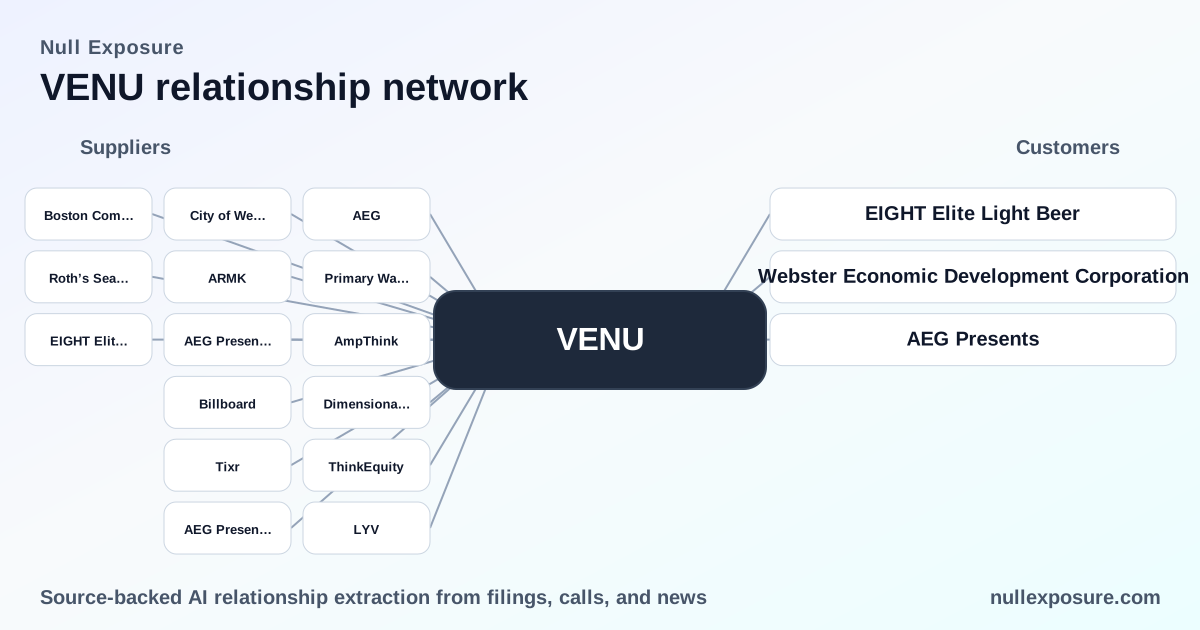
Venu Holding (VENU): Customer relationships that build a live-entertainment moat
Venu Holding Corporation operates, brands and monetizes luxury live-entertainment venue campuses by combining restaurant and food & beverage operations with event promotion, venue rentals and premium licensing deals. The company converts foot traffic into recurring hospitality revenue (restaurant/F&B) and episodic, high-margin event revenue (concerts, amphitheaters), while extracting ancillary income through naming rights and licensing of branded hospitality offerings. For investors, the key dynamic is a dual revenue model—highly material restaurant operations for steady cash flow and spot-driven event revenues that deliver scale and margin upside. Learn more at https://nullexposure.com/.
What the operating model looks like in practice
Venu’s income stream is predominantly services-oriented, driven by food & beverage and event operations rather than product sales. Public disclosures and extracted evidence show:
- Restaurant Operations accounted for 61% of total revenue in 2024, making F&B the company’s most material, cash-generative line.
- Event Operations generated 30% of revenue in 2024, reflecting meaningful but episodic income tied to show schedules and venue utilization.
- The company operates exclusively within the United States, focusing on strategically selected markets for its indoor and outdoor music venues.
- Contracting mixes include licensing agreements (longer-term, deposit-backed club and hospitality licenses) and spot contracts (event revenue recognized when shows occur), producing a hybrid cashflow profile. Examples of licensing evidence include royalty payments and prepaid license deposits ranging from tens to hundreds of thousands of dollars.
From an investor lens, these are critical control points: steady, high-share F&B revenue supports working capital and day-to-day operations, while spot events drive scale, brand visibility and episodic margin expansion. Balance-sheet discipline and event cadence therefore determine near-term volatility and upside.
Commercial relationships that matter (full coverage)
Below I cover every customer-related relationship surfaced in the public record and explain the practical significance to Venu’s model.
EIGHT Elite Light Beer / Troy Aikman — premium naming and membership partnership
Venu named a premium 350-seat Aikman Club as part of a venue expansion, developed in partnership with NFL Hall of Famer Troy Aikman, founder of EIGHT Elite Light Beer; the arrangement functions as a naming and membership-based premium space that supports higher-margin hospitality revenue. (TicketNews, Dec 2025 — article on Venu’s Sunset Amphitheater Houston announcement)
Webster Economic Development Corporation / City of Webster — municipal development LOI for Sunset Amphitheater Houston
Venu signed a letter of intent with the City of Webster and the Webster Economic Development Corporation to develop Sunset Amphitheater Houston, a 12,500-capacity year-round amphitheater, establishing a municipal partnership that secures market entry and local facilitation for a major, capacity-driving asset. (TicketNews, Dec 2025 — LOI announcement for Sunset Amphitheater Houston)
AEG Presents — strategic industry partnership for promotion and scale
Venu lists AEG Presents among strategic industry partners used to shape its entertainment strategy, positioning the company to leverage established promoter relationships and distribution for show bookings and ticketing scale. (StockTitan coverage, Mar 2026 — announcement referencing AEG Presents as a strategic partner)
Constraints and what they signal about risk and scalability
The company-level constraints highlighted in filings and media reveal the following operating characteristics, not relationship-level assertions unless specifically named in the source:
- Contracting posture: mixed. Venu uses licensing for premium hospitality assets and memberships—with evidence of recurring royalty arrangements and prepaid license deposits—and spot recognition for event revenues that are realized on occurrence. This dual posture reduces single-source concentration but creates forecasting complexity.
- Concentration: domestic and service-heavy. Operations are focused in the U.S., with restaurant/F&B contributing the majority of revenue (61% in 2024), concentrating the company on local market execution and hospitality economics.
- Criticality: restaurants underpin cash flow; events drive upside. The restaurant business is the financial backbone; events are high-leverage growth drivers that can rapidly change revenue and margin profiles around event schedules.
- Maturity: early growth with margin pressure. 2024 results show negative EBITDA and EPS, with EV/Revenue well above revenue—indicating investor growth expectations but operating losses that require continued volume growth and improved operating leverage.
Evidence supporting these signals includes specific licensing disclosures (royalty payments such as $10,000 per month under a trademark license and prepaid license deposits from $50k–$200k) and explicit revenue breakdowns by segment for 2023–2024.
Investment implications and risk-adjusted view
Venu’s customer and partner network follows a deliberate strategy: lock in recurring hospitality revenue through memberships, club licensing and restaurants, and use partnerships with promoters, naming partners and municipalities to scale amphitheater and event footprints. For an investor:
- Strengths: The dual revenue model reduces reliance on any single income source and premium partnerships (naming, celebrity affiliations, municipal LOIs) accelerate venue development and brand recognition. Restaurants supply the largest share of revenue and steady cash flow.
- Risks: Event revenue is inherently spot-driven and seasonal; municipal and promoter partnerships are execution-sensitive. Financials show negative margins and elevated valuation multiples relative to current revenue, so execution on venue openings and event calendars must materialize to justify the premium.
- Catalysts to watch: Successful openings and utilization of Sunset Amphitheater Houston, the commercial performance of premium memberships (Aikman Club sponsorship), and expanded promoter relationships (e.g., activity with AEG Presents) that increase ticketed event throughput and ancillary spend.
Actionable takeaways for operators and investors
- Monitor event cadence and utilization metrics for new amphitheaters—these directly convert into higher-margin event revenue and ancillary F&B spend.
- Track licensing revenue rollouts and prepaid license schedules to understand predictable cash flows from membership products.
- Assess municipal partnership tightness (LOI to definitive agreements and permitting timelines) as a short-to-medium term execution risk.
For a concise, investor-focused dossier on Venu’s customer and partnership signals, visit https://nullexposure.com/ for the full coverage and data feed.