Veru Inc. (VERU): What the FC2 divestiture tells investors about the company’s customer relationships and operating posture
Veru is a small, late‑stage oncology biopharmaceutical company that monetizes primarily through drug development and strategic asset sales. The company’s current commercial footprint has shifted materially after the divestiture of its FC2 female condom business; going forward Veru’s value proposition centers on progressing two late‑stage drug candidates (enobosarm and sabizabulin) toward commercialization and licensing. Investors should treat Veru as a development‑stage drug sponsor with limited commercial revenues and residual transition obligations from the FC2 sale. Learn more at https://nullexposure.com/
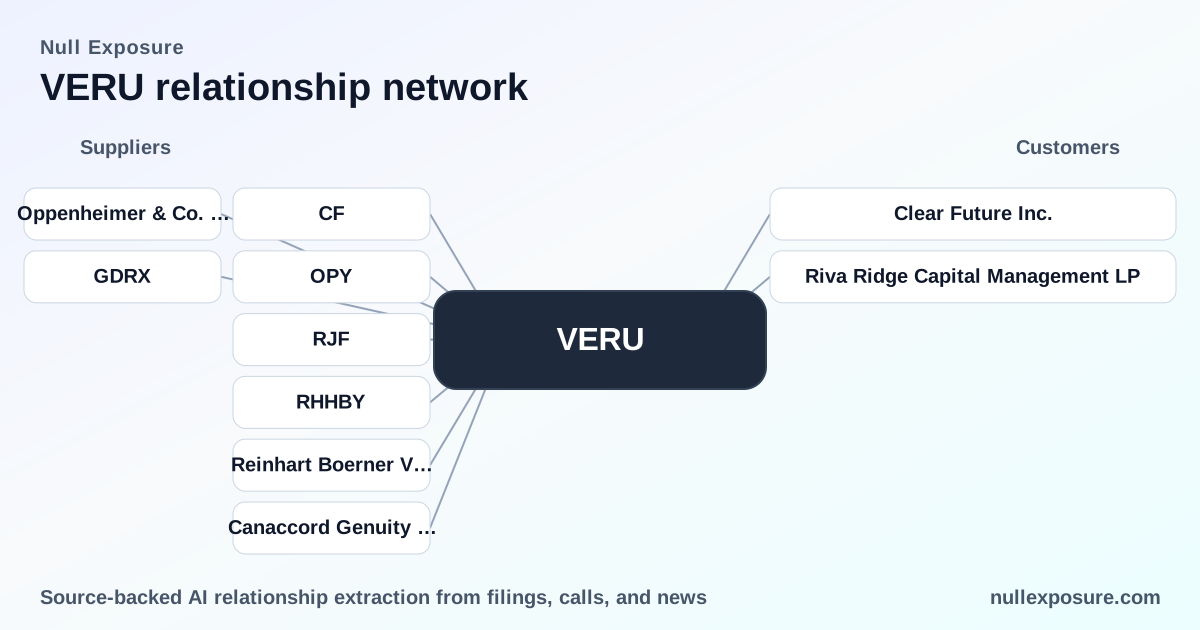
Two buyers show up in the record — documentable facts, not speculation
-
Veru’s FY2024 press release and SEC‑period disclosures state that the FC2 Female Condom® business was sold for $18 million to clients managed by Riva Ridge Capital Management LP and other co‑investors. This transaction was announced publicly in a Finance Yahoo press release describing the sale and purchase terms in FY2024.
Source: Finance Yahoo press release (FY2024). -
Earnings‑call transcripts and market summaries in Q1 FY2026 refer to the same FC2 business having been sold to Clear Future Inc., with the effective sale date recorded as December 30, 2024. Those transcripts appear in publications such as InsiderMonkey and The Globe and Mail’s Motley Fool transcripts in March 2026.
Source: InsiderMonkey and The Globe and Mail earnings call transcripts (Q1 FY2026).
Both records are part of the public trail documenting the FC2 divestiture; investors should reconcile the buyer naming and transaction parties when performing diligence on title, purchase agreement assignment and escrow arrangements.
What the sale disclosure reveals about Veru’s operating and contracting posture
The sale documentation and accompanying disclosures present several company‑level operating signals that affect how investors should view Veru’s customer and counterparty landscape:
-
Short‑term transition obligations are defined and time‑boxed. The transition services agreement (TSA) obligates Veru to provide certain IT, contract transition and administrative services generally within six months, with some IT services extending to 12 months and contract transition work up to 32 months; those services are provided at no fee apart from reimbursable out‑of‑pocket costs. This creates limited post‑close operational exposure and predictable cost reimbursement mechanics disclosed in the sale materials.
-
Counterparty mix includes governments and individuals. Veru notes that government authorities and third‑party payors determine reimbursement and that physicians, patients and payors influence market acceptance, indicating that customers span public payors and individual prescribers/patients — a typical mix for health‑care commercial products and an important constraint on pricing and uptake.
-
Global footprint contraction — EMEA and APAC exposures were part of the sale. The purchaser acquired substantially all FC2 assets, including the stock of U.K. and Malaysian operating subsidiaries, signaling that the divestiture materially reduced Veru’s direct EMEA and APAC commercial footprint and transferred associated operational responsibilities.
-
The transaction was material and strategically consequential. Company disclosures characterize the FC2 Business Sale as a strategic shift with a major effect on operations and financial results; historically, the FC2 business had substantial customer concentration (the Pill Club accounted for roughly 44% of FC2 net revenues in FY2022). That concentration explains why the divestiture represents a material reorientation of Veru’s revenue profile.
-
Role and lifecycle: seller and terminated commercial relationship. Veru is the seller; the assets and liabilities tied to the FC2 business were written off at closing and are no longer presented as discontinued operations on the balance sheet as of September 30, 2025, indicating the commercial relationship has been closed out for accounting and operating purposes.
-
Strategic focus on core product development. At the company level Veru now emphasizes its late‑stage drug candidates (enobosarm and sabizabulin), signaling a pivot from running a consumer health commercial business to concentrating resources on clinical development and eventual partnering or commercialization of novel therapeutics.
How these constraints shape commercial risk and investor priorities
-
Transition risk is contained but measurable. The TSA defines limited, time‑bound obligations that create manageable operating costs and counterpart risk; investors should monitor for any litigation, indemnities, or unexpected transition costs but expect outsized ongoing commercial obligations to be minimal.
-
Reimbursement and regulatory counterparty exposure remains a material risk. With government payors and pricing controls cited for EU markets, Veru’s future commercial value hinges on successful regulatory and reimbursement strategies for its drug candidates rather than legacy consumer revenues.
-
Concentration risk was a driver of the sale’s impact. Historical dependence on a few large customers for FC2 explains why the divestiture is a structural shift — investors should expect revenue volatility until development programs are partnered or commercialized.
Relationship‑by‑relationship note (concise investor summaries)
-
Riva Ridge Capital Management LP — Veru announced in a FY2024 press release that the FC2 Female Condom® business was sold to clients managed by Riva Ridge Capital Management LP and other co‑investors for $18 million, subject to purchase‑agreement adjustments. This public notice frames Riva Ridge (or its clients) as principal financial acquirers in the FY2024 transaction. Source: Finance Yahoo press release (FY2024).
-
Clear Future Inc. — Q1 FY2026 earnings call transcripts and market summaries published in March 2026 state that Veru sold the FC2 business to Clear Future Inc. on December 30, 2024, which is the date referenced in the company’s investor communications. Source: InsiderMonkey and The Globe and Mail earnings call transcripts (Q1 FY2026).
Investor implications and next steps
-
Scale and capital runway matter. Veru’s trailing‑twelve‑month revenue (~$16.9M) and negative EBITDA indicate the company is operating with development‑stage economics; the FC2 sale provides cash proceeds but also removes recurring commercial revenue, so investors must track financing, partnering and trial milestones closely.
-
Monitor transition disclosures and remnant liabilities. Although the TSA limits long‑term obligations, the staggered transition windows (6–32 months by service type) create a finite schedule of deliverables and reimbursements that can affect near‑term cash flow and operational bandwidth.
-
Focus on clinical and licensing catalysts. With the legacy commercial asset divested, valuation upside depends on clinical readouts, regulatory progress and any future licensing or co‑development agreements for enobosarm and sabizabulin.
For a more systematic view of counterparty relationships, transition obligations and commercial‑stage exposures across biopharma issuers, visit https://nullexposure.com/ — our platform aggregates these signals and provides tractable datasets for investment due diligence.
Bottom line
The FC2 divestiture was a material, deliberate pivot that reduces Veru’s commercial complexity while concentrating the company’s risks and upside in its late‑stage oncology and related development programs. Investors should treat Veru as a development‑heavy firm with time‑bound transition obligations, concentrated historical customer exposures and a need for clinical or corporate milestones to justify upside.