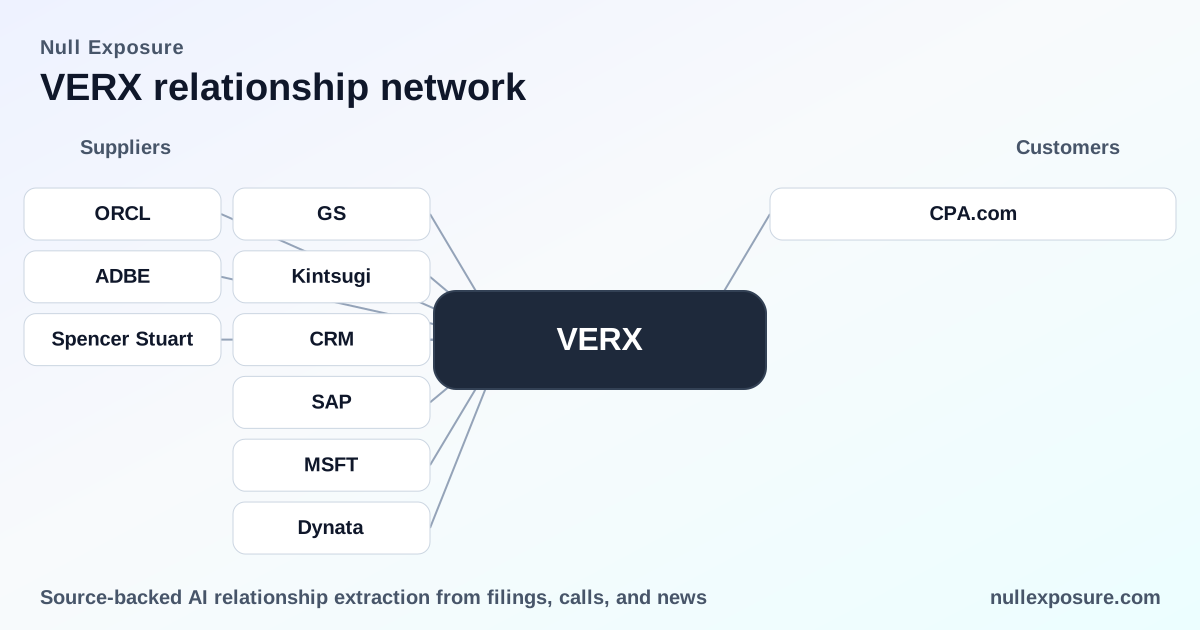
Vertex (VERX) — Customer relationships and commercial posture investors should price in
Vertex operates a subscription-first tax software and services business that sells primarily to enterprise and mid‑market customers; it monetizes through recurring software subscriptions, professional services and managed compliance offerings, with an ARR profile centered roughly around $122.7k per direct customer and a global customer base of over 4,900 accounts. For investors, the combination of subscription revenue, low single-customer concentration, and enterprise sales motion defines both resilience and sensitivity to wide macro budget cycles. Learn more or request deeper relationship-level analysis at https://nullexposure.com/.
How Vertex’s model converts tax complexity into recurring cash
Vertex sells indirect tax automation and compliance solutions to companies with complex transactional tax needs. The company’s core economics are driven by annual subscription contracts, supplemented by implementation, outsourcing and managed filing services that convert one-time sales into multi-year customer lifecycles. Revenue is largely recurring, and the company reports software and related services as the dominant revenue streams, which creates predictable cash flow while exposing Vertex to enterprise renewal cycles and budget timing.
- Contracting posture: Predominantly annual subscription agreements invoiced up-front for the subscription term.
- Customer mix: A mix of large enterprises and mid‑market firms, with a strong presence in North America and a footprint in over 195 countries.
- Revenue characteristics: High software concentration with professional services and managed services layered on top.
The one publicized customer relationship tracked here
CPA.com — expanding toward AI-driven tax compliance
Vertex announced an expansion of its partnership with CPA.com in March 2026 to include an AI-driven tax compliance solution developed with Kintsugi, extending a long-standing channel and partnership relationship that targets accounting and finance transformation in the profession. A March 2026 press release reported on StockTitan summarized the expanded collaboration and product focus. (Source: StockTitan news report, March 10, 2026.)
What the recorded relationships and company signals mean for valuation
Vertex’s customer signals and disclosed constraints paint a clear commercial profile that should be incorporated into valuation and risk models.
- Subscription-first, predictable ARR: The company states it derives the majority of revenue from recurring software subscriptions and invoices many subscription customers annually at the start of each period. This supports higher revenue visibility and justifies premium valuation multiples compared with pure services businesses, but also requires modeling of renewal rates and churn.
- Enterprise bias with mid-market scale: Vertex reports serving the majority of the Fortune 500 while also targeting mid‑market customers; this duality increases total addressable market but also creates sensitivity to corporate budget cycles—enterprise procurement can be lumpy and tied to ERP and finance transformation timelines.
- Global reach with North American concentration: Revenue is primarily U.S.-domiciled, but the product supports compliance in over 195 jurisdictions. Global coverage increases competitive differentiation for multinationals and upsell potential; North American concentration keeps macro exposure correlated to U.S. corporate capex and software spend.
- Low customer concentration: No single customer accounted for more than 10% of revenue in recent years, which reduces counterparty concentration risk and supports more stable collections and lower single-client revenue volatility.
- Moderate per-customer economics: An ARR per customer of about $122,706 positions Vertex in a sweet spot for enterprise-grade SaaS: large enough to justify dedicated sales and implementation investments, but low enough to support scalable growth across thousands of customers.
- Service layer increases lock‑in and implementation cycles: Managed filing and compliance services increase customer dependency and lifetime value, but raise delivery complexity and professional services margin pressure versus pure SaaS.
- Maturity signals: With nearly 4,915 direct customers and a mix of subscription and services revenue lines, Vertex demonstrates product-market fit at enterprise scale but still requires continuous investment in product (AI, global tax rules) and integrations.
Commercial and risk implications for investors
- Upside drivers: Continued penetration into accounting channels (as with CPA.com), expansion of AI-enabled tax automation, and cross-sell of managed compliance will increase ARR per customer and reduce relative churn. Partnerships that expand reseller reach accelerate growth without proportional sales expense.
- Value preservation risks: Renewal timing and enterprise budget windows drive near-term revenue lumpyness; professional services and managed services introduce margin variability. Investors should model subscription renewal rates and the productivity of services revenue separately.
- Operational exposure: Global tax rule changes and the need to maintain jurisdictional tax logic impose ongoing R&D and content update costs; failure to keep pace would threaten stickiness for large customers.
- Capital allocation: Low single‑customer concentration grants the company flexibility, but growth depends on continued investment in product enhancements (AI) and channel partnerships.
Constraints and company-level signals investors should internalize
The following constraints are company-level signals drawn from Vertex disclosures and are not assigned to any specific partner unless explicitly named.
- Contracting posture: Subscription-dominant, with many customers invoiced annually at the start of the subscription period; subscription revenue comprises a substantial portion of overall revenue.
- Counterparty profile: Primarily large enterprises and mid‑market companies; Vertex serves many Fortune 500 companies while also addressing mid‑market needs.
- Geography: Global product footprint with North American revenue concentration. Vertex provides tax coverage in over 195 jurisdictions while most revenue is generated from U.S.-domiciled customers.
- Materiality: No single customer exceeds 10% of revenue, signaling low revenue concentration on a per-client basis.
- Roles and delivery: Vertex functions as seller/licensor and a service provider, combining software licensing with managed compliance and tax return outsourcing.
- Relationship stage: Overall customer base is active, with most agreements on annual cadence and typical renewal cycles aligning with the initial contract quarter.
- Segment mix and spend band: Business is software-first with services appended, and median ARR per customer (~$122.7k) places many customers in a $100k–$1M annual spend band, consistent with enterprise or high‑end mid‑market profiles.
Bottom line for investors
Vertex’s customer relationships are structured for recurring cash flow, low per-customer concentration risk, and enterprise-grade economics anchored in annual subscriptions and services. The CPA.com expansion to deliver AI-driven tax compliance products exemplifies Vertex’s route-to-market via channel partnerships and its focus on embedding tax automation into broader finance transformation efforts. For investors, valuation should reflect durable ARR, the optionality of services and AI product expansion, and sensitivity to enterprise procurement cycles and professional services margins.
If you want a tailored relationship-risk scorecard or a deeper read into Vertex’s customer contracts and renewal profile, visit https://nullexposure.com/ for bespoke analysis and datasets.