Vermilion Energy (VET): Customer Relationships, Commercial Concentration, and What Investors Should Price In
Vermilion Energy is an international upstream oil & gas producer that monetizes reserves through direct commodity sales and contractual offtake arrangements across North America, Europe and Australia. The company’s cash flow profile is driven by production volumes, commodity prices and a growing reliance on marketed gas contracts in Europe — notably a multi‑year supply agreement in Germany — which compresses volumetric risk but increases counterparty concentration. For investors evaluating customer exposure and counterparty risk, the Uniper relationship in Germany is a material commercial anchor; other signals in recent coverage include at least one unrelated match that should be treated as noise. For a concise view of coverage and signals, visit https://nullexposure.com/.
Uniper: a multi‑year anchor for Vermilion’s German gas output
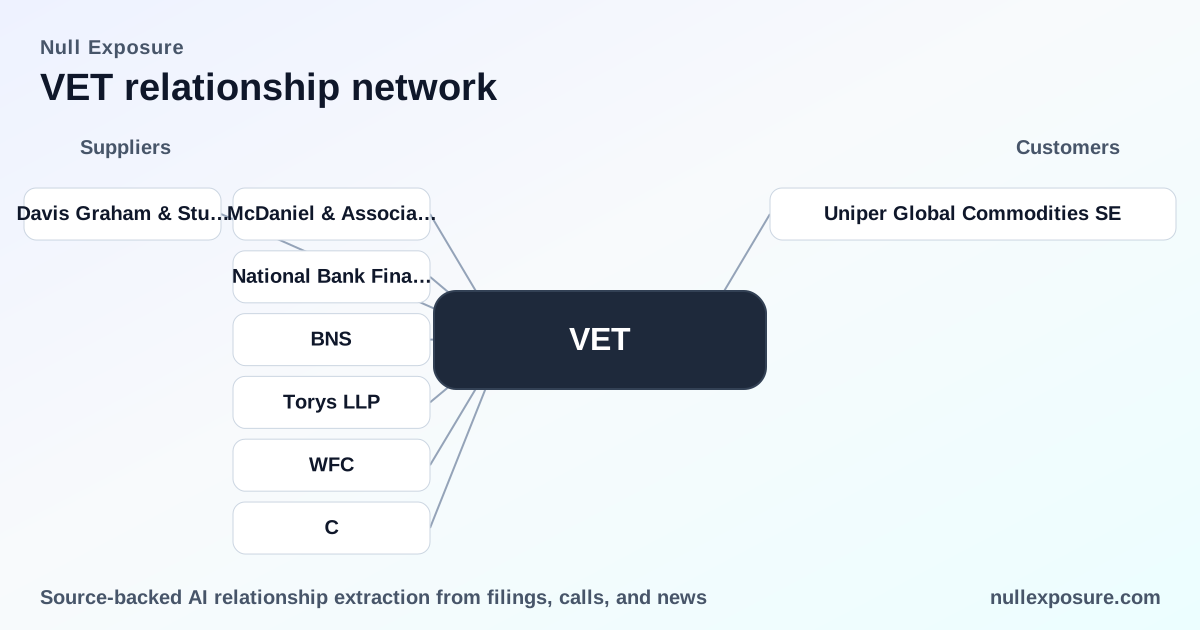
Vermilion’s most prominent customer linkage in the record is with Uniper Global Commodities SE, where the company has negotiated a formal supply arrangement for German production.
- Vermilion entered a two‑year contract to supply its natural gas production in Germany to Uniper, securing near‑term revenue visibility for that regional portfolio (Uniper press release, May 4, 2026: https://www.uniper.energy/news/uniper-and-vermilion-to-continue-gas-supply-partnership-in-germany).
- Under the renewed terms, Vermilion will market its entire output of both low‑ and high‑calorific natural gas from its German upstream operations to Uniper, concentrating German offtake with a single counterparty and simplifying commercial logistics (industry report, ChemAnalyst, March 10, 2026: https://www.chemanalyst.com/NewsAndDeals/NewsDetails/uniper-and-vermilion-renew-gas-supply-partnership-in-germany-40402).
These two items together document a clear commercial posture: Vermilion has converted regional production into contracted sales with Uniper, trading some diversification for the revenue certainty that a bilateral buyer provides.
A third record: unrelated blockchain coverage flagged as a match
One result in the coverage links VET to a story about WGRX and blockchain platforms, but the substantive content is not about Vermilion’s commercial activities.
- The item references WGRX’s choice of blockchain platforms (Hyperledger Fabric, Ethereum/Polygon, VeChain, Quorum/Besu and Corda) to initiate a PharmacyChain project; the story’s content is corporate‑tech oriented and does not describe a commercial customer relationship between Vermilion and WGRX (BitGet news summary, March 10, 2026: https://www.bitget.com/amp/news/detail/12560605240890).
Treat this match as noise: it is recorded in the results but it does not alter Vermilion’s customer risk profile.
What the Uniper relationship reveals about Vermilion’s operating model
The Uniper agreements surface several operational and business‑model characteristics investors should weigh:
- Contracting posture: Vermilion is using medium‑term bilateral contracts to lock in offtake and price exposure for a discrete regional portfolio. A two‑year contract provides working capital stability while leaving management flexibility at the next re‑negotiation point.
- Concentration: Marketing the entire German output to a single buyer materially increases counterparty concentration in that market; this reduces volumetric sales risk but increases counterparty credit and negotiation risk if market conditions shift.
- Criticality: For Vermilion’s German operations, Uniper functions as a critical commercial counterparty — any disruption to that link would have an outsized impact on the region’s realized revenues.
- Maturity of relationships: The renewal language and repeat supply partnership indicate a mature supplier‑buyer relationship rather than an ad‑hoc sales arrangement, signaling commercial stability for the German book through the contract term.
- Company‑level signal on constraints: There are no recorded customer constraints in the available relationship data set, which is a company‑level signal rather than a relationship‑specific finding.
These characteristics should be contextualized against Vermilion’s broader financial picture: Revenue TTM of roughly $1.7bn and EBITDA in the order of $1.19bn point to material scale, but profitability metrics and EPS volatility reflect commodity sensitivity and portfolio complexity (company financials, latest reported quarter 2025).
Risk implications investors must price
- Counterparty concentration risk: With entire German offtake funneled to Uniper, investors must price the likelihood and impact of sharp counterparty credit deterioration or renegotiation.
- Price and volume sensitivity: A two‑year lock mitigates near‑term price swings for the contracted volumes but leaves Vermilion exposed at contract renewal to market cycles.
- Geopolitical and regulatory risk: European gas markets are sensitive to regulatory shifts and seasonal demand; a single‑buyer marketing strategy amplifies exposure to regional policy changes.
- Data‑quality noise: Third‑party coverage can introduce irrelevant matches (e.g., the WGRX blockchain story), so due diligence should focus on primary press releases and company filings rather than automated match outputs alone.
Where investors should look next
- Review Vermilion’s latest corporate filings and investor presentations for details on the German production base, realized pricing on the Uniper contract, and the proportion of total volumes committed under fixed or indexed contracts.
- Monitor Uniper’s credit and liquidity commentary in European power and gas markets, since a deterioration there would transmit quickly to Vermilion’s German cash flows.
For an actionable view of contractual concentration and counterparty exposure across your portfolio, see the coverage tools at https://nullexposure.com/ — they provide structured signals and direct links to source documentation.
Bottom line
Vermilion’s commercial position in Germany is now explicitly anchored to Uniper through a multi‑year supply agreement, creating both revenue visibility and concentration risk. Outside of that material Uniper relationship, recent coverage contains at least one unrelated match that does not affect Vermilion’s customer footprint. Absent recorded customer constraints in the dataset, investors should treat the Uniper linkage as the primary customer‑risk factor to model into valuations and scenario analysis.