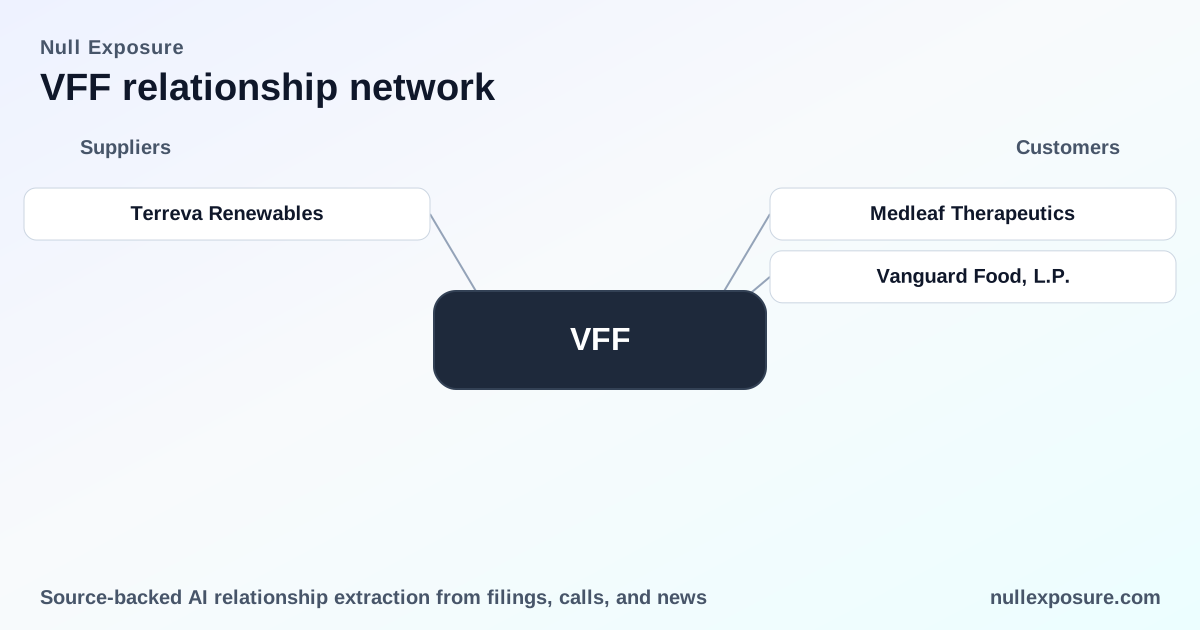
Village Farms (VFF): How customer relationships shape revenue, margins and concentration risk
Village Farms International operates large controlled-environment greenhouses that produce and sell tomatoes, peppers and cucumbers, and distributes adult-use and medical cannabis in North America and select international markets. The company monetizes through direct produce sales to retailers and distribution partners, cannabis wholesale to provincial boards and partners, and selective commissioned distribution arrangements, with revenue recognized at delivery under single-performance-obligation contracts. For investors, the critical signals are revenue concentration among a small set of buyers, mixed short- and long-term contracting posture, and commission-based arrangements that affect reported top-line comparability. For a consolidated view of customer-level intelligence, visit https://nullexposure.com/.
High-level takeaways investors should lock in
- Concentration risk is material: the top ten produce customers generated roughly 52% of produce revenue in 2024, and two individual customers exceeded 10% of total sales in 2024, signaling high buyer leverage and revenue volatility if retail terms shift. This comes directly from the company’s 2024 filing.
- Contracting is mixed but skewed to short-term, operationally: Village Farms sells much of its fresh produce against short-term purchase orders and rolling contracts (six to twelve months) with recognition at delivery, while other segments (notably an Energy royalty business) use long-term contracts. These are company-level disclosures in the 2024 filing.
- Geographic footprint is North America-centric: roughly half of sales were in the United States and half in Canada in recent years, with Canadian cannabis sales heavily routed through provincial distributors. This creates exposure to regional regulatory and retail dynamics.
- Commission arrangements can distort reported produce sales: recent press releases disclose commissions paid to Vanguard Food, L.P., which reduce headline produce sales and change comparability across periods. See the GlobeNewswire and The Globe and Mail coverage cited below.
- Revenue mechanics are uniform: produce and cannabis transactions are recognized as a single performance obligation at a fixed price, typically when the customer receives goods, supporting predictable short-term cash flow timing. This is described in the company’s 2024 10‑K.
Vanguard Food, L.P. — commission arrangement is directly referenced in filings and press releases
Village Farms reported that 2025 and 2024 produce sales were net of a commission paid to Vanguard Food, L.P., and that commissions materially affected year-over-year produce revenue comparisons for certain quarters. This commission arrangement is explicitly noted in the company’s news releases for Q3 2025 and full-year 2025. (See Village Farms press release via GlobeNewswire, November 10, 2025 and March 12, 2026; and coverage in The Globe and Mail, March 10, 2026.)
Why this matters: a commission agent relationship reduces reported gross sales and can mask true volumes and underlying margin economics if analysts rely on net sales alone; investors must reconcile gross throughput, commission rates and unit pricing to assess core produce economics. The company’s own releases state the 2025 sales figures are net of these commissions, so model adjustments are necessary for period-to-period comparability.
Sources: Village Farms press release, GlobeNewswire, March 12, 2026 and November 10, 2025; The Globe and Mail coverage, March 10, 2026.
Medleaf Therapeutics — a strategic international medical cannabis agreement
Village Farms discloses an agreement with Medleaf Therapeutics, a New Zealand-based medical cannabis company, indicating a commercial relationship that extends the company’s cannabis footprint beyond North America. This contractual relationship is cited in Village Farms’ 2024 annual report. (See Village Farms 2024 10‑K.)
Implication: the Medleaf arrangement signals international distribution ambitions in medical cannabis and represents a non-core but strategic partner channel; the disclosed excerpt does not quantify revenue, so its current materiality to consolidated sales is limited in public filings.
Source: Village Farms 2024 10‑K (filed year-end December 31, 2024; agreement reference noted in the 2024 annual filing).
What the company-level signals reveal about operating posture and business model maturity
- Contracting posture: operationally short-term for produce, with purchases determined close to delivery through purchase orders and revenue recognized upon customer receipt; long-term contracts exist in other business lines (the Energy royalty example), indicating a hybrid model with differing revenue predictability across segments. This is described in the 2024 10‑K.
- Concentration and criticality: customer concentration is high — top ten produce customers comprised roughly half of produce revenue in 2024 — which creates outsized sensitivity to retail consolidation, category pricing pressure, or a single large buyer’s renegotiation. The 10‑K shows two customers individually represented more than 10% of total sales in 2024.
- Channel structure: Village Farms acts as both seller and distributor, with evidence that it markets under its Village Farms® brand into retail supermarkets and fresh-food distribution companies across the U.S. and Canada; Canadian cannabis sales rely heavily on provincial boards as the primary wholesalers, implying government counterparty risk in that segment. These are company-level disclosures.
- Revenue recognition and maturity: the business recognizes revenue at a single performance obligation at delivery, which aligns cash conversion closely to shipment fulfillment and implies a mature, logistics-driven revenue model rather than subscription or long-tail receivables. The 2024 filing explicitly states this accounting posture.
- Geographic exposure: approximately 50% U.S. / 48% Canada split in recent years, with regulatory and market dynamics in each market directly affecting sales patterns and pricing. This is from the company’s 2024 disclosures.
Investment implications and operational checkpoints for buyers and operators
- Model for volatility: high customer concentration and short-term contracting for produce implies revenue volatility; stress test forecasts for 10-20% retail price compression and the loss/renegotiation of a top-two customer.
- Adjust for commission arrangements: treat reported net produce sales with caution when commissions are disclosed; reconstruct gross throughput and commission rates where possible to analyze unit economics. Vanguard Food’s commission disclosures should be normalized in financial models.
- Regulatory and counterparty risk: Canadian cannabis revenue is routed through provincial distributors, concentrating counterparty risk and exposing the business to provincial policy changes; U.S. cannabis exposure is concentrated in online and retail channels and is sensitive to state-level CBD and cannabinoid regulation. Company filings document these channel dynamics.
- Operational focus for operators: expand diversification across buyers and geographies, secure longer-term supply commitments where feasible for fresh produce, and maintain transparency on commission relationships to preserve comparability.
For a structured summary of customer relationships and to access signals that help reframe revenue and counterparties, see how our coverage assembles relationship-level evidence at https://nullexposure.com/.
Bottom line
Village Farms runs a hybrid model that converts controlled-environment production into short-term, delivery-tied revenue for produce while layering in cannabis and select international partnerships that diversify but do not yet offset buyer concentration. Key risks are customer concentration, commission-based distribution arrangements that alter reported sales, and regional regulatory exposure, while the company’s revenue recognition and greenhouse scale deliver consistent near-term cash flow visibility. Investors should focus on gross throughput metrics, commission disclosures (notably Vanguard Food, L.P.), and the evolution of the Medleaf relationship to gauge whether diversification is progressing meaningfully.