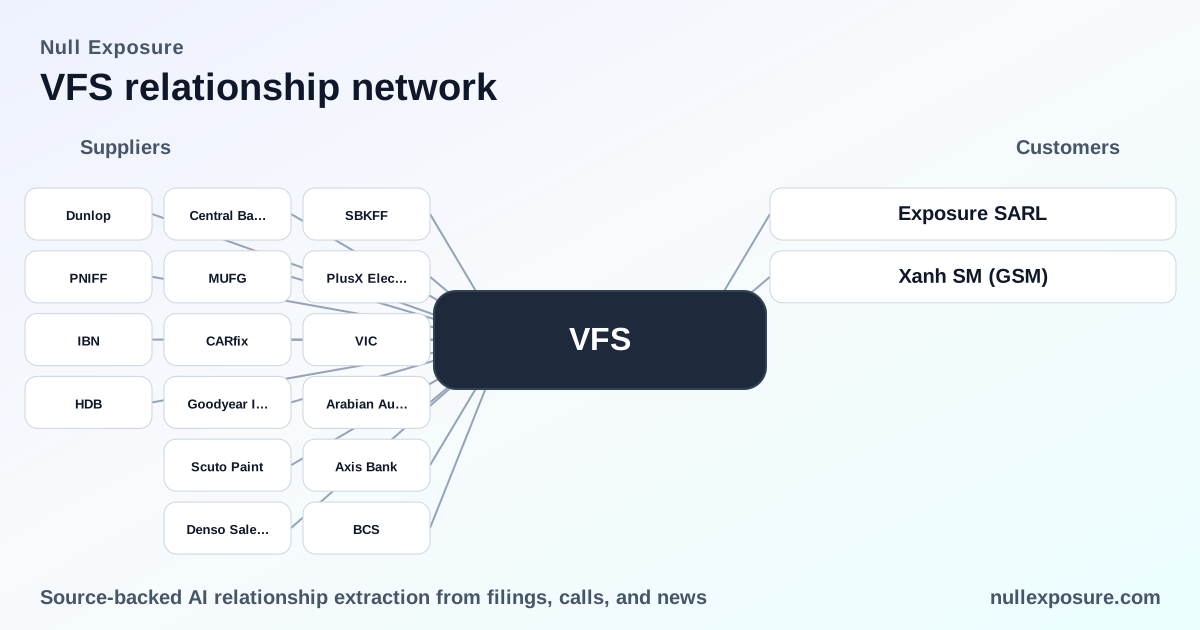
VinFast customer map: fleet deals, emerging-market MOUs, and a manufacturing pivot
VinFast Auto Ltd. manufactures electric vehicles and e-scooters and monetizes primarily through unit vehicle sales, fleet contracts and commercial supply agreements, plus manufacturing partnerships where it provides industrial capabilities to third-party autonomous and mobility ventures. For investors, the company’s top-line growth is driven by large fleet buyers and strategic industrial partnerships, while profitability remains challenged by heavy negative margins and ongoing capital intensity.
If you want a concise intelligence product on customer and partner flows for VFS, see how these relationships intersect with VinFast’s commercial strategy at https://nullexposure.com/.
What these customer links tell investors about VinFast’s operating model
VinFast’s reported metrics through the March 31, 2026 quarter show a company with scale in revenue but deep negative profitability (diluted EPS -1.6; negative EBITDA and gross profit). That financial posture frames every customer interaction: deals are structured to drive volume and factory utilization rather than near-term margin expansion. High insider ownership (about 98%) and very low institutional ownership concentrate control with founders and management, which accelerates strategic pivots but raises governance and liquidity considerations for outside investors. Source: company filings and consolidated summary through Q1 2026.
Operationally, these relationships reveal four characteristics of VinFast’s commercial model:
- Contracting posture: VinFast executes both direct fleet sales and Memoranda of Understanding with local operators and distributors, combining firm purchase orders with early-stage MOUs to open markets.
- Concentration: Large buyers in Vietnam have already driven meaningful volume, exposing revenue concentration risk to a few major commercial buyers.
- Criticality: Manufacturing partnerships that place VinFast as an industrialization partner increase the company’s strategic value beyond vehicle sales, embedding it in future autonomous and mobility stacks.
- Maturity: Customer engagements range from mature, high-volume domestic fleet contracts to nascent, exploratory MOUs in emerging markets.
The relationship landscape — direct takeaways investors need
Xanh SM (GSM)
VinFast has an established commercial buyer relationship with Xanh SM, which bought about 20,000 EVs in 2023 and generated over 20 trillion đồng in revenue for VinFast that year, illustrating the importance of large domestic fleet customers to the company’s top line. This is a material example of revenue concentration in Vietnam and a key channel for vehicle distribution. (Source: TheVietnamese.org, March 2026)
Exposure SARL (Democratic Republic of the Congo)
On February 10, 2026, VinFast signed a Memorandum of Understanding with Exposure SARL to explore supplying electric vehicles for green taxi services in Kinshasa, and Exposure has expressed interest in becoming VinFast’s official distributor in Congo; the MOU signals expansion into African urban mobility markets through local partners. (Source: Finviz summary of Feb 10, 2026 MOU; additional reporting from InsiderMonkey, March 2026)
Tensor (autonomous robocars)
VinFast is the manufacturing and industrialization partner for Tensor’s personally owned L4 autonomous robocar program, positioning VinFast as the production backbone for an autonomous vehicle developer rather than merely a sales channel. This partnership embeds VinFast into next‑generation mobility manufacturing and could create long-term revenue streams tied to industrialization and scale-up services. (Source: VinFast press release and PR Newswire, May 2026)
How these relationships affect valuation and risk
These customer and partner links have distinct valuation implications:
- Revenue upside concentrated in a few contracts. The Xanh SM fleet relationship demonstrates that a small number of large commercial buyers can drive outsized top-line growth; investors must model concentration risk into revenue multiples.
- Commercial MOUs are market-entry tools, not guaranteed revenue. The Exposure SARL MOU opens access to Kinshasa taxi fleets but is an early-stage commercial arrangement; value should be discounted until firm purchase commitments or binding distribution agreements are in place.
- Manufacturing partnerships change the margin profile. The Tensor arrangement upgrades VinFast from OEM to industrialization partner, which can improve factory throughput and create recurring engineering and manufacturing revenue, but it also shifts CapEx and operational risk onto VinFast’s balance sheet.
- Governance and liquidity dynamics matter. With ~98% insider ownership and negligible institutional stakes, strategic deals can be executed quickly but minority shareholders have limited influence; this ownership structure should factor into takeover, capital raise, and upside scenarios. (Company overview metrics through Q1 2026.)
Actionable investor takeaways
- Prioritize contract quality over headline MOUs. Firm purchase orders and long-term fleet contracts (like Xanh SM’s documented purchases) are the immediate drivers of cash flow; treat MOUs as optional upside until confirmed orders arrive.
- Value the industrialization role independently. Assign separate revenue and margin assumptions to manufacturing/industrialization partnerships (Tensor) versus retail and fleet vehicle sales; the two business lines have different economics and execution risk.
- Factor in concentrated ownership risk. Heavy insider control influences strategic direction and capital allocation; independent governance safeguards are limited, so assume management-led strategic outcomes.
For a focused look at how these customer and partner flows translate into commercial risk and upside scenarios for VFS, visit https://nullexposure.com/ for structured exposure analysis.
Bottom line
VinFast’s customer relationships reveal a company executing a two‑track commercial strategy: scaling vehicle volume through large fleet customers and market-entry MOUs, while simultaneously monetizing manufacturing capability via industrial partnerships. That dual approach increases top-line growth optionality but leaves profitability, concentration risk, and governance squarely on the investor’s checklist.