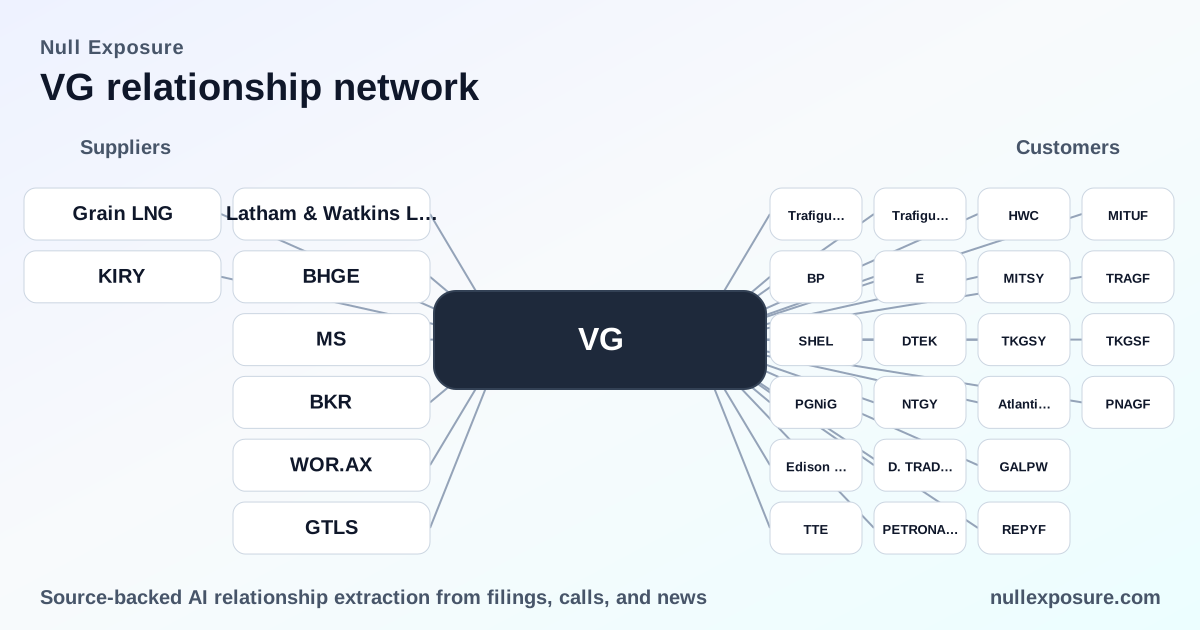
Venture Global (VG) — customer relationships that underwrite growth and test governance
Venture Global builds and operates U.S. LNG export facilities and monetizes primarily by selling liquefied natural gas under long‑term, fixed‑charge Sales and Purchase Agreements (SPAs) plus variable commodity charges; complementary short‑ and medium‑term sales smooth returns during commissioning and capacity optimization. The company’s economics rest on a dominant block of 20‑year SPAs for nameplate capacity, supplemented by commercial cargo sales, while legal and counterparty disputes have become a material source of downside risk. For a centralized view of relationship signals and source links visit https://nullexposure.com/.
Contracts, geography and counterparty posture — the operating model that matters
Venture Global’s commercial model is anchored by long‑duration contracts: the company discloses that roughly 95% of contracted post‑COD SPAs — ~37.45 mtpa of 39.25 mtpa — are 20‑year fixed‑price agreements, which produces a long stream of contracted cash flow and supports project finance structures. The firm also uses short‑ and medium‑term SPAs and pre‑COD commissioning sales to capture upside and optimize average facility charges; that dual posture gives the company both predictable base cash flow and tactical exposure to tight spot markets.
Geography is deliberately broad: the company sells into North America, Europe/EMEA and APAC, with 9.5 mtpa of long‑term SPAs with Chinese customers noted as of year‑end 2024, while management describes the model as repeatable and global. Contract terms tilt to the seller: post‑COD SPAs collect a fixed facility charge plus a variable commodity charge equal to at least 115% of Henry Hub, preserving margin capture versus Henry Hub movements. However, large arbitration claims and multi‑billion dollar damage demands reported in filings indicate concentration of counterparty risk and the potential for outsized contingent liabilities.
Customer roster: one‑line takeaways for every relationship in the results
- TotalEnergies (TTE) — TotalEnergies rejected becoming a long‑term Venture Global customer and cited trust issues in a February 5, 2025 interaction referenced in later news filings. Source: Newsfile/press releases referencing the February 2025 development (reported FY2025).
- PGNiG — PGNiG was listed among expected global customers in Venture Global communications tied to the Calcasieu Pass/Stonepeak investment story; the PR Newswire release referenced planned deliveries in 2022. Source: PR Newswire (FY2019).
- Shell (SHEL) — Shell is a major long‑term counterparty that entered arbitration with Venture Global over alleged delivery shortfalls; subsequent rulings and court activity (late‑2025/early‑2026) are part of a public legal record. Source: Marketscreener and investing.com coverage of arbitration and court decisions (FY2025–FY2026).
- Trafigura / Trafigura Group (TRAGF) — Venture Global announced a binding five‑year sale to Trafigura for ~0.5 MTPA starting in 2026; management discussed this as Venture Global Commodities’ first five‑year contract. Source: Q4 2025 earnings call and March 2026 press coverage (FY2025–FY2026).
- BP (BP) — BP is a principal claimant in arbitration related to Calcasieu Pass, with public reports noting BP’s claim for at least $3.7 billion after an ICC finding on breach of contract tied to delayed commercial operations. Source: Claimdepot and MarketScreener reporting on arbitration and damages (FY2025).
- Edison S.p.A. — Named in Venture Global’s earlier commercial roll‑outs as an intended customer for LNG deliveries in 2022. Source: PR Newswire (FY2019).
- Eni S.p.A. (E) — Eni appears among long‑term counterparties cited in period press releases as reinforcing Venture Global’s market position. Source: Venture Global press coverage in Globe and Mail (FY2025).
- Vitol — Reported as counterparty to a five‑year offtake agreement announced in early May 2026, cited in market news that drove a material share price reaction. Source: Finviz news coverage (FY2026).
- D. TRADING (DTEK commercial arm) — Venture Global signed a head‑of‑agreement to supply LNG to Ukraine and eastern Europe via D. TRADING, signaling political/sovereign demand exposure. Source: Yahoo Finance coverage (reported FY2024 context).
- DTEK — Independent reports indicate talks with DTEK to source LNG from the Plaquemines project, reflecting targeted regional sales conversations. Source: MarketScreener reporting (FY2025).
- PETRONAS / PETRONAS LNG Ltd. (PNAGF) — Venture Global announced a 20‑year SPA for 1 MTPA with PETRONAS for the CP2 facility in July 2025, a material long‑term commitment from a national oil company. Source: Chemanalyst reporting and Globe press references (FY2025).
- Naturgy / Naturgy Atlantic LNG (NTGY) — Venture Global disclosed a 1 MTPA 20‑year SPA with Naturgy and a separate 0.5 MTPA contract with Atlantic‑SEE LNG in its Q4 disclosures. Source: Q4 2025 earnings call and Globe and Mail press release (FY2025).
- Atlantic‑SEE LNG — Signed a 0.5 MTPA 20‑year SPA disclosed alongside Naturgy contracts in late‑2025. Source: Q4 2025 earnings call and Globe and Mail (FY2025).
- Hanwha Aerospace (HWC) — Venture Global announced a 1.5 MTPA 20‑year SPA with Hanwha Aerospace, its first long‑term agreement with a South Korean counterparty, disclosed on the Q4 2025 earnings call. Source: VG 2025 Q4 earnings call (2025Q4).
- Tokyo Gas (TKGSF / TKGSY) — Tokyo Gas was announced as a 20‑year SPA partner in the Q4 2025 set of transactions, expanding APAC offtake. Source: Q4 2025 earnings call and related press (FY2025).
- Mitsui (MITUF / MITSY) — Mitsui executed a 20‑year SPA with Venture Global, disclosed alongside other long‑term SPAs in late 2025. Source: Globe and Mail / press release reporting (FY2025).
- Galp (GALPW) — Named in earlier communications (2019) among customers that Venture Global expected to serve as capacity came online. Source: PR Newswire (FY2019).
- Repsol (REPYF) — Included in the 2019 commercial list of prospective customers for early project deliveries. Source: PR Newswire (FY2019).
How the public constraints shape investment analysis
- Contract composition is a stabilizer. The predominance of 20‑year SPAs (95% of post‑COD contracted mtpa) supports predictable cash flow and project financing, a clear positive for equity and credit investors who value contracted revenue streams.
- Short‑term sales are a double‑edged sword. Pre‑COD and short/medium‑term SPAs increase near‑term cash generation but created the commercial decisions that spawned arbitrations; management uses short‑term volume (~1.8 mtpa post‑COD short/medium) to optimize economics.
- Geographic diversification reduces single‑market concentration but raises delivery and regulatory complexity. APAC exposure (notably China and other Asian buyers) is material, EMEA regasification commitments increase counterparty mix, and North American supply underpins volume.
- Counterparty legal risk is material and quantifiable. Public excerpts cite damages claims in the hundreds of millions to multibillion dollar range, making contingent liabilities a core underwriting risk and a driver of market volatility.
- Commercial terms favor the seller but require operational delivery. Fixed facility charges plus commodity linkages at ≥115% of Henry Hub protect economics, but failure to meet COD milestones converts contractual strength into litigation exposure.
For an aggregated, source‑level view of these customer relationships and the potential balance‑sheet impacts, see our relationship signal hub at https://nullexposure.com/ (select “Venture Global” in the customer module).
Bottom line for investors and operators
- Positive: A roster of long‑duration SPAs with blue‑chip and national counterparties underpins long‑term cash flows and project financeability.
- Negative: High‑value arbitration and litigation driven by commissioning‑period commercial choices create large contingent liabilities and reputational risk that directly affect equity valuation and refinancing windows.
- Operational focus: Investors should watch COD timing, cargo allocation decisions between contractual versus spot sales, and the progression of material arbitrations (BP, Shell) as the primary drivers of short‑term downside.
Key takeaway: Venture Global’s business model is cash‑flow centric and contract‑driven, but legal outcomes from delivery disputes materially reprice the company’s risk profile.