Verde Clean Fuels (VGAS): Partnership profile and implications for investors
Verde Clean Fuels operates a dual commercial model: it develops and sells renewable gasoline (RBOB and related fuels) produced via its proprietary STG+® gas-to-liquids process and licenses that technology to third parties where Verde does not deploy capital. The company monetizes through direct fuel sales and licensing fees, and advances commercialization by entering joint development agreements with energy operators. Investors should treat Verde as an early-stage commercial operator whose value hinges on winning and converting strategic partnerships rather than recurring current revenue. Learn more at https://nullexposure.com/.
Operational snapshot
- Product and technology: Verde’s STG+® process converts natural gas and renewable feedstocks into gasoline and other liquid fuels; RBOB is cited as the marketed product.
- Financial position: The firm reports zero trailing revenue and negative EBITDA, with high insider ownership (~81%) and low institutional ownership (~6.7%), reflecting founder control and limited public float.
- Commercial posture: Verde pursues a hybrid strategy of project development and technology licensing, targeting both domestic project deployment and international expansion into EMEA jurisdictions.
Key partnership relationships (directly from public coverage)
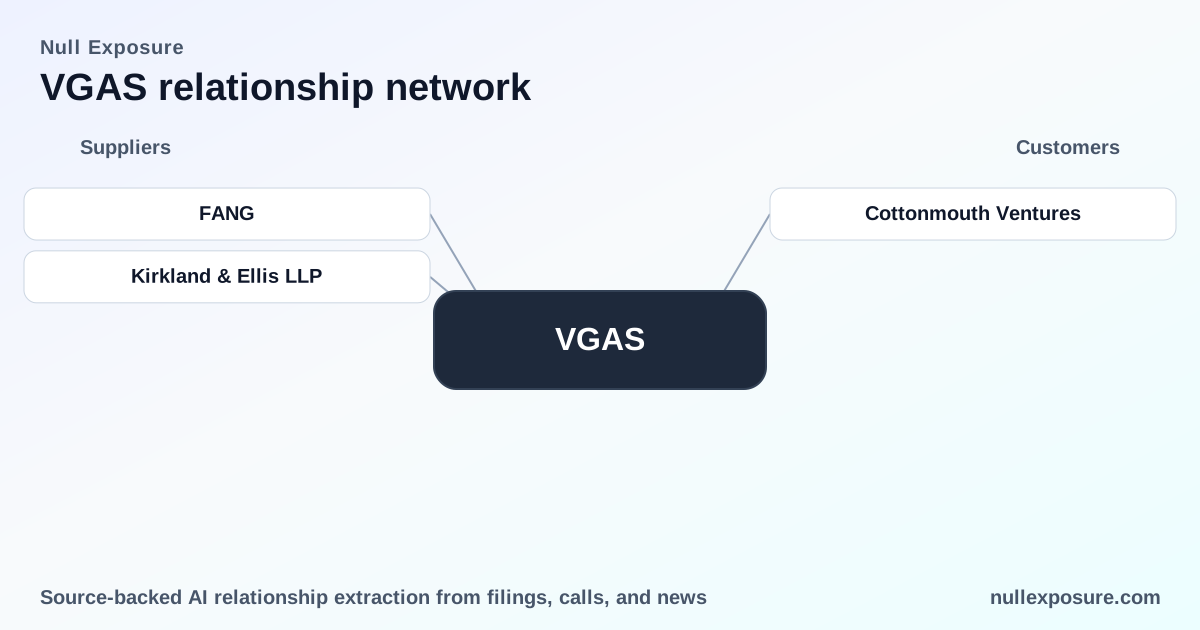
Joint development with Cottonmouth Ventures, LLC — project suspended
Verde entered a joint development agreement with Cottonmouth Ventures, LLC (a subsidiary of Diamondback Energy) to develop a Permian Basin natural gas‑to‑gasoline plant using Verde’s STG+® technology; Verde subsequently suspended development of the Permian project. This relationship was reported in news coverage from Investing.com on May 4, 2026 describing the project suspension and noting Cottonmouth’s role as the counterparty in the joint development agreement. Source: Investing.com, May 4, 2026 — "Verde Clean Fuels suspends Permian Basin project development."
Strategic link to Diamondback Energy, Inc. (FANG) via Cottonmouth
The Permian Basin project was structured with Cottonmouth Ventures as a wholly‑owned subsidiary of Diamondback Energy, linking Verde to Diamondback as the ultimate partner in the joint development arrangement; public reporting identifies Diamondback as the corporate parent associated with the JV. Investing.com coverage on May 4, 2026 references Diamondback’s involvement through its Cottonmouth subsidiary in the STG+® Permian project. Source: Investing.com, May 4, 2026 — reporting on the joint development agreement and subsequent suspension.
Earlier reporting on the Cottonmouth collaboration and market re-evaluation
Press coverage in March 2026 reiterated that Verde entered the Cottonmouth agreement in February 2024 to pursue a Permian natural gas‑to‑gasoline facility, and that subsequent market changes forced a reevaluation of the project’s future. This timeline and the decision to pause development were summarized by Intellectia.ai on March 10, 2026, which described the original 2024 JV and the later reassessment. Source: Intellectia.ai, March 10, 2026 — "Verde suspends development of Permian Basin project amid market changes."
Constraints and company-level operating signals
- International expansion intent (EMEA): Verde explicitly signals intent to expand internationally to regions interested in STG+® such as the European Union and the United Kingdom, and to enter relationships to create service networks for production and delivery. This is a company-level strategic cue indicating geographic ambition beyond North America, useful for assessing long‑term market opportunity and licensing targets.
- Dual relationship roles — buyer and licensor: Verde positions itself both as a participant in physical fuel markets (marketing RBOB to refiners, distributors, blenders, retailers and trading organizations) and as a licensor of technology in markets where Verde will not deploy capital. These excerpts show an operational mix of project development, direct commodity sales, and technology licensing—a contracting posture that diversifies revenue pathways but concentrates execution risk on a small number of large partnerships.
- Implication for contracting posture and maturity: The company’s disclosures portray a project-centric, partnership-dependent contracting posture typical of early commercial-stage energy technology firms rather than of mature downstream fuel merchants. The suspension of the Permian project underscores execution and market-timing risk inherent in converting MOUs and JDAs into operating assets.
How these relationships affect investor risk/reward
- Concentration and counterparty reliance: Verde’s pathway to revenue is concentrated on a limited set of large partners and JV outcomes—Cottonmouth/Diamondback was the flagship industrial partner for the Permian deployment. The suspension of that project demonstrates single-project concentration risk that directly impacts near‑term commercialization.
- Criticality of partnerships to value realization: For Verde, partnerships are not peripheral—they are the primary route to scale. The company’s licensing intent softens capital intensity but increases reliance on the ability to sign credible licensees in EMEA and elsewhere to prove technology economics.
- Execution and market sensitivity: Market movements can rapidly alter project economics for gas-to-liquids builds; the March 2026 and May 2026 reports together show Verde’s projects are sensitive to energy market dynamics, which in turn exposes Verde’s project pipeline to rapid re-evaluation and potential suspension.
Investment implications and key takeaways
- Catalyst-driven upside: Successful reactivation of paused projects or new licensing deals—particularly in EMEA or with integrated oil & gas partners—would materially change Verde’s valuation narrative from speculative IP to revenue-generating operator.
- Near-term downside: Zero reported trailing revenue, negative EBITDA, suspended flagship project, and concentrated insider ownership are clear downside factors; investors should price in execution risk and limited liquidity in the public float.
- Watch list items: Track formal project re-start announcements, signed licensing agreements in EMEA, and any offtake or engineering, procurement and construction (EPC) agreements with major partners. These are the operational readouts that convert Verde’s pipeline into measurable cash flows.
Final assessment Verde Clean Fuels executes a hybrid project development and licensing model built around STG+® technology, and its near-term prospects are closely tied to converting strategic JV and licensing relationships into active projects. The public record shows a high‑profile Permian JV with Cottonmouth (and by extension Diamondback) that has been paused; that development status is the single most relevant datapoint for valuation today. Investors should treat Verde as a partnership-dependent, early-stage renewables player with high upside if commercial deployments resume and substantial downside if partner-driven projects remain stalled.
For a structured, relationship‑level monitoring service and continuous updates on Verde and its counterparties, visit https://nullexposure.com/.