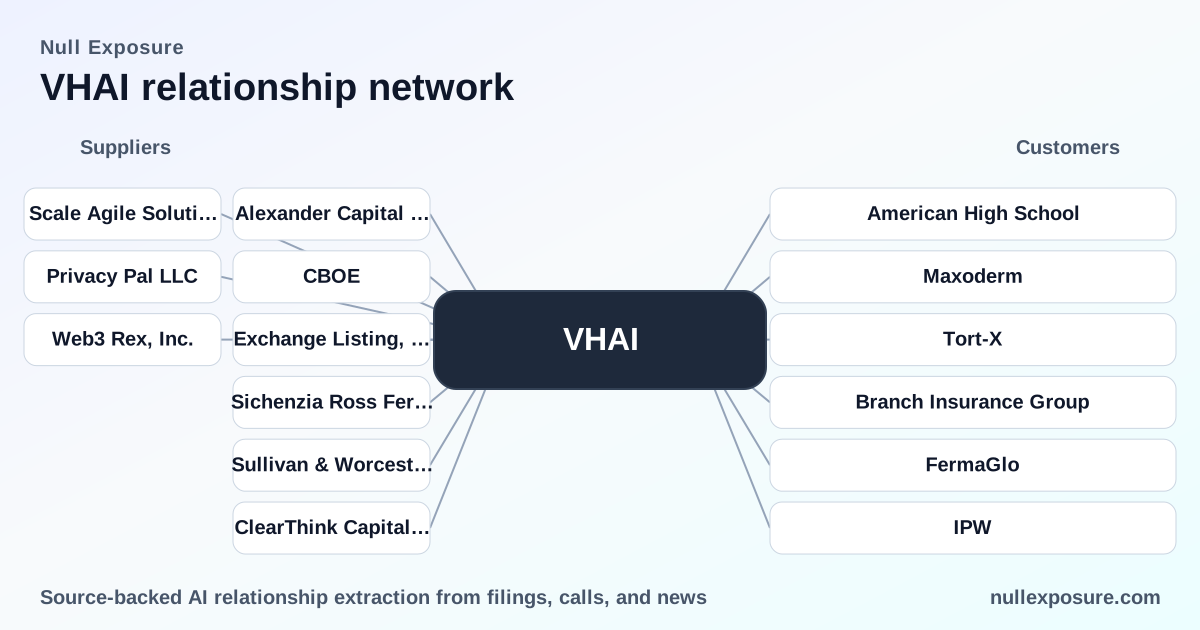
Vocodia Holdings (VHAI) — Customer Relationships and What They Signal to Investors
Vocodia is a conversational-AI provider that monetizes through three channels: recurring SaaS subscriptions, implementation fees, and lead generation/verification services. The company sells its DISA conversational agent into both business call centers and B2C channels, signs 12‑month subscription contracts priced by agent units, and supplements recurring revenue with project and lead‑sales work. For investors, the mix implies a revenue profile driven by small‑unit subscription economics and service upsells, with lead-generation contracts creating an additional, variable revenue stream. Learn more about our coverage at https://nullexposure.com/.
Why the customer list matters right now
Vocodia’s customer and counterparty set reveals a business that is commercializing AI through direct client contracts and strategic asset acquisition. The presence of commercial buyers, a law‑firm lead generation campaign partner, and a capital provider in the same rollcall points to a company balancing product sales with service-driven revenue and active capital markets activity.
- Recurring revenue focus: Contracts are structured on a 12‑month subscription basis with per‑DISA monthly pricing, indicating predictable, unit-based revenue when retention holds.
- Mixed counterparty profile: Evidence supports both individual/B2C use cases and enterprise B2B targets (call centers), which expands addressable markets but complicates sales cadence.
- U.S. concentration: Operations and revenues are primarily U.S.-based, concentrating geopolitical and regulatory exposure domestically.
- Early commercial maturity: The business positions itself as a software and services provider with a diversified pipeline rather than a mature enterprise with large, multi-year enterprise deals.
Key takeaway: Vocodia’s model is subscription-first with services and lead generation bolstering top-line growth, and its customer relationships reflect that hybrid go‑to‑market posture.
A concise, relationship-by-relationship breakdown
Below are every named counterparty in the available results, each summarized in plain English with source attribution.
American High School
Vocodia signed an agreement to integrate its conversational AI into American High School’s online tutoring program to support enrolled students. This partnership was announced in a GlobeNewswire release in FY2024 and positions Vocodia in digital education applications beyond traditional sales call centers. (GlobeNewswire, FY2024)
ClearThink Capital Partners, LLC
ClearThink entered a Standby Equity Purchase Agreement with Vocodia that allows the company to sell up to $25 million of Class A common stock under specified conditions. The financing arrangement was disclosed in October 2025 and represents a liquidity/financing counterparty rather than a product customer. (The Globe and Mail / TipRanks coverage, FY2025)
Maxoderm
After evaluating multiple AI platforms, Maxoderm selected Vocodia for deployment in real‑world sales environments, citing proven performance. The commercial win was reported in FY2025 and highlights Vocodia’s traction selling DISA into sales enablement use cases. (Yahoo Finance, FY2025)
Tort‑X
Vocodia partnered in an AI‑driven motor vehicle accident (MVA) lead generation campaign where Tort‑X is the buyer and Scale Agile Solutions is the seller, focused on delivering highly qualified leads for law firms. The campaign launched in FY2025 and demonstrates Vocodia’s role in lead generation and verification services for legal verticals. (GlobeNewswire, FY2025)
Branch Insurance Group
Branch Insurance Group is listed among clients tied to assets Vocodia proposed to acquire from Scale Agile Solutions, indicating an existing commercial relationship with the SAS platform that Vocodia targets for integration. The LOI narrative in FY2025 names Branch Insurance among SAS’s client base that would transition under the asset acquisition. (GlobeNewswire, FY2025)
FermaGlo
FermaGlo appears in the roster of commercial contracts associated with Scale Agile Solutions’ asset package that Vocodia intends to acquire; the LOI indicates FermaGlo is a source of ARR for the SAS business being purchased. This was disclosed in the October 2025 LOI materials. (GlobeNewswire, FY2025)
iPower (IPW)
iPower is identified as a commercial customer within the SAS asset base Vocodia plans to acquire, and the LOI values SAS assets while listing iPower as a contract reference; the security ticker referenced is IPW. The inclusion of iPower in the asset purchase narrative signals contracted revenue that Vocodia expects to fold into its revenue mix post‑close. (GlobeNewswire, FY2025)
IPW (duplicate entry)
A second entry labeled IPW reiterates the same contractual connection within the SAS asset purchase LOI; the transaction values SAS assets at approximately $10.5 million and cites SAS ARR of $697,000 with a $1.5 million pipeline. This documentation was published in FY2025 as part of Vocodia’s LOI announcement and provides explicit figures for the SAS business being acquired. (GlobeNewswire, FY2025)
What the constraints tell investors about operating posture
Treat the following as company‑level operational signals. They are not tied to any single counterparty unless explicitly named in the source material.
- Contracting posture — subscription oriented. Vocodia offers 12‑month contract terms and charges per‑DISA monthly fees (a disclosed example: $1,495 per DISA per month), pointing to unit economics and churn sensitivity rather than one‑off project revenue as the primary revenue engine.
- Revenue mix — software plus services. Management discloses three revenue streams: implementation fees, recurring SaaS, and lead generation/verification, confirming a hybrid software + services commercial model.
- Counterparty types — broad set. The company targets both individual/B2C and large enterprise buyers (call centers and phone market enterprises), which expands addressable market but requires distinct sales motions.
- Geographic concentration — North America. The company reports primary operations and substantially all revenue in the United States, concentrating market risk domestically.
- Relationship role — provider and seller. Vocodia positions itself as the service provider/seller of conversational AI solutions and lead products.
- Commercial stage — pipeline driven. Management references a diversified pipeline, consistent with a company in early commercial expansion that relies on pipeline conversion to scale ARR.
Investment implications and primary risks
Vocodia’s commercial footprint shows product traction in niche verticals (education, legal leads, insurance-related contracts) and a clear subscription backbone that supports recurring revenue growth if retention remains high. However, investors must weigh several risks:
- Revenue concentration and integration risk tied to the planned SAS asset acquisition and the conversion of those clients into Vocodia’s platform.
- Churn sensitivity given per‑agent pricing and 12‑month contract terms; small unit economies require scale to amortize acquisition costs.
- U.S. concentration exposes the business to domestic regulatory and market fluctuations.
Bottom line: Vocodia is executing a subscription-first commercialization while augmenting growth with targeted acquisitions and lead-generation partnerships. The customer list validates the strategy but also highlights integration and concentration risks investors should monitor. For more signal coverage and relationship analytics, visit https://nullexposure.com/.