VHAI-WS-A: Customer Relationships and Commercial Signals for Investors
Vocodia (ticker VHAI-WS-A) sells AI-driven voice contact solutions to brands and monetizes through direct deployments that replace or augment human call-centers, capturing revenue via per-call or per-outcome pricing and platform licensing. Revenue is driven by per-interaction economics and by proof points that demonstrate higher revenue per call versus legacy human centers, which creates a scalable value proposition for customer acquisition and upsell. For investors evaluating customer traction and commercial risk, the available customer evidence is limited but directionally positive for early commercial adoption. Learn more about how this analysis is assembled at https://nullexposure.com/.
What the public record actually shows about customers
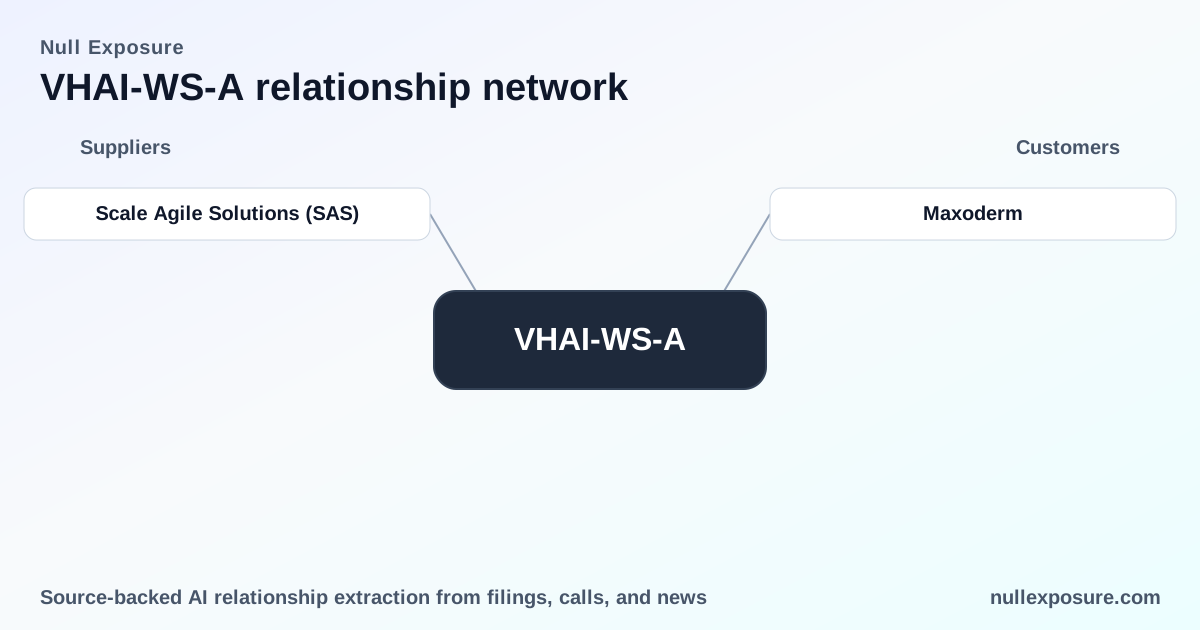
Public evidence for VHAI-WS-A’s customer relationships is narrow in scope. The dataset returned a single named customer engagement: Maxoderm, a men’s wellness brand. The reporting is concise and focused on performance versus a human call center rather than on contract length, revenue contribution, or geographic reach. That profile is typical for early commercial AI vendors that sell outcome-focused conversions rather than long-term enterprise agreements.
Maxoderm — a commercial deployment with a performance claim
Vocodia deployed its AI-driven voice agents for Maxoderm, and the engagement delivered higher revenue per call than an American-based human call center, according to a StockTitan overview dated March 10, 2026 describing activity in FY2025. The report frames this as a representative use-case highlighting unit economics rather than a disclosure of contract size or exclusivity (StockTitan, March 10, 2026).
How each documented relationship maps to commercial signals
- Maxoderm: Vocodia’s digital agents were implemented for a men’s wellness brand and generated higher revenue per call than a U.S. human call center, suggesting the product competes on conversion and monetization efficiency rather than simply cost reduction; reported in a StockTitan news overview covering FY2025 (StockTitan, March 10, 2026).
This single-record footprint indicates early commercial validation through outcome-based wins rather than an installed base of large, recurring enterprise contracts.
Operating model and business-model characteristics investors should watch
Given the available evidence, construct the commercial profile of VHAI-WS-A as follows. These are company-level signals derived from the public customer evidence rather than from contract text.
- Contracting posture — outcome-focused, transactional: The public example emphasizes revenue per call, signaling commercial propositions that are measured and priced at the interaction level. This points to shorter sales cycles with proof-of-value pilots leading to scaled deployments when metrics improve.
- Concentration — currently low visibility, likely concentrated: With only a single named customer disclosed in public reporting, investor exposure should be treated as concentrated until additional client wins or multi-year enterprise agreements are disclosed.
- Criticality to customers — moderate to high for revenue-sensitive lines: Delivering higher revenue per call positions Vocodia as revenue-enhancing rather than purely cost-saving, increasing the criticality of the solution to customer P&L in direct-response or direct-to-consumer channels.
- Commercial maturity — early commercial / growth phase: The evidence reads as early commercial validation (single-case performance reporting) rather than broad deployment across categories or geographies. Expect the company to be focused on case studies, conversions, and expanding proof points into repeatable commercial contracts.
- Data and disclosure posture — transactional reporting, limited public disclosure: The public narrative emphasizes unit economics but omits contract duration, ARPU, churn, and revenue share. Investors must rely on follow-on filings or new press activity for confirmation of scale.
Investment implications: what this means for valuation and diligence
The Maxoderm engagement constructs a narrative that is attractive to growth investors: a product that demonstrably increases revenue per call is intrinsically monetizable and defensible because customers will pay for proven incremental revenue. However, the single-public-engagement picture raises concentration and scalability questions that are material to valuation.
Key investment considerations:
- Proof-of-value is present but not scale: One case showing superior revenue per call validates the unit economics but does not quantify recurring revenue or breadth of demand.
- Concentration risk is real until additional customers are disclosed: A single named customer in public filings increases sensitivity to churn or one-off arrangements.
- Commercial model favors fast payback: Outcome-based pricing tied to revenue per call accelerates ROI for customers and supports rapid adoption when conversion lifts are repeatable.
- Due diligence priorities: Request contract-level detail on term length, minimum commitments, pricing formula, churn history, and references that confirm deployment scope across channels and geographies.
For investors who require systematic verification, this is the moment to press for customer-level KPIs that turn case-study claims into reliably recurring revenue streams.
Constraints, disclosure gaps, and next steps for research
The available search returned no explicit contractual constraints, exclusivity clauses, or limitation notices. Presently there are no constraints listed in the public results returned for customer relationships, which itself is a signal: the company’s public communications emphasize outcome claims over legal or contract-level disclosures. Investors should treat this as a governance and disclosure gap and request supplementary information.
- Company-level signal: Absence of disclosed constraints suggests either standard commercial contracts without regulatory encumbrances or limited public disclosure practice; confirm via direct diligence.
- Actionable request list for management: provide a sample non-sensitive statement of typical contract terms, concentration metrics (top-10 customers and percentage of revenue), and examples of renewal rates for outcome-based agreements.
If you want more systematic tracking of VHAI-WS-A’s customer traction and commercial disclosures, additional investigative follow-up is available through our platform at https://nullexposure.com/.
Bottom line: a performance claim that requires scale proof
Vocodia’s public customer evidence shows an actionable commercial advantage—higher revenue per call versus a human call center—that justifies investor interest. The critical next step for any rigorous investment thesis is to convert that single case into a portfolio of replicable, recurring contracts. Until management provides broader disclosure on contract terms, customer concentration, and renewal dynamics, valuation must account for execution and concentration risk alongside the attractive unit economics.
For hands-on investor due diligence and ongoing monitoring of customer-level disclosures, visit https://nullexposure.com/ for tools and curated updates.