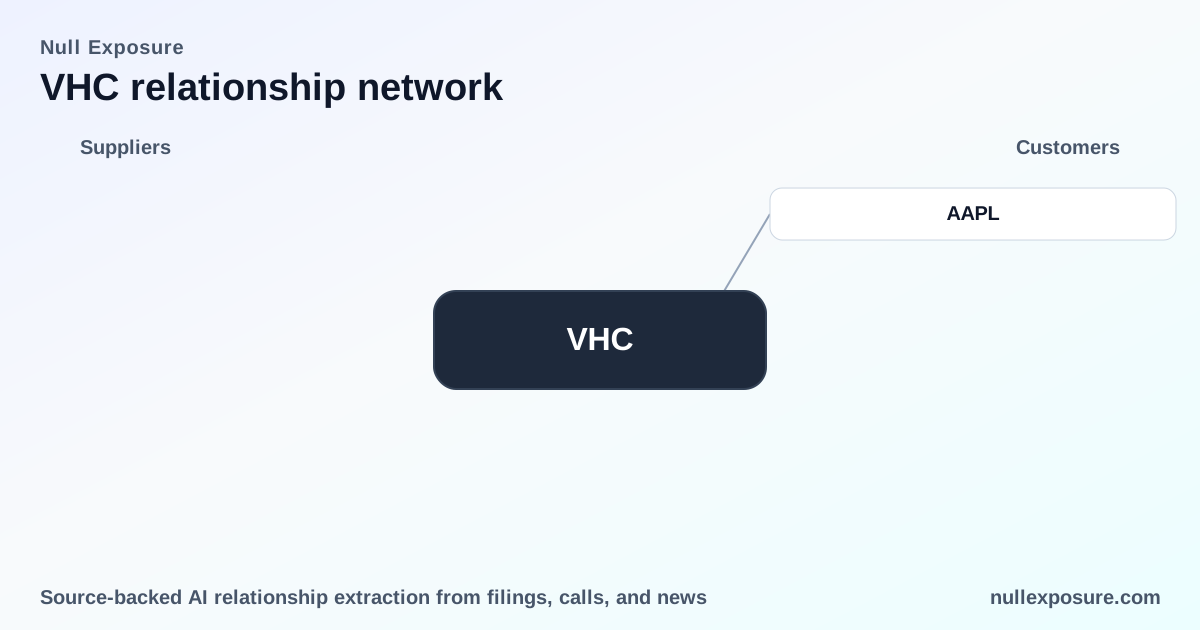
VirnetX (VHC): Customer Relationships — government contracts, defense subcontracts, and legacy licensing revenue
VirnetX monetizes a mix of patent licensing and software sales, supplemented recently by federal contracting which grants easier procurement access for its cybersecurity products. The company generates revenue as a licensor to OEMs, a seller of ZTNA/security software, and now as an approved GSA Schedule vendor, while continuing to draw historical royalties from large technology counterparts. For relationship intelligence and counterparty tracking, see https://nullexposure.com/.
Quick read: the relationships that drive revenue and access
VirnetX’s public footprint shows three classes of counterparty: federal government procurement (GSA), defense research subcontracting (Air Force Research Laboratory), and a long-running licensing/royalty history with major tech firms (Apple). Each relationship has different contract economics and strategic implications for investors.
Disclosed counterparties — what to know
General Services Administration (GSA)
VirnetX has been awarded a GSA Multiple Award Schedule contract, which positions the company to sell cybersecurity and related solutions directly into the federal market and simplifies procurement for U.S. government buyers. This is reported in multiple outlets, including GuruFocus (May 4, 2026) and TradingView coverage of the October 16, 2025 award (see https://www.gurufocus.com/news/3147341/virnetx-vhc-secures-gsa-contract-for-government-tech-services and https://www.tradingview.com/news/tradingview:b418b1a3cbb8f:0-virnetx-holding-corp-awarded-gsa-schedule-contract/).
Why it matters: GSA access transforms sales motion from one-off procurements to cataloged, repeatable federal opportunities and increases the addressable market for VirnetX’s War Room™, Matrix™, and managed ZTNA offerings.
Air Force Research Laboratory
VirnetX’s revenue base includes Department of Defense subcontract work with the Air Force Research Laboratory, indicating direct participation in defense R&D or integration projects, as noted in TradingView coverage summarizing FY2026 drivers (https://www.tradingview.com/news/tradingview:61a5fb7d5611b:0-virnetx-holding-2025-10-k-revenue-0-162m-eps-5-00/).
Why it matters: Defense subcontracting implies program-level relationships and technical integration requirements that can create multi-year revenue tails and higher barriers to entry for competitors, while also tying part of VirnetX’s topline to government budget cycles.
Apple Inc. (historical licensing and litigation context)
VirnetX has a well-documented, decade-long licensing and litigation history with Apple around secure communications technology used in FaceTime and VPN functionality; the LA Times chronicled those disputes and royalty claims in 2020 (https://www.latimes.com/business/technology/story/2020-02-24/apple-rebuffed-supreme-court-billion-facetime-patent).
Why it matters: The Apple relationship illustrates VirnetX’s historic business model as a patent licensor generating royalties from large OEMs; while direct current royalty flows are small relative to market cap, the presence of legacy licensing revenue and enforcement posture remains a strategic asset and risk driver.
What the disclosed relationships imply about VirnetX’s operating model
- Contracting posture — licensing-first, now procurement-enabled. The company’s stated business mix combines patent licensing with software product sales; recent GSA accreditation signals a shift toward recurring contract sales to government buyers rather than one-off settlements alone.
- Counterparty concentration and profile. Public signals show emphasis on government and large-enterprise customers, including defense agencies, which increases revenue concentration risk but raises per-customer contract value and stickiness.
- Roles and revenue mechanics. VirnetX operates simultaneously as licensor, licensee, manufacturer partner (through OEM licensing), and seller of software — a hybrid model that spreads revenue across royalties, licensing fees, and product sales.
- Market geography and maturity. The company positions its products globally, but the current disclosed wins and subcontract pipelines emphasize U.S. federal and defense demand as the near-term revenue driver.
- Relationship stage. Disclosed evidence supports active commercial and contractual relationships rather than purely contingent or speculative ties.
These characteristics derive from company filings and public disclosures describing licensing agreements, product lines (VirnetX War Room™, Matrix™, VirnetX One™), and statements on government sales channels.
Risk and concentration — what investors should watch
- Revenue scale and visibility remain limited. VirnetX’s trailing revenues are small in absolute terms, while operating losses and balance sheet metrics emphasize that contract wins must scale to materially change cash flow dynamics.
- Dependence on government procurement cycles. GSA listing and defense subcontracts increase addressable demand but tie performance to federal budgets and procurement timing — a source of predictability when programs scale, but of volatility during appropriations or program reprioritization.
- Licensing/legal legacy can be both asset and distraction. Past litigation and royalty enforcement (e.g., with Apple) show the company can extract value from IP, but litigation outcomes are timing- and cost-intensive and can distort management focus.
How these relationships translate to investment opportunity
- Upside thesis: GSA schedule access plus active DoD subcontracts create a pathway from one-off licensing and legal settlements toward repeatable, contract-based software revenue into federal accounts — a higher-margin, higher-visibility route if VirnetX converts pipeline to backlog. For deeper relationship analytics, visit https://nullexposure.com/.
- Downside thesis: Small revenue base and heavy reliance on a few government/large-enterprise relationships and legacy licensing outcomes concentrate execution risk; failure to convert or renew contracts will pressure cash flow and magnify valuation volatility.
Bottom line for investors
VirnetX is a specialized security-software and IP-licensing firm transitioning toward government procurement channels. The GSA award and DoD subcontract activity materially change the company’s go-to-market posture and improve access to federal budgets, but the firm’s valuation remains sensitive to contract conversion and the continuation of license-derived cash flows. Investors should track contract scopes, award values, and integration milestones closely to separate headline wins from revenue-backed growth.
For ongoing tracking of counterparties, contract types, and relationship staging, explore the relationship intelligence resources at https://nullexposure.com/.