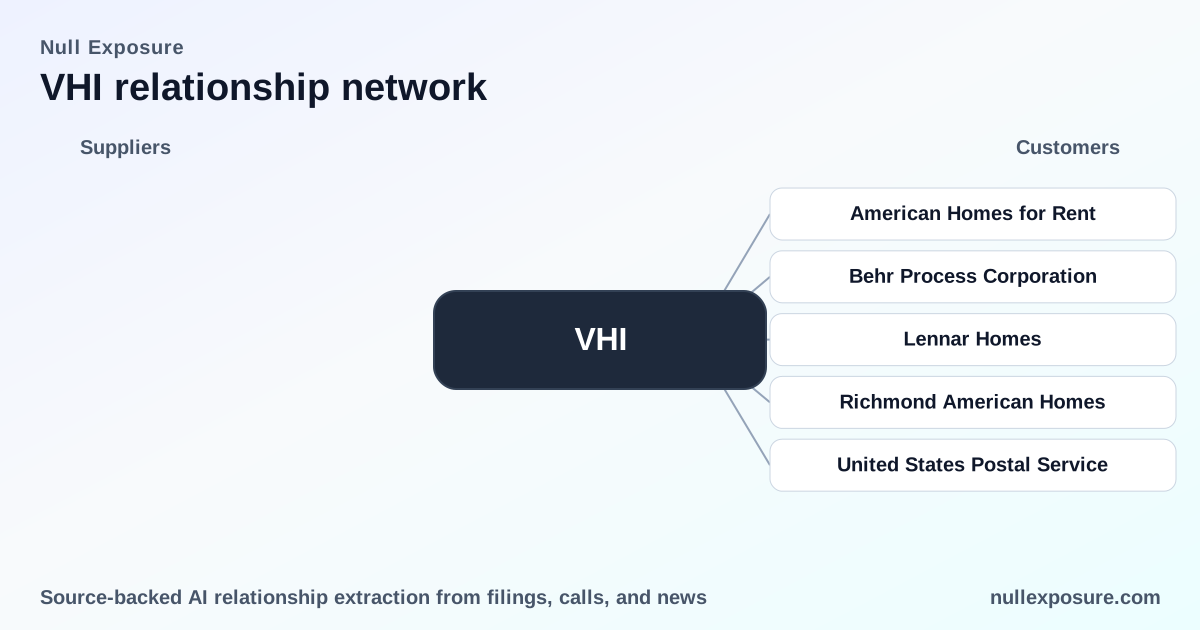
Valhi Inc (VHI): Customer map that underpins manufacturing scale and land-sale volatility
Valhi monetizes through three distinct channels: industrial chemicals (Kronos TiO2 pigment manufacturing), component products (CompX security and hardware), and real estate development and land sales (BMI/LandWell). Revenue derives from ongoing specialty-chemicals contracts and sales to distributors and manufacturers, from recurring component-product customers, and from episodic land sales to large homebuilders — a mix that produces steady industrial cashflow alongside lumpy real-estate proceeds. For a concise company-level analysis and tracking of counterparties, see https://nullexposure.com/.
Why the customer roster matters for investors
Valhi’s customer relationships reveal a hybrid operating model: manufacturing scale with industrial concentration plus cyclical, transaction-driven real-estate counterparties. The Chemicals segment (run primarily through majority-owned Kronos) sells TiO2 into coatings, plastics and specialty applications across roughly 3,000 customers in about 100 countries, with the top ten customers growing from 33% of segment sales in 2022 to 39% in 2024, signaling an increasing concentration among major buyers (Valhi 2024 Form 10‑K). Kronos’ product — titanium dioxide — is a critical input for coatings, plastics, paper and consumer specialties, which elevates the strategic importance of its customer links and raises switching-cost implications for both supplier and buyer.
At the same time, the Real Estate Management and Development segment generates material revenue through discrete land-sale transactions to a small set of large homebuilders, producing lumpy cashflow that amplifies quarterly and annual headline volatility. The Component Products segment sells into niche industrial and institutional markets where single large customers can represent a material share of sales.
Key company-level operating characteristics:
- Global sales footprint with meaningful concentration in North America and Europe, and meaningful activity in Asia Pacific. Valhi reports Kronos’ majority sales in Europe, North America and the Asia Pacific region (10‑K, FY2024).
- Concentration risk in Chemicals: top ten customers account for ~39% of Chemicals net sales in 2024 (company filing).
- Critical product exposure: TiO2 is essential for many downstream industries, making these customer relationships high-impact for revenue stability.
- Mixed maturity and cadence: manufacturing businesses provide recurring demand; land sales are transaction-driven and cyclical.
- Distribution channels: Kronos uses direct sales plus agents/distributors, which moderates single-buyer dependency but introduces channel risk.
For an actionable view of counterparties and where value and risk concentrate, visit https://nullexposure.com/.
Five customer relationships that move the needle
Lennar Homes — major buyer in land-sales program
Lennar accounted for 23% of Real Estate Management and Development segment net sales in 2024, driven by land purchases rather than recurring services, making Lennar a major determinant of that segment’s annual revenue profile. According to Valhi’s 2024 Form 10‑K, those sales are recorded as land dispositions in the real-estate segment (Valhi 10‑K, FY2024).
Richmond American Homes — sizable real-estate counterparty
Richmond American Homes represented 16% of the Real Estate Management and Development segment’s net sales in 2024, placing it among the three builders that collectively dominated land-sale revenue for the year. Valhi disclosed this concentration in its FY2024 10‑K.
American Homes for Rent — institutional land buyer
American Homes for Rent made up 14% of the real-estate segment’s net sales in 2024, indicating that institutional single-family rental operators are material customers for Valhi’s land assets. The FY2024 Form 10‑K identifies this buyer as part of the trio responsible for over half of the segment’s net sales from land dispositions.
Behr Process Corporation — significant Chemicals customer
Behr Process Corporation represented 10% of Kronos’ Chemicals segment net sales in 2024, marking Behr as a top-ten customer in a segment where the top tier captured a rising share of revenue. Valhi’s 2024 Form 10‑K lists Behr as the lone Chemicals customer at or above the 10% threshold for that year.
United States Postal Service — concentrated Component Products buyer
The United States Postal Service accounted for 21% of the Component Products segment’s sales in 2024, making USPS a single, material buyer for CompX’s security and postal-related products. Valhi reported this in its FY2024 10‑K, identifying USPS as the only Component Products customer exceeding the 10% level that year.
How these counterparties affect valuation, risk and optionality
The customer mix creates a dual set of investment considerations. On one side, Kronos provides scale, recurring industrial demand and margin leverage tied to global TiO2 markets; on the other, real-estate revenue is lumpy and concentrated among a few large homebuilders, which introduces headline risk and earnings variability. The Chemicals segment’s increasing top-ten concentration (33% → 35% → 39%) signals both the benefit of larger, stable off-take contracts and the risk that any major buyer slowdown compresses volumes or pricing power.
Operational and contracting posture observations:
- Valhi functions primarily as a manufacturer/seller in Chemicals and Components and as a land seller/operator in real estate; Kronos runs a mixed direct/distributor channel that blunts but does not eliminate counterparty concentration.
- Criticality of TiO2 elevates customer retention value and reduces pure price elasticity in some end markets, but downstream cyclicality (construction, automotive, durable goods) transmits demand swings.
- The Component Products segment’s reliance on a major institutional buyer like USPS concentrates counterparty risk for that line of business and warrants monitoring of contract renewals or procurement changes.
Investment implications and monitoring checklist
- Track quarterly disclosures for land-sale timing and counterparties; the real-estate segment’s cashflow profile hinges on the cadence of transactions with large builders such as Lennar, Richmond American and American Homes for Rent.
- Monitor Kronos customer concentration and pricing dynamics, particularly the top-ten list and any loss or gain of large accounts like Behr.
- Watch procurement decisions at large institutional buyers in the Component Products segment (e.g., USPS) for contract renewals or competitive shifts that could materially affect segment sales.
- Evaluate macro indicators for coatings/plastics demand and North American housing activity to anticipate cyclical swings in TiO2 and land-sale volumes.
Valhi’s customer relationships present a blend of industrial durability and cyclically exposed cashflow. For a clean, investor-oriented map of counterparty exposure and to track updates to these relationships, visit the Valhi customer hub at https://nullexposure.com/.