VenHub Global (VHUB): Customer Partnerships Turn Smart‑Store Pilots into a Commercial Rollout
VenHub Global designs and deploys AI‑powered autonomous retail stores and monetizes through retail sales, hardware deployments and commercial partnerships with venue operators that grant access to high‑traffic customer flows. Recent agreements with transit and hospitality operators position VenHub to scale kiosks and unattended stores into venues where footfall converts directly into revenue and recurring integration fees.
For a closer operational read and relationship mapping, visit https://nullexposure.com/ for strategic intelligence and ongoing monitoring.
Why these customer wins matter to investors
VenHub is an early‑stage operator converting technology into revenue via physical retail footprints. Partnering with large venue owners accelerates distribution while transferring customer acquisition responsibility to the venue, reducing VenHub’s need to build retail traffic from scratch. Given the company’s small revenue base and negative EBITDA, these partnerships are a critical pathway to scale—but they also create concentration and execution risk that investors must weigh.
Relationship breakdown: who VenHub is working with today
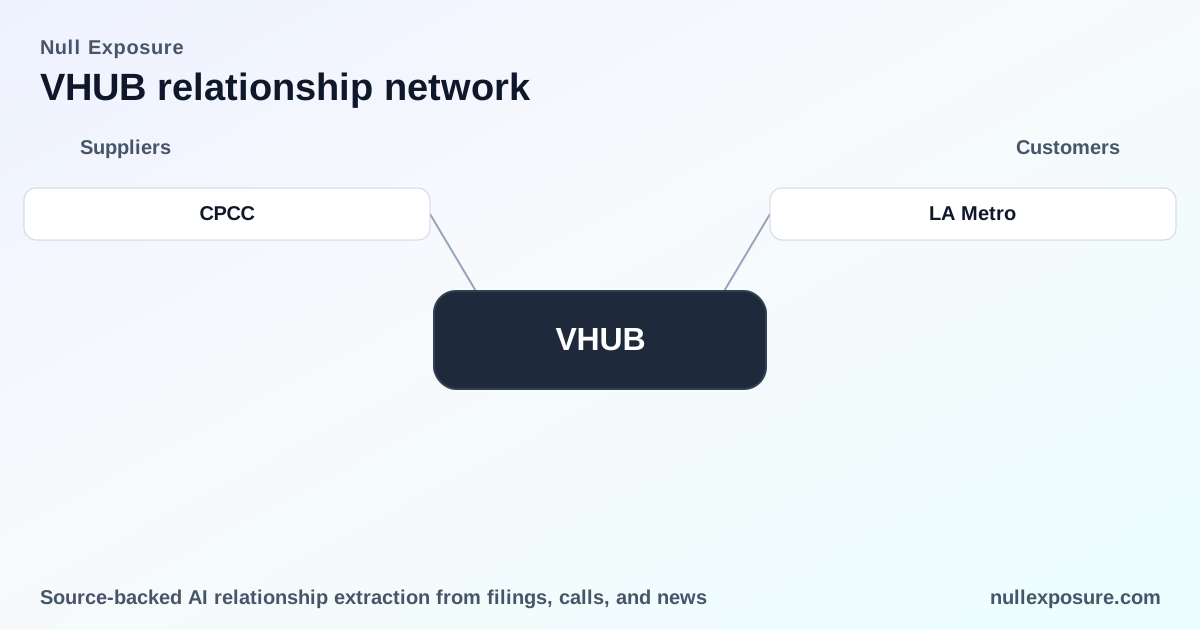
LA Metro — transit deployment at LAX and Union Station
VenHub has deployed an AI‑powered, 24/7 smart store within the Metro transit environment to serve travelers at LAX and is expanding into additional Southern California transit locations. According to RetailCustomerExperience (March 10, 2026) and a VenHub news release (March 2026), the LA Metro installations are being positioned to handle demands from major future events including the 2026 FIFA World Cup and the 2028 Olympics, and additional locations are planned across Southern California. (RetailCustomerExperience, Mar 10, 2026; NewsfileCorp/GlobeNewswire releases, Mar 2026 — https://www.retailcustomerexperience.com/news/venhub-opens-ai-powered-smart-store-at-laxmetro-transit-center/)
Circa Resort & Casino — flagship Las Vegas hospitality rollout
VenHub and Circa Resort & Casino launched what both parties call an autonomous, 24‑hour smart store on Circa’s Las Vegas campus, described in press coverage as a high‑visibility, advanced unattended retail installation tailored for leisure environments. VendingTimes and multiple VenHub press releases describe this as a marquee deployment intended to demonstrate scale, security and dynamic merchandising in a demanding, high‑traffic leisure setting. (VendingTimes, May 4, 2026; VenHub GlobeNewswire releases, Mar–May 2026 — https://www.vendingtimes.com/articles/autonomous-retail-concept-scales-up-at-circa-resort/)
Los Angeles Union Station — strategic central‑city location
VenHub has opened an autonomous store at Los Angeles Union Station, one of the nation’s largest and most iconic transportation hubs, giving the company exposure to long‑dwell commuters and intercity travelers. Chain Store Age and VenHub commentary place this deployment as part of the company’s strategy to place smart stores in marquee transportation hubs. (ChainStoreAge, 2026 — https://chainstoreage.com/first-its-kind-autonomous-store-open-las-vegas)
What these relationships reveal about VenHub’s operating model
- Contracting posture: VenHub’s go‑to‑market relies on partnership contracts with venue owners rather than opening standalone retail locations; this shifts commercial negotiations toward B2B venue deals and away from independent store economics.
- Concentration and customer risk: The current customer base is concentrated in a few marquee venue partners. That concentration accelerates visibility and trial results but creates revenue volatility if any partner reduces deployments.
- Criticality of deployments: Installations in transit hubs and major casinos are operationally critical—they require robust security, continuous operations and integration with venue systems (payments, footfall analytics). These site characteristics increase technical and service demands versus simple kiosk rollouts.
- Maturity signal: Company financials show low revenue (TTM ~$0.86M) and negative EBITDA, consistent with an early commercial stage relying on pilot conversions to drive scale. The balance of insider ownership and limited institutional holdings suggests founder‑led control during growth. These are company‑level signals rather than tied to any one customer.
Investment implications — upside and risk
VenHub’s customer strategy generates a clear upside: rapid access to dense customer flows without the incremental cost of building traffic, and the potential to monetize both product margins and recurring technology/service fees. The Circa and LA Metro relationships function as high‑visibility proofs of concept that can accelerate enterprise integrations.
Key risks include:
- Execution risk in scaling hardware, installation cadence and site reliability across multiple venues.
- Concentration risk from early reliance on a small number of large partners.
- Capital and margin pressure given the company’s negative EBITDA, modest revenue base and extremely high valuation multiples (Price/Sales ~72.99; EV/Revenue ~80.38), which position VHUB as a speculative growth play.
Read this as a strategic inflection point
The recent venue agreements are not incremental marketing wins; they are the pathway VenHub needs to validate a recurring, venue‑centric business model and to show operational robustness at scale. Investors should watch: (1) conversion of pilots into multi‑site contracts, (2) unit economics per store, and (3) cadence of new venue rollouts.
For a full relationship map and to track future customer developments in real time, explore our company intelligence hub at https://nullexposure.com/.
Bottom line
VenHub is converting smart‑store technology into commercial deployments by partnering with high‑traffic venue operators. If the company proves repeatable economics across venues like LA Metro and Circa, upside is substantial; if pilots stall or concentration persists, downside is material. Investors evaluating VHUB should price in execution complexity, near‑term capital needs and the binary nature of scaling from pilots to network revenue.