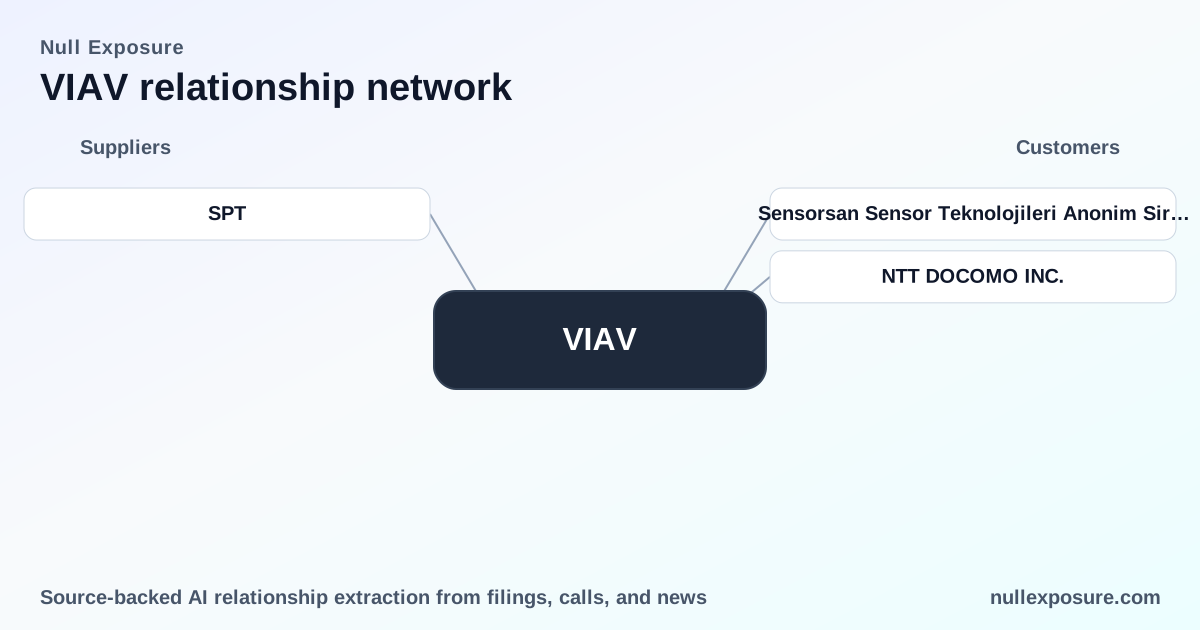
Viavi Solutions: customer footprint that underwrites testing and secure-communications revenue
Viavi Solutions builds and sells network test, monitoring and assurance equipment, perpetual software licenses, and related services to telecom carriers, network equipment vendors, government and defense customers, and enterprise operators. The company monetizes through hardware and software sales, professional services, and volume manufacturing in its Optical Security and Performance (OSP) business, with a notable concentration in a single OSP customer that contributes more than 10% of revenue. Investors should view new partner integrations and telecom demonstrations as product-extension plays that increase addressable markets while the company’s customer mix and contract types create both concentration and mission-critical revenue characteristics.
Visit https://nullexposure.com/ for more on customer-driven risk signals and relationship analytics.
What the public record shows about named customers and partners
Below are the customer and partner relationships surfaced in filings and press coverage, with a concise plain-English description and source reference for each entry.
Sensorsan Sensor Teknolojileri Anonim Sirketi
Viavi recorded direct product sales of $1.8 million to Sensorsan in fiscal 2025 and carried $1.4 million in accounts receivable related to those sales, indicating a meaningful single-year commercial transaction with receivable exposure in that period. According to Viavi’s FY2025 Form 10‑K, those amounts reflect recognized revenue and outstanding receivables in the fiscal year ended June 28, 2025 (viav-2025-06-28).
Ground Control
Viavi entered a partnership to integrate its Secure µPNT STL-1000 receiver into Ground Control’s RockFLEET Assured maritime tracking and navigation solution, targeting GNSS-denied maritime environments and assured asset tracking; the collaboration positions Viavi in maritime edge and assured-navigation use cases. This integration was announced in Viavi’s press release and widely reported (PR Newswire, April 2026), with secondary coverage in industry outlets such as Engineering.com and Investing.com (April–May 2026).
NTT DOCOMO INC.
NTT DOCOMO and Viavi collaborated on a demonstration of DOCOMO’s Self-awareness Network concept using Viavi’s digital twin and the TeraVM AI RAN Scenario Generator, showcasing Viavi’s test and simulation capabilities in AI-driven network control scenarios for a major carrier. The demonstration was covered in news items reporting the DOCOMO evaluation of Viavi’s network simulator (StockTitan news coverage, March 2026).
QNu Labs
Viavi’s MAP‑300 platform was used in a study to assess the real‑world readiness of QNu Labs’ ARMOS Quantum Key Distribution solution, underlining Viavi’s role as a validation and test partner for next‑generation cryptographic and quantum-safe communications products. The assessment and use of Viavi’s MAP-300 platform were noted in a thematic industry piece on quantum readiness (The Quantum Insider, April 2026).
How these relationships map to Viavi’s operating model and commercial posture
The relationships above reinforce several company-level operating characteristics that investors should internalize:
-
Contracting and revenue mix: Viavi sells hardware, perpetual software licenses, and product-related services, which creates a mix of one-time product revenue and higher-margin services; licensing and perpetual software are explicit elements of the product portfolio. This contracting posture produces lumpy revenue recognition around product shipments and project milestones while supporting aftermarket services and support revenue.
-
Customer types and criticality: The company’s customers include large enterprises and government/defense entities, reflecting a commercial posture oriented to mission‑critical networks and regulated buyers. Products are deployed in telecom cores, critical infrastructure and defense contexts, raising the criticality of select engagements and the stickiness of support contracts.
-
Global go‑to‑market with regional revenue assignment: Viavi reports operations across Americas (North America), EMEA and Asia‑Pacific, and it sells into South America — supporting a genuinely global footprint that exposes the company to regional cycles and cross‑border sales complexity.
-
Concentration risk and material accounts: The OSP segment shows customer concentration, with a single OSP customer accounting for more than 10% of total net revenue in FY2023–FY2025. That is a company-level materiality signal that elevates supplier and counterparty risk relative to more diversified peers.
-
Product and go-to-market maturity: Viavi’s portfolio spans manufacturing (OSP), hardware instrumentation, perpetual software, and services, indicating mature product lines (optical coatings, test instruments) combined with growing platform plays (secure PNT and network simulation). Manufacturing capabilities support volume production and proprietary hardware margins; software and services push toward recurring revenue opportunities.
Investment implications — risks and sources of upside
Viavi’s relationships show both structural strengths and clear concentration risks:
-
Upside factors:
- Strategic integrations (Ground Control) and validation partnerships (QNu Labs) expand Viavi’s addressable markets into secure PNT for maritime, quantum-safe communications testing, and GNSS-denied navigation — high-growth, high-value niches with limited competition.
- Carrier engagements such as the NTT DOCOMO demonstration validate Viavi’s role in advanced network automation and AI-driven testing, supporting premium pricing for complex test suites.
-
Risks:
- Revenue concentration in the OSP segment produces earnings volatility if major customers slow purchases or switch suppliers.
- Much of revenue remains transactional (hardware and perpetual licenses), which pressures organic recurring revenue growth and increases sensitivity to telecom capex cycles and defense procurement timing.
- Global sales exposure introduces geopolitical and regional demand risk, particularly across APAC, EMEA and LATAM.
Key investor signal: partnering enables entry into adjacent, defense-grade and maritime markets, but customer concentration and lumpy hardware sales keep headline risk elevated.
Bottom line and recommended diligence steps
Viavi is a mature test-and-assurance vendor that monetizes through hardware, perpetual software licensing, manufacturing and services, with new partnerships extending the company into secure navigation and quantum-readiness validation. Investors should monitor: (1) OSP customer concentration trends and any signs of revenue leakage; (2) cadence of repeat orders versus one-off project revenue; and (3) commercial traction from new integrations like Ground Control and QNu Labs that can convert into recurring service or platform revenue.
For a structured view of customer relationships, materiality and contract-type signals across suppliers and partners, see further analysis at https://nullexposure.com/.
Overall: strength in product breadth and defense/telecom grade positioning, tempered by concentration and transactional revenue mix — partnerships are promising routes to recurring, higher‑value use cases.