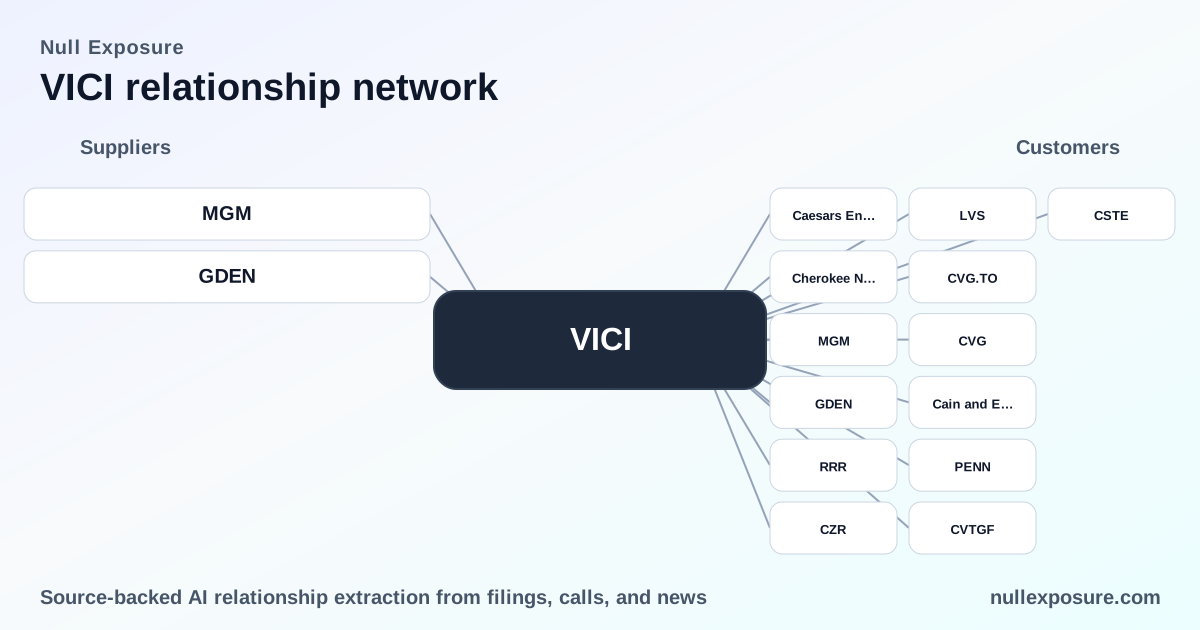
VICI Properties: Tenant relationships that drive cash flow and define risk
VICI Properties is a net-lease REIT that owns large, experiential gaming, hospitality and entertainment real estate and monetizes through long‑term, triple‑net leases and selective lending to operators. The business model collects predictable base rent from a concentrated roster of large operators while supplementing returns with financings and sale‑leaseback transactions that expand the footprint and cash yield. For a quick overview of our reporting and original analysis, visit https://nullexposure.com/.
The investment thesis in one line
VICI converts operating real estate into a long‑duration, high‑visibility cash stream tied to a handful of market‑leading gaming and experiential operators; credit concentration is the central value driver and the principal risk.
Tenant roll call: relationship‑by‑relationship (plain English, sourced)
Below are the customer relationships found in VICI’s filings and public reporting. Each entry is a concise description with the primary source for the reference.
Caesars Entertainment, Inc. (CZR)
VICI leases significant Las Vegas and regional assets to Caesars and reports that Caesars accounted for roughly 36% of lease revenues in 2024, making the operator a cornerstone tenant; VICI also holds about 33 acres adjacent to the Strip leased to Caesars that it can monetize. (Source: VICI 2024 Form 10‑K, FY2024)
Caesars Palace
VICI is the landlord for iconic assets including Caesars Palace; the property is cited as part of the company’s experiential portfolio that underpins rental income. (Source: Market commentary and VICI corporate filings, FY2026 reporting)
MGM Resorts International / MGM (MGM, including MGM Grand)
MGM is VICI’s other anchor tenant; MGM and Caesars together comprised approximately 74% of leasing revenues for 2024. Recent operator transactions (for example, the sale of Northfield Park) produced amendments to MGM’s master lease that reduced annual rent by $53 million. (Source: VICI 2024 Form 10‑K; MGM press release and market coverage, Apr–May 2026)
MGM Grand (property level)
The MGM Grand is among the Strip assets that generate long‑term rent under VICI’s leases and is highlighted by management as a property where tenants are investing into the asset base. (Source: Q1 2026 earnings call transcript coverage, May 2026)
The Venetian / Venetian Resort (LVS)
VICI owns the real estate underlying the Venetian Resort and has referenced the Venetian in growth initiatives such as partner property funds. The Venetian is included in the company’s North America‑focused experiential portfolio. (Source: VICI 2024 Form 10‑K and Q1 2026 commentary)
Golden Entertainment (GDEN)
In 2025–2026 VICI completed a roughly $1.16 billion sale‑leaseback of seven Nevada casino properties with Golden Entertainment, adding a new, material tenant and predictable rent tied to that portfolio. (Source: BusinessWire/FinViz/SimplyWall.st coverage, Mar–Apr 2026)
Golden OpCo
Upon closing of the Golden transaction, Golden OpCo (the operating entity controlled by Blake Sartini) becomes a VICI tenant and is expected to be one of the company’s larger rent contributors by annualized cash rent. (Source: BettorsInsider and press coverage, Apr 2026)
Century Casinos / CNTY
VICI funded construction for Century Casinos’ Caruthersville project, owns the real estate improvements and now receives incremental rent under a triple‑net master lease; the Canadian portfolio additions also increased annual rent materially. (Source: PR Newswire and Yogonet coverage; VICI/Century announcements, FY2022–FY2024)
Clairvest / Clairvest Group (CVG / CVTGF)
Following MGM’s sale of Northfield Park, Clairvest acquired operations and entered a lease agreement with VICI for Northfield Park, becoming the company’s 14th tenant with an initial annual base rent cited at about $53 million. (Source: MarketScreener and press releases, Apr 2026)
Red Rock Resorts (RRR)
VICI structured a $510 million delayed‑draw term loan with Red Rock Resorts, highlighting that VICI acts not only as landlord but as a capital partner/lender to large operators. (Source: InsiderMonkey and coverage summarizing strategic financings, Mar 2026)
Cherokee Nation Businesses, L.L.C. (CNB)
VICI’s filings list a long‑dated lease for the Gold Strike Tunica/Robinsonville asset with Cherokee Nation Businesses, reflecting the REIT’s exposure to tribal‑operator relationships in its regional portfolio. (Source: VICI 2024 Form 10‑K, FY2024)
Pure Casino Entertainment / Gamehost
VICI announced the pending acquisition of four Alberta real estate assets in connection with Pure Casino Entertainment’s take‑private of Gamehost, a deal referenced at an ~8% cap rate and a $144 million purchase price. (Source: InsiderMonkey Q1 2026 coverage)
One Beverly Hills
VICI provided a $1.50 billion mezzanine loan tied to the One Beverly Hills development, signaling an expanded role as a capital provider in addition to landlord. (Source: SimplyWall.st and SahmCapital articles, Apr–May 2026)
IGP (IGPG)
Management referenced a working relationship with IGP and PURE over several years, noting operator competency and the company’s comfort with their ability to run gaming platforms. (Source: Q1 2026 earnings call transcript coverage, May 2026)
Penn (PENN)
VICI’s small‑tenant engagement model includes discussions and active management with operators such as Penn; management has flagged ongoing dialogue across the tenant roster given the concentrated nature of the business. (Source: InsiderMonkey Q4 2025 earnings call transcript)
Cain and Eldridge Industries
VICI expanded its long‑term strategic relationship with Cain and Eldridge Industries by providing a $1.5 billion mezzanine loan as part of construction financing for the One Beverly Hills project. (Source: InsiderMonkey Q1 2026 transcript and FinViz coverage)
What the relationship set says about VICI’s operating model (constraints and company‑level signals)
- Long‑term contracting posture: VICI’s leases are purposefully long‑dated—initial terms generally range from 15 to 32 years with multiple renewal options—creating durable, predictable cash flow. (Company signal: lease term language from Form 10‑K)
- Concentration and materiality: Revenue concentration is high; VICI reported that Caesars and MGM together accounted for ~74% of lease revenues in 2024, a structural exposure that drives both valuation and downside risk. (Explicit constraint naming Caesars and MGM: VICI 2024 Form 10‑K)
- Geographic focus: The portfolio is North America‑centric (United States and Canada), composed largely of Strip‑level and regional gaming properties—this informs demand sensitivity to tourism, regional gaming trends and U.S. macro conditions. (Company signal: 10‑K geographic disclosure)
- Triple‑net and low‑operational role: Rental income is primarily triple‑net; tenants pay operating costs, which isolates VICI from day‑to‑day property expense volatility but concentrates credit risk on tenant operators. (Company signal: Form 10‑K lease structure)
- Active capital provider: Beyond landlord functions, VICI increasingly deploys structured financings (loans, mezzanine facilities, term loans, buy‑and‑leasebacks) that expand earnings sources but increase balance‑sheet complexity. (Company signal: recent loan and mezzanine transactions cited in Q1 2026 coverage)
- Maturity and stage: VICI reports properties are essentially fully leased with a long weighted average lease tenor (including extensions), indicating a mature, income‑oriented REIT rather than a development‑stage platform. (Company signal: 10‑K and earnings commentary)
Bottom line for investors
- Core proposition: VICI sells investors exposure to experiential real estate cash flows secured by long‑term leases with large gaming operators.
- Key risk/reward balance: The concentrated tenant mix (Caesars and MGM dominate revenues) compresses downside protection but underpins high revenue visibility when operators perform.
- Strategic evolution: The firm’s increasing use of lending and sale‑leaseback transactions diversifies income but requires credit discipline and execution.
For a deeper look at the underlying documents and a curated reading list on these tenant relationships, visit https://nullexposure.com/ for our reports and source notes.