Viking Holdings (VIK): marketing partnerships as a demand lever for a capital-intensive cruise operator
Viking Holdings operates a premium passenger-transport business that monetizes primarily through cruise ticket sales, onboard services and ancillary travel products across ocean and river itineraries. Revenue is driven by occupancy and yield per passenger, with brand and distribution partnerships functioning as scalable marketing channels rather than direct revenue lines. For investors, the key question is whether marketing partnerships materially lift bookings and onboard spend relative to their cost and how these partnerships sit within Viking’s broader return-on-capital profile. Visit https://nullexposure.com/ for tools that track these customer relationships and their commercial timing.
Why a PGA TOUR tie-up matters to investors: brand, reach and the economics of customer acquisition
Viking’s business is exposure-sensitive: occupancy and per-passenger revenue respond to travel demand cycles and effective audience targeting. A multi-year marketing partnership with a major sports property like the PGA TOUR is a demand-generation play — it places Viking in front of a high-value demographic and extends campaign reach across broadcast, digital and event platforms. For a company with significant fixed costs and high capital intensity, marketing that demonstrably improves forward bookings or raises yields is economically valuable because incremental revenue flows directly to operating leverage once fixed capacity is filled.
Operationally, such partnerships also provide calendar predictability for promotional windows and campaign cadence, which helps revenue management teams optimize pricing and inventory. Viking’s fiscal profile — roughly $6.5 billion in trailing twelve‑month revenue with an operating margin in the low 20s — means that incremental yield improvements can disproportionately improve EBITDA when occupancy is strong. Investors should watch how Viking measures conversion from TOUR exposure into bookings, and whether the partnership is paired with preferential offers or exclusive packages that can be tracked in booking trends and yield statistics.
Key takeaway: the PGA TOUR deal is not a revenue stream in itself, but a potential lever to improve booking velocity and yield across Viking’s premium customer base.
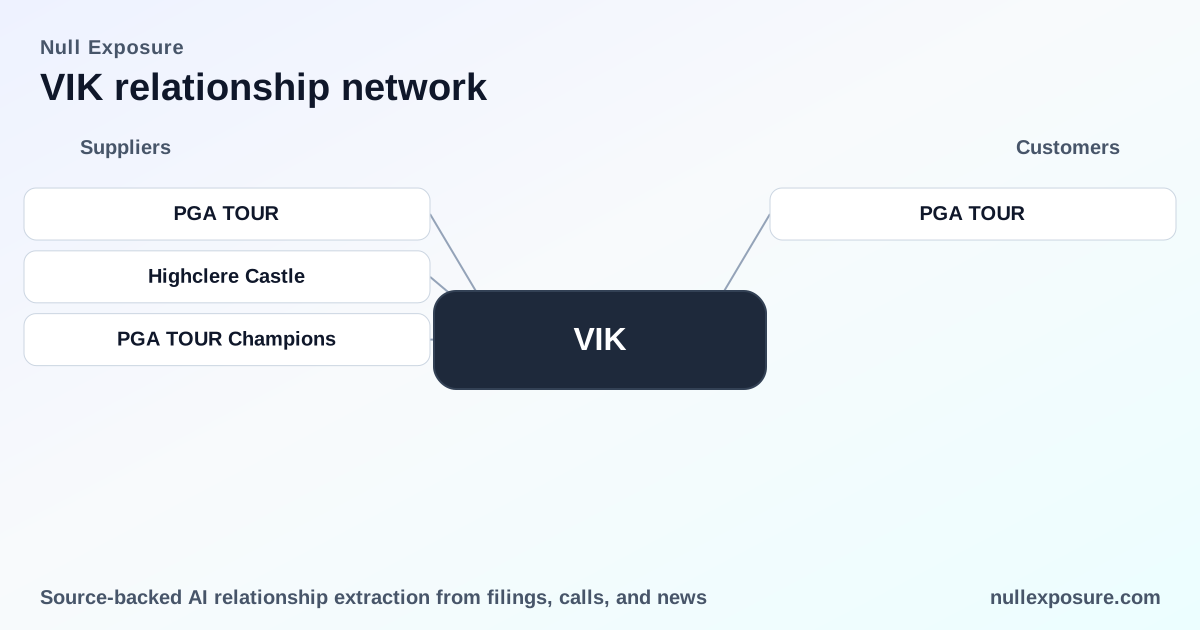
The disclosed customer relationship: PGA TOUR
Viking announced a multi‑year marketing partnership naming the company the Official Cruise Line of the PGA TOUR through 2030, positioning Viking across TOUR platforms to reach spectators and broadcast audiences. According to Simply Wall St coverage on March 10, 2026, the arrangement designates Viking as the Official Cruise Line across TOUR platforms through 2030 and is described as a multi‑year marketing partnership (Simply Wall St, March 10, 2026). This relationship is promotional and distributional in nature; it provides marketing reach rather than direct ticketing integration or material revenue guarantees.
How this relationship maps to Viking’s operating model and commercial constraints
Below are company-level signals that frame how Viking uses customer and partner relationships to drive its business; these are not attributed to any single partner unless explicitly stated in source material.
- Contracting posture — preference for multi‑year marketing agreements. Viking’s engagement with major consumer platforms reflects an approach that values multi‑year visibility over one-off activations, improving planning for sales and revenue management cycles.
- Concentration dynamics — diversified passenger base but concentrated economic exposure. While Viking serves global markets (North America, UK and internationally), the economics are concentrated in premium leisure travelers and in seasonal itineraries; partnerships that target this demographic can reduce marginal marketing inefficiency.
- Criticality — partnerships are important but not critical revenue anchors. Marketing partnerships drive awareness and booking lift; they do not replace core ticketing revenue. The company remains capital-intensive, so partners are tools to improve utilization rather than substitutes for owned distribution.
- Maturity and scale — public company metrics underpin bargaining power. Viking’s trailing revenue of approximately $6.5 billion, robust gross profit and institutional ownership exceeding 99% give the company the scale to negotiate valuable brand placements and national sports‑property deals; this scale also raises expectations for measurable ROI from partner programs.
These signals indicate a disciplined approach to partner selection: Viking prioritizes deals that align with premium customer acquisition rather than volume discounts or deep distribution concessions.
Risk and reward: what investors should monitor next
- Measureable conversion metrics. Investors should expect visibility on booking trends following TOUR activations (campaign start dates, promotional codes, or exclusive packages) and monitor yield and occupancy data in subsequent quarters. This will determine if media exposure translates into profitable passenger flow.
- Marketing spend vs. return. Large-scale sponsorships carry upfront costs; the capital intensity of Viking’s fleet means the firm must convert marketing dollars efficiently to avoid diluting return on invested capital.
- Brand alignment and demographic fit. The PGA TOUR audience skews affluent and engaged — a favorable match for Viking’s premium positioning — but investors should evaluate geographies and channels where the TOUR’s reach overlaps Viking’s highest-yield markets.
- Contract length and exclusivity. The 2030 term gives time to optimize campaigns, but it also commits Viking to a long horizon; any shift in consumer preferences or a downturn in travel demand could stretch the marketing investment over periods of weaker conversion.
The disclosure record and how to use it
Viking’s disclosed partnership with the PGA TOUR is recorded in public reporting and press summaries; treat these announcements as signal events that set the marketing calendar but not as standalone revenue drivers. According to the Simply Wall St report published March 10, 2026, Viking is designated the Official Cruise Line through 2030 across TOUR platforms, highlighting the explicit marketing role of the relationship (Simply Wall St, March 10, 2026).
For investors and operators seeking structured tracking of partner relationships and the timing of their commercial campaigns, resources aggregating customer relationship events and fiscal timing can be useful. For a concise hub of customer relationship insight and chronological tracking, see https://nullexposure.com/.
Bottom line: tactical partnership, strategic intent
The PGA TOUR partnership is a strategic marketing investment that aligns with Viking’s premium positioning and the economics of attracting higher‑yield passengers. Investors should value it as a tool to increase booking efficiency and yield capture rather than as a direct revenue stream. The real test will be measurable booking and yield improvement in the quarters following major TOUR activations and whether Viking sustains operating leverage as passenger volumes normalize.
For timely updates on customer relationships and how they feed into revenue cycles, see https://nullexposure.com/.