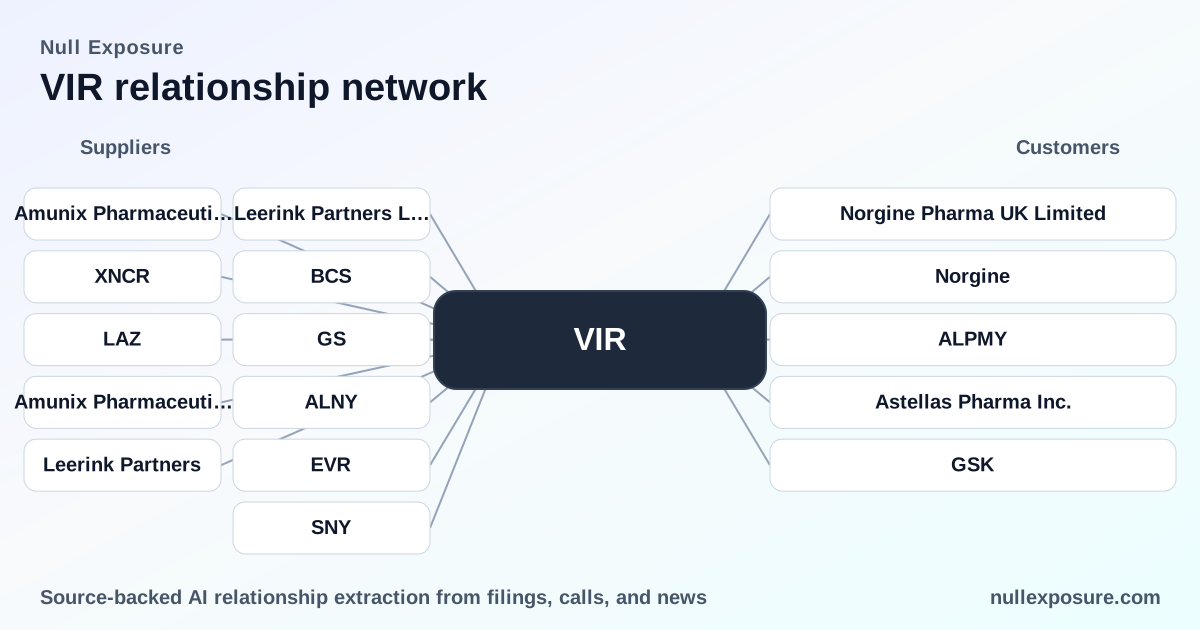
Vir Biotechnology: Partnership-led monetization and concentrated commercial pathways
Vir Biotechnology is a clinical-stage immunology company that monetizes through strategic licenses, co-development collaborations, milestone-driven payments and selective equity placements rather than product sales today. The firm's operating model focuses on advancing clinical assets to inflection points and transferring or sharing commercialization risk with specialty pharmas and large biopharma partners, producing lumpy but material upfront cash and equity proceeds that fund development. For investors and operators, the key lens is partner concentration and deal structure — Vir extracts near-term value from assets while retaining targeted U.S. exposure on select programs. Learn more about the relationship signals that drive that strategy at https://nullexposure.com/.
How Vir’s commercial playbook shows up in the numbers
Vir is still a research-and-development first company: clinical programs drive valuation and revenue is overwhelmingly collaboration/licensing related. This creates several company-level operating characteristics that matter for underwriting and operations:
- Contracting posture: Aggressive licensing and strategic collaborations are the primary route to commercialization; Vir routinely cedes regional commercialization rights to partners in exchange for upfront cash, equity investments and milestones.
- Concentration risk: A small set of large, high-value collaborations account for the bulk of recognized license revenue and near-term cash inflows, producing revenue volatility quarter to quarter.
- Criticality of partners: External commercialization capabilities are critical to realizing market value for late-stage assets; partners take lead roles in launch and distribution in assigned territories.
- Maturity and capitalization: As a clinical-stage developer, Vir’s maturity profile centers on de-risking clinical readouts and converting those readouts into partner-led commercialization deals to improve capital efficiency.
No formal third-party operational constraints were provided in the source set, so these signals are drawn from the company’s disclosed deals and earnings commentary.
Relationship-by-relationship lens: what each partner means to investors
Norgine — significant European commercial license for hepatitis D (large potential value)
Vir granted Norgine an exclusive license for certain hepatitis D assets, a deal that unlocks up to €550 million in potential consideration and transfers commercial execution in Europe to a specialty pharma while Vir retains U.S. rights. According to FierceBiotech (March 2026), the agreement is worth up to €550 million and leaves the U.S. market for Vir.
Source: FierceBiotech report, March 2026.
Norgine Pharma UK Limited — region-specific commercialization assignment for CHD combination
Vir specifically granted Norgine Pharma UK Limited an exclusive commercial license to the combination of tobevibart and elebsiran for chronic hepatitis delta (CHD) in Europe, Australia and New Zealand, positioning Norgine to lead commercialization in those territories while Vir focuses on other geographies. This was announced in Vir press summaries and syndicated reports (StockTitan and BioSpace, March 2026).
Source: Vir press releases reported by StockTitan and BioSpace, March 2026.
Astellas Pharma Inc. (Astellas / ALPMY / ALPMF) — transformational upfront cash, equity and co-development for oncology asset
Vir executed a global strategic collaboration with Astellas to advance VIR-5500, a PRO-XTEN dual-masked CD3 T‑cell engager targeting PSMA for prostate cancer; the transaction delivered approximately $335 million in upfront and near-term consideration, including $240 million in cash, a $75 million equity investment at a 50% premium, and near-term milestones. The agreement establishes a co-development/co-commercialization framework with Astellas leading U.S. commercialization and obtaining exclusive ex-U.S. rights while Vir retains an option to co-promote in the U.S., crystallizing large near-term liquidity and offloading substantial commercialization cost and risk. PharmExec and PR Newswire reported the financial terms and structure; Vir’s Q4 earnings call and later closing notices confirmed transaction close and regulatory clearance in April 2026.
Sources: PharmExec reporting the deal terms (March 2026); PR Newswire and PharmiWeb press releases and Vir earnings call commentary (March–April 2026); closing noted via industry coverage in April 2026.
ALPMY / ALPMF references in market press — market reaction and deal close commentary
Multiple market outlets and investor sites documented the market reaction and the closing mechanics of the Astellas transaction, reporting the $240M cash upfront, the $75M equity placement (priced at ~$10.36 per share) and the expiration of the HSR waiting period before closing; these pieces provide context around investor sentiment and cash impact to Vir’s balance sheet. Coverage by SimplyWallSt, InsiderMonkey and The Globe and Mail highlighted share movement and insider transactions linked to the deal.
Sources: SimplyWallSt and InsiderMonkey coverage (April–May 2026); The Globe and Mail investor commentary (May 2026).
GSK — legacy collaboration revenue is a variable contributor
GSK shows up in Vir’s revenue commentary as a factor affecting year-over-year license and collaboration revenue, with Vir noting lower license and collaboration revenue from GSK relative to the prior full year and placing that decline in the context of overall revenue shifts. This was referenced in Vir’s fiscal commentary captured in a March 2026 corporate update.
Source: Vir corporate update and associated reporting via StockTitan (March 2026).
What these relationships imply for valuation and risk
- Cash and near-term de-risking: The Astellas transaction is a material de-risking event that supplies cash, an equity cushion and validation for Vir’s PRO-XTEN platform; this reduces financing risk and advances a high-value oncology asset through partner resources. (See PharmExec and PR Newswire, March–April 2026.)
- Lumpy revenue profile: Licensing receipts—like the Norgine and Astellas deals—produce step changes in revenue recognition; investors must model Vir’s income statement with episodic license recognition rather than predictable product sales.
- Geographic rights splitting: Regional licensing (Norgine for Europe/Australia/NZ; Astellas commercial leadership U.S. and exclusive ex-U.S. rights) creates asymmetric upside based on each partner’s commercialization footprint and incentives.
- Partner concentration as operational leverage: A small number of high-value partners drive much of Vir’s short-term cash profile; this translates to meaningful upside on successful partnerships but also single-counterparty exposure.
Bottom line for investors and operators
Vir’s commercial and financing strategy is partner-first and asset-centric: the company converts scientific progress into execution by transferring commercialization risk to capable partners in return for cash, equity and milestone upside. That model creates near-term liquidity events and a concentrated counterparty profile; investors should underwrite both the upside from landmark collaborations and the revenue volatility that follows. For further analysis of Vir’s partner network and how these deals reposition cash runway and product strategy, visit https://nullexposure.com/.
Bold takeaways: Astellas is the transformational deal; Norgine monetizes hepatitis D ex-U.S.; revenue recognition will remain lumpy; partner execution capability is the critical operational variable.