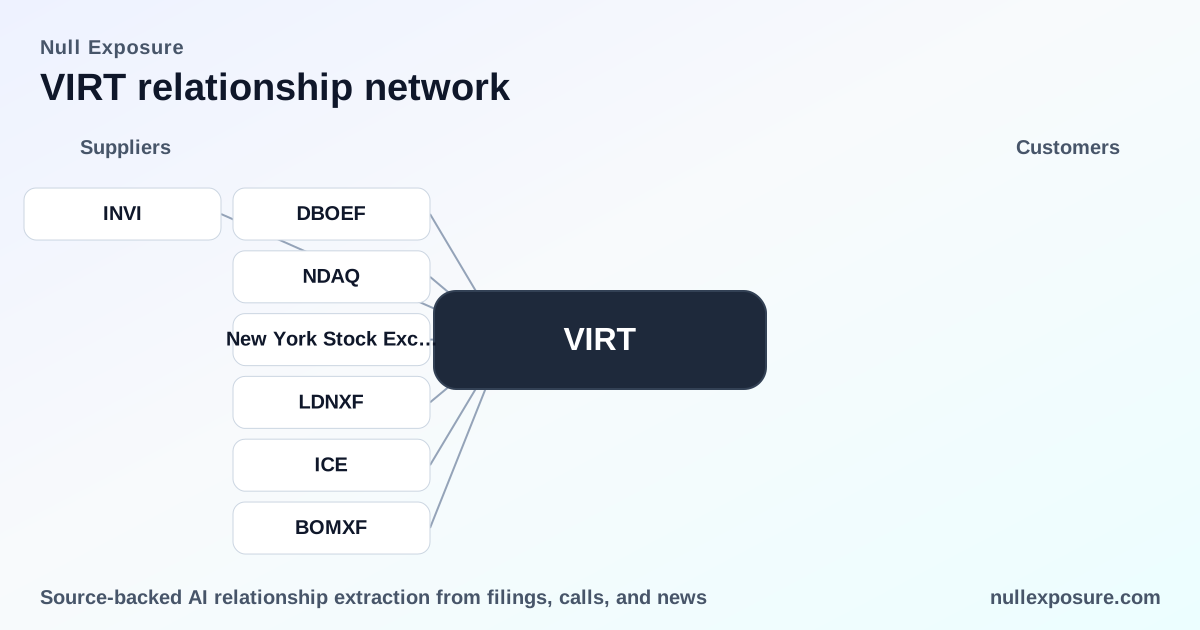
Virtu Financial: Client Flows Reveal a Business Built on Execution, Software and Agency Distribution
Virtu Financial operates a three-pronged, high-margin market services business: proprietary market making and liquidity provision, execution and agency services (commissions and venue access), and workflow software and connectivity (license, subscription and usage fees). Virtu monetizes by capturing spread and principal trading profits, collecting commissions and distribution fees when acting as agent on equity offerings, and selling recurring software and connectivity contracts to institutional clients. For investors evaluating customer relationships, recent public signals show Virtu extending its agency distribution footprint on at-the-market (ATM) programs, deepening execution relationships with asset managers, and supporting ETF and capital market flows globally. Learn more about client-level signals at https://nullexposure.com/.
Market commentary below synthesizes every customer relationship in the available results and translates those items into what they imply about revenue durability, counterparty mix, geographic scope, and operational constraints.
What the recent client flow says about Virtu’s go-to-market
Recent headlines fall into two clear buckets: ATM equity distribution and sales-agent activity across small- and mid-cap issuers, and execution/technology wins with institutional asset managers and ETF sponsors. The ATM work drives transaction and fee income and establishes Virtu as a preferred sales-agent/principal for issuers seeking flexible capital-raising; the Triton and execution engagements reinforce recurring, higher-margin software and agency execution revenue. Key takeaway: Virtu’s customer mix blends transactional agency revenue with recurring software/connectivity income, giving the company both volume sensitivity and a steady base of fee revenue.
Explore the broader client landscape at https://nullexposure.com/ for investor-grade relationship intelligence.
Deal and client log — every relationship reported (source-cited, one to two sentences each)
-
Nissay Asset Management — SahmCapital (Mar 2026)
Nissay selected Virtu’s Triton execution management system for global multi-asset trading, signaling a strategic technology and execution relationship across APAC and global markets. Source: SahmCapital report (2026-03-25) — https://www.sahmcapital.com/news/content/virtu-triton-win-with-nissay-highlights-push-for-steadier-fee-revenue-2026-03-25 -
NovaBay Pharmaceuticals (NBY) — Intellectia (Mar 2026)
NovaBay announced a $100 million stock sale agreement with Virtu Americas, and the market reacted sharply with an approximately 54% intraday price drop, reflecting investor sensitivity to equity-financing mechanics. Source: Intellectia news (2026-03-10) — https://intellectia.ai/news/stock/novabay-pharmaceuticals-nby-announces-100m-stock-sale-agreement-with-virtu-americas -
Gladstone Land (LANDP) — Investing.com UK (May 2026)
Gladstone Land executed agreements naming Virtu Americas LLC and Lucid Capital Markets as sales agents and/or principals for a $500 million at-the-market equity offering, positioning Virtu as a distribution partner on a material ATM program. Source: Investing.com UK (2026-05-03) — https://uk.investing.com/news/sec-filings/gladstone-land-announces-500-million-atthemarket-equity-offering-agreements-93CH-4628232 -
Gladstone Land (LAND) — Investing.com South Africa (May 2026)
A separate Investing.com posting reiterates the Gladstone Land agreements with Virtu Americas and Lucid, confirming multiple outlets reported Virtu’s role as agent/principal for the ATM facility. Source: Investing.com ZA (2026-05-03) — https://za.investing.com/news/sec-filings/gladstone-land-announces-500-million-atthemarket-equity-offering-agreements-93CH-4231376 -
Nissay Asset Management Corporation — SahmCapital (Mar 2026, alternate release)
A parallel SahmCapital item confirms Nissay’s selection of Triton to streamline global trading operations, reinforcing the execution-services and workflow-technology revenue vector. Source: SahmCapital (2026-03-23) — https://www.sahmcapital.com/news/content/nissay-asset-management-adopts-triton-2026-03-23 -
Fidelity Solana ETF cash-creation counterparties (FSOL) — TradingView (2025 filing coverage)
Fidelity’s dual-settlement approach for its Solana ETF included trading agreements with counterparties such as Virtu Americas to facilitate cash creations, indicating Virtu’s role in specialized ETF settlement workflows. Source: TradingView/CryptoNews (2026 coverage of FY2025 activity) — https://www.tradingview.com/news/cryptonews:65a0b31d8094b:0-wall-street-s-solana-bet-advances-as-fidelity-updates-etf-filing/ -
NovaBay (NBY) — TradingView (Mar 2026)
TradingView reports Virtu Americas will act as sales agent or principal for NovaBay’s ATM program, using commercially reasonable efforts to execute sales under the agreement. Source: TradingView (2026-03-10) — https://www.tradingview.com/news/tradingview:695bc84c36365:0-novabay-pharmaceuticals-signs-atm-sales-agreement-with-virtu-americas/ -
Volato Group (SOAR) — TradingView (May 2026)
Volato terminated its ATM Sales Agreement with Virtu Americas effective March 22, 2026, after issuing a termination notice on March 19, 2026, demonstrating that ATM mandates can be short-lived or paused. Source: TradingView (2026-05-04) — https://www.tradingview.com/news/tradingview:85208e9ddfa38:0-volato-ends-9-3-million-atm-sales-agreement-with-virtu-americas-477k-sold-before-termination/ -
Volato Group (SOAR) — TipRanks (May 2026)
TipRanks documents Volato’s December 5, 2025 ATM agreement with Virtu Americas LLC to sell up to $9.3 million in Class A common stock, highlighting an initial distribution mandate prior to termination. Source: TipRanks company announcement (2026) — https://www.tipranks.com/news/company-announcements/volato-group-ends-at-the-market-equity-offering-agreement -
Alico, Inc. (ALCO) — StockTitan (SEC filing excerpt)
A Rule 144/A notice reported a proposed sale of 31,250 Alico shares through broker Virtu Americas, LLC on 08/15/2025, illustrating Virtu’s participation in restricted-share transactions and brokered distributions. Source: StockTitan SEC filings collection (2026) — https://www.stocktitan.net/sec-filings/ALCO/page-3.html -
Vince Holding Corp. (VNCE) — TradingView (Q3 2025)
Vince issued and sold 370,878 shares under the Virtu at-the-market program, raising approximately $1.3 million in net proceeds, showing Virtu’s throughput on smaller issuer capital raises. Source: TradingView (2026 coverage of FY2025 results) — https://www.tradingview.com/news/tradingview:a0d04ccd2cc25:0-vince-holding-corp-reports-third-quarter-2025-results/ -
Gladstone Land (LANDP) — Investing.com India (May 2026)
An Investing.com India post repeats the Gladstone Land arrangement with Virtu Americas and Lucid, further confirming the multi-jurisdictional reporting of that $500 million ATM program. Source: Investing.com IN (2026-05-03) — https://in.investing.com/news/sec-filings/gladstone-land-announces-500-million-atthemarket-equity-offering-agreements-93CH-5357318 -
IsoEnergy (ISOU) — CruxInvestor (May 2026)
IsoEnergy entered an equity distribution agreement with Virtu Canada Corp. and Virtu Americas LLC to distribute up to C$50 million in common shares, expanding Virtu’s presence in Canadian capital markets execution and distribution. Source: CruxInvestor (2026-05-03) — https://www.cruxinvestor.com/posts/isoenergy-launches-c-50-million-at-the-market-equity-programme-to-preserve-strategic-optionality -
Nissay Asset Management — GlobeNewswire (Virtu Q1 2026 press release)
Virtu’s Q1 2026 results press release announced Nissay Asset Management’s adoption of Triton, reinforcing the company’s execution-sales narrative at the corporate reporting level. Source: GlobeNewswire press release (2026-04-29) — https://www.globenewswire.com/news-release/2026/04/29/3283591/30815/en/virtu-announces-first-quarter-2026-results.html -
QQUP (ETF listing) — MarketBeat (FY2025/2026 coverage)
MarketBeat lists Virtu Financial as the lead market maker for QQUP, confirming Virtu’s ongoing role providing liquidity on exchange-traded products. Source: MarketBeat quote page (2026) — https://www.marketbeat.com/stocks/NASDAQ/QQUP/ -
IsoEnergy (ISOU) — Intellectia (May 2026, alternate)
Intellectia reports IsoEnergy’s financing activity and the equity distribution agreement with Virtu Canada/Americas, reiterating Virtu’s role in Canadian issuer capital programs. Source: Intellectia news (2026-05-03) — https://intellectia.ai/news/stock/isoenergy-closes-c575-million-financing-deal -
Volato Group (SOAR) — MarketScreener (May 2026 duplicate)
MarketScreener cites the SEC filing showing Volato’s termination of the ATM agreement with Virtu Americas LLC effective March 22, 2026, underscoring churn risk in small-issuer ATM mandates. Source: MarketScreener (2026-05-04) — https://www.marketscreener.com/news/volato-group-announces-six-month-pause-on-at-the-market-equity-offering-program-ce7e59d8d98af621
Operational constraints and what they mean for investors
Virtu’s public statements and the relationship sample deliver clear company-level signals about contract structure and operating posture:
- Contracting mix: Virtu combines subscription and licensing revenues for analytics and OMS products (fixed fees and point-in-time recognition) with usage-based connectivity charges recognized monthly, and transactional agency commissions recorded on trade date. This mix produces partial revenue predictability tethered to trading volumes.
- Customer profile and criticality: The firm serves large enterprises and institutional clients across buy-side and sell-side channels; execution services and market making are mission-critical to those customers, while software and connectivity create sticky, recurring touchpoints.
- Geographic reach: Virtu operates on a global footprint (North America, EMEA, APAC), providing execution across hundreds of venues, which is consistent with the multinational distribution and ETF counterparty work shown above.
- Segments: Execution Services and Market Making are core, while software and workflow technology are growing, higher-visibility revenue streams that diversify away from pure volatility-driven principal profits.
- Relationship dynamics: Many engagements are active, transactional and agency-oriented (ATMs, sales-agent mandates), which deliver fee spikes but also exhibit turnover risk (as seen in Volato) and sensitivity to issuer decisions and equity market conditions.
Investment implications — concise conclusions for operators and investors
- Revenue durability: The combination of recurring subscriptions/licenses and high-frequency transactional income makes Virtu’s revenue profile resilient but sensitive to market volume and equity issuance cycles. The NovaBay price reaction to a $100M sale agreement underscores how issuer events can create short-term volatility around agency deals.
- Competitive positioning: Virtu’s participation as sales agent/principal on multiple ATM programs and as a lead market maker for ETFs demonstrates distribution breadth, enhancing fee opportunities and cross-sell potential for its workflow products.
- Risk vectors: ATM terminations and issuer concentration on small programs highlight churn and single-client event risk for agency revenue; execution and connectivity contracts mitigate that through recurring fees and broad client coverage.
For a structured, investor-grade view of customer exposures and distribution arrangements, visit https://nullexposure.com/ to see how client relationships translate to cash-flow drivers and operational risk across market cycles.
Bold takeaway: Virtu blends volatile, high-margin trading profits with recurring software and execution fees, and recent client evidence confirms the firm’s role as both a principal liquidity provider and a preferred agency distributor for ATM programs and institutional execution.