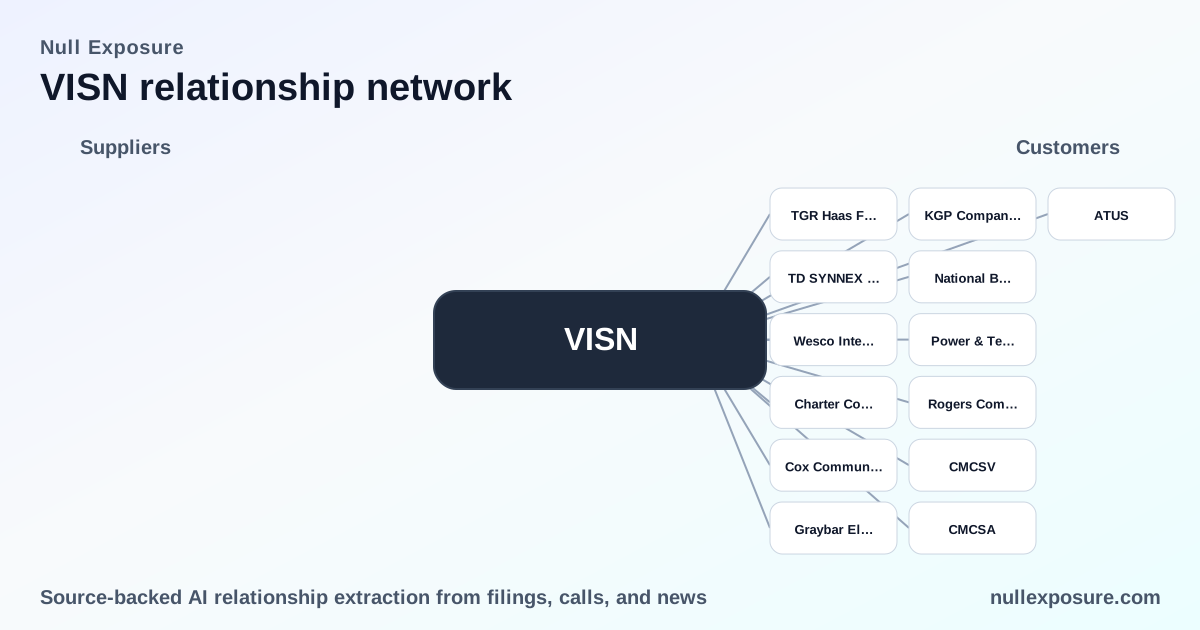
VISN customer map: who pays, who resells, and what that means for investors
Commencing thesis: VISN monetizes by selling network infrastructure hardware and complementary services to large telecommunications operators, cable MSOs, data center managers and global distributors; revenue is predominantly point-in-time product sales with services and integration as recurring adjuncts, and the company leverages a mixture of direct enterprise contracts and broad-channel distribution to scale. Investors should view VISN as an infrastructure supplier with concentrated top-two exposure but broad-based, global customer coverage—a profile that supports stable gross margins while leaving operating results sensitive to a handful of operator upgrade cycles. For deeper coverage of customer relationships and contract signals, visit https://nullexposure.com/.
Market context in one line: VISN sells to customers who drive capital upgrade programs (MSOs, telcos, distributors), and the cadence of those programs determines organic revenue swings more than recurring annuities.
What the customer list tells us about commercial positioning
VISN’s public filings frame its go-to-market as a hybrid of direct enterprise engagement and large-scale distribution. Products account for over 90% of revenue, sold at point of shipment, while services like integration and technical support provide margin relief and customer lock-in. The company lists leading MSOs and distributors as “major customers and distributors,” which highlights a dual risk/reward dynamic: dependence on a few large operators for volume, coupled with broad geographic reach that diversifies end-market cyclicality.
Key investor signals:
- Concentration: Top two customers represent roughly 19% of sales, yet no single customer exceeds the 10% threshold—this is a concentration profile that is material at the top end but not single-counterparty-critical (FY2024 10‑K).
- Global footprint: Roughly one-third of sales are international; VISN operates manufacturing and distribution across 100+ countries (FY2024 10‑K).
- Contracting posture: Post-close Transitional Service Agreements (TSAs) exist, suggesting episodic short-term transitional work alongside longer-standing direct relationships.
Explore the dataset of customer relationships at https://nullexposure.com/ for a structured view.
Line-by-line: every customer relationship disclosed (plain English summaries)
TGR Haas F1 Team
VISN’s Ruckus Networks business will supply purpose-driven networking solutions to the TGR Haas F1 Team, indicating a marketing/technology showcase relationship rather than a core telco revenue stream. This came up on the 2025 Q4 earnings call (March 7, 2026).
National Broadband Network Company Limited
Listed among “major customers and distributors” in the FY2024 Form 10‑K, the National Broadband Network Company Limited is included as a channel or end-customer supporting VISN’s large-scale broadband deployments. The FY2024 10‑K (filed 2024-12-31) cites this entity explicitly.
Power & Telephone Supply Company
Named in the FY2024 10‑K as a major customer or distributor, Power & Telephone Supply Company functions as part of VISN’s distribution network that supplies operators and contractors. The FY2024 10‑K lists it among major partners (filed 2024-12-31).
Rogers Communication Inc.
Rogers appears on VISN’s FY2024 customer roster, representing a Canadian operator relationship that supports regional deployment orders and upgrade cycles. The FY2024 10‑K identifies Rogers as a major customer (filed 2024-12-31).
TD SYNNEX Corporation
TD SYNNEX is listed as a major distributor in VISN’s FY2024 10‑K, pointing to a channel partnership that routes product into enterprise, telco and systems integrator pipelines. See the FY2024 10‑K (filed 2024-12-31).
Wesco International, Inc.
Wesco (including Anixter) is named in the FY2024 10‑K among key distributors, indicating VISN’s reliance on broad electrical and networking distribution partners to reach installers and operators. The FY2024 10‑K (2024-12-31) contains this listing.
Charter Communications, Inc.
Charter is included in the FY2024 10‑K list of major customers and likely represents a significant MSO deployment customer supporting recurring upgrade orders. The FY2024 10‑K lists Charter (filed 2024-12-31).
Cox Communications, Inc.
Cox is explicitly named in the FY2024 10‑K; as a major U.S. MSO customer, Cox drives scale purchases for cable and broadband infrastructure upgrades. Reference: FY2024 10‑K (filed 2024-12-31).
Graybar Electric Company, Inc.
Graybar is cited in the FY2024 10‑K as a distributor in VISN’s go‑to‑market, channeling hardware and supplies to contractors and network build teams. See the FY2024 10‑K (2024-12-31).
KGP Companies, Inc.
KGP Companies appears in the FY2024 10‑K’s list of major customers/distributors, representing regional distribution or contracting relationships that support installations. This is noted in the FY2024 10‑K (filed 2024-12-31).
CMCSV (inferred symbol) / Comcast Corporation
CMCSV and Comcast Corporation are listed in the FY2024 10‑K as major customers/distributors, and Comcast is separately discussed on the 2025 Q4 earnings call as an active deployment partner for VISN’s FDX amplifiers. The FY2024 10‑K (filed 2024-12-31) names Comcast; the 2025 Q4 earnings call (March 7, 2026) references the ongoing FDX amplifier deployment.
CMCSA (inferred symbol) / Comcast (earnings call)
On the 2025 Q4 earnings call VISN noted their FDX amplifier deployment with Comcast “continues to go well” and has been qualified by another major operator, signaling product validation and potential uplifts in operator orders. This comment is from the 2025 Q4 earnings call (March 7, 2026).
Comcast (duplicate earnings-call entry)
The earnings call reiterated Comcast as a strategic operator customer for amplifier rollouts, reinforcing its role as a near-term revenue driver for VISN’s access-network products. Source: 2025 Q4 earnings call (March 7, 2026).
Altice Labs / ATUS
VISN disclosed that Aurora Networks’ cloud‑native vCAP evo is being deployed in network upgrades that “advance our relationship with Altice Labs,” signaling product adoption in another operator environment. This discussion occurred on the 2025 Q4 earnings call (March 7, 2026).
What these relationships collectively imply for investors
- Customer mix is large‑enterprise heavy: VISN’s buyer list reads like the roll call of global MSOs, telcos and distribution partners—consistent with the company’s FY2024 disclosure that its customers include leading global telecommunications operators (10‑K).
- Top-two concentration is meaningful but not single‑point risky: The top two customers drive ~19% of sales collectively, which is material but leaves the company insulated from any single counterparty failure, per the FY2024 10‑K.
- Revenue is cyclical and upgrade-driven: Product sales represent over 90% of revenue and get recognized at shipment, so quarterly results correlate tightly to operator upgrade cycles rather than long-term recurring contracts.
- Global diversification with regional variability: International sales represent about one-third of net sales, which moderates U.S. cyclicality but introduces FX and regional demand risk (FY2024 10‑K).
Operational constraints and risk signals investors should monitor
- Short-term transitional work exists: The company has engaged in TSAs for post-closing support, indicating episodic short-term obligations that can temporarily add costs to margins.
- Mature relationships but exposure to upgrade timing: VISN reports long-standing direct relationships and sells both as a seller of infrastructure and as a buyer in some channels; these mature ties reduce acquisition risk but leave revenue timing concentrated around operator capex cycles.
- Service complement reduces churn risk: Services such as systems design, integration and technical support enhance stickiness and can convert one-time hardware buyers into multi-year partners.
- Geographic and customer concentration: Global footprint reduces single-market exposure, yet regional declines in U.S. net sales year-over-year highlight sensitivity to North American operator spend.
Investors evaluating VISN should weigh validation signals (Comcast FDX deployment, Altice Labs adoption) against concentration and cadence risk of large MSO customers. For a structured investor view of these customer relationships and to track changes over time, visit https://nullexposure.com/.