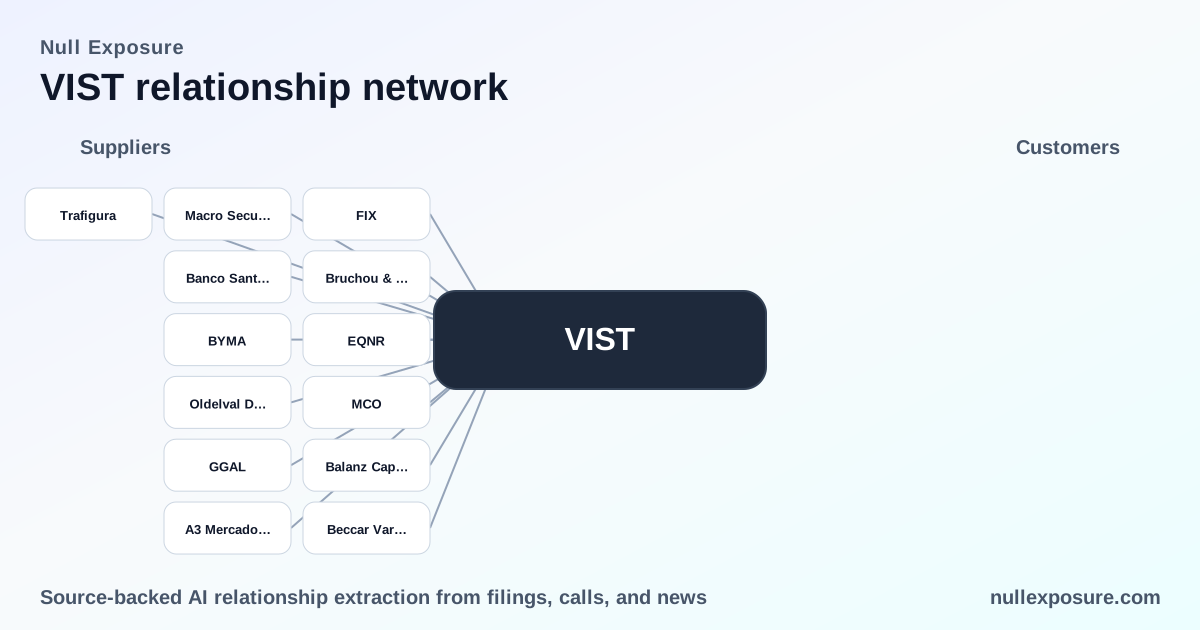
Vista Oil & Gas (VIST) — Customer relationships and what they signal to investors
Vista Oil & Gas is an upstream oil and gas exploration and production company focused on Latin America that monetizes through production, asset development and strategic farm-ins/partnerships on high‑value blocks. Revenue is driven by operated production plus cash flow generated through joint ventures and selective asset acquisitions; profitability is reflected in high operating margins and a strong return on equity. For investors evaluating counterparties and customer relationships, the recent public disclosures around Vaca Muerta partnerships are the most material commercial linkages to track. For deeper relationship intelligence, see https://nullexposure.com/.
The business model in plain English: how Vista makes money and scales value
Vista operates as a conventional E&P company that combines operated field development with partnership transactions to expand reserves and production. Key business-model characteristics:
- Upstream monetization: cash flow from hydrocarbon production and asset sales funds development activity and debt servicing.
- Partnership-driven growth: growth often comes through farm‑ins, asset swaps, and JV arrangements with regional majors or national oil companies on prolific plays such as Vaca Muerta.
- Capital discipline and profitability: Vista’s FY figures show high operating margins (approximately 24.9%) and a profit margin of ~25.7%, supporting EBITDA of about $2.276 billion and systematic reinvestment into exploration and development.
- Institutional footprint and scale: market capitalization is roughly $7.71 billion with about 40% institutional ownership, signaling mainstream investor scrutiny and access to capital markets when needed.
These characteristics create a contracting posture focused on project-level commercial agreements and joint-development structures rather than simple tolling or commodity‑sales contracts. That posture increases counterparty importance where partner execution affects project timing and value.
What the YPF relationship actually is — two public signals investors should track
Vista’s most visible counterparty activity in public records relates to YPF and development of Vaca Muerta. The dataset returned two discrete public mentions; both are material for evaluating Vista’s regional partnership footprint.
YPF — mention in YPF 2025 Q4 earnings call (March 7, 2026)
YPF management stated that they “also acquired part of Equinor assets in Vaca Muerta in partnership with Vista Energy,” which confirms a co‑investment/asset transfer dynamic between Vista and YPF on Vaca Muerta blocks. This comment was made on YPF’s 2025 Q4 earnings call (transcript dated March 7, 2026).
Source: YPF 2025 Q4 earnings call transcript, March 7, 2026.
YPF — press report on the Feb 1, 2026 agreement expanding Vaca Muerta stakes
A press release reported by The Globe and Mail and originating from YPF notes that on February 1, 2026 YPF entered into agreements with Vista Energy to expand interests in key unconventional hydrocarbon blocks in Argentina’s Vaca Muerta, under a deal valued at approximately US$163 million, underscoring the financial and strategic dimension of the partnership.
Source: The Globe and Mail press release reporting on YPF/Vista Energy agreement (date of release covering FY2026 activity), https://www.theglobeandmail.com/investing/markets/stocks/YPF-N/pressreleases/37380619/ypf-boosts-vaca-muerta-stakes-with-us163-million-vista-energy-deal/
Both entries document the same contractual relationship expressed in two public formats—an earnings transcript acknowledgment and a market-facing press report—demonstrating active bilateral commercial engagement between Vista and YPF in Argentina’s premier unconventional play.
Company-level constraints and operating-model signals investors should incorporate
There are no constraint excerpts tied to individual relationships in the materials provided, so the following are company-level signals derived from Vista’s public profile and the relationship evidence above:
- Contracting posture: Vista structures growth through project-level JVs and farm-ins, favoring shared technical and capital risk rather than sole-carried greenfield exposure. This posture increases dependency on partner execution and capital coordination.
- Concentration and criticality: Geographic concentration in Latin America—and visible activity in Argentina’s Vaca Muerta—makes regional partner ties like YPF strategically critical for access to acreage and local operational capacity.
- Commercial maturity: Financial metrics (EBITDA of ~$2.28B, profit margin ~25.7%, ROE ~35.1%) indicate a mature, cash‑generative upstream operator capable of funding development through internal cash flow augmented by partner transactions.
- Counterparty negotiation dynamics: The presence of transactions reported as asset acquisitions and stake expansions suggests Vista leverages asset transfers and capital injections to reallocate risk and scale production efficiently.
- Ownership and governance signal: Institutional ownership at ~40% and low insider percentage (~3.5%) reflect external governance oversight and the expectation of continued market‑oriented decision making.
These company-level constraints explain operational behavior: Vista pursues regional scaling through partnerships, retains high margins through disciplined development, and treats major partners as essential execution levers.
Investment takeaways and risks for allocators
- Positive case: Vista is a high-margin, cash-generative Latin American E&P operator with an execution model that accelerates growth through strategic partnerships like those with YPF in Vaca Muerta; this model supports attractive returns on capital and valuation multiples consistent with its EV/EBITDA (~5.05).
- Key risks: Partner execution and regional regulatory/geopolitical exposure are the dominant second-order risks—project timing, approvals and cost overruns on JV projects directly affect Vista’s production growth. Concentration in a few prolific basins amplifies these risks.
- Valuation context: With a trailing P/E of ~10.7 and forward P/E around 12.5 plus an analyst target near $90.32, the market prices Vista as a profitable E&P with growth optionality tied to partner-driven acreage developments.
For researchers focused on counterparty risk, the YPF disclosures are proof of active transactional partnerships rather than mere marketing collaborations; tracking subsequent regulatory filings and JV agreements will be essential.
For further relationship mapping and disclosure monitoring, visit https://nullexposure.com/ for continuous coverage and alerts.
Bottom line
Vista’s public linkage with YPF—documented in both an earnings call and a press release—confirms a concrete, transaction‑level partnership in Vaca Muerta that fits Vista’s partner-centric growth model. Investors should treat such relationships as execution nodes: they materially affect reserve growth, near-term capex commitments, and production trajectories, and therefore warrant ongoing monitoring as part of any investment or operating due diligence.