Vital Farms (VITL): Retail partnerships, distribution posture, and what customers reveal about risk
Vital Farms operates as a branded ethical food company that packages, markets and distributes pasture‑raised eggs, butter and related products primarily across the United States. The company monetizes through retail and foodservice channels, selling directly to retailers and through third‑party distributors; net revenue is concentrated in shell eggs and butter, with distribution reach into roughly 24,000 stores. For investors, the customer map and contract posture reveal a business with strong retail placement and margin history but meaningful concentration and short‑term contract exposure that affects pricing power and predictability. Learn more at https://nullexposure.com/.
How Vital Farms actually makes money — beyond the label
Vital Farms earns revenue by selling branded food products (eggs and butter) to natural‑channel and mainstream retailers and to foodservice customers. Revenue is driven by retail shelf penetration, trade execution and distribution relationships, not long upfront contracts: the company sells product on recurring, typically sub‑one‑year arrangements and relies on both direct shipments and third‑party distributors to reach stores. Financially, Vital Farms reports roughly $759 million in trailing revenue, positive operating margins and healthy gross profit, which reflects the premium positioning of its core products and the scale benefits of national retail placement.
Operating model and constraints you should treat as structural signals
The company’s filings and disclosures frame a clear operating posture that informs investment risk and optionality:
- Short‑term contracting posture. The 2024 Form 10‑K states that key sales terms such as pricing and quantities are established regularly and that “most customer arrangements and related incentives have a duration of less than one year,” which creates recurring renegotiation and pricing exposure (FY2024 10‑K, filed Dec 29, 2024).
- United States concentration. Management reports that all long‑lived assets and customers are located in the U.S., and most revenue is domestic, which concentrates macro and retail risk to a single geography (FY2024 10‑K).
- Seller and distributor roles at company level. Vital Farms explicitly describes itself as the seller and as a user of third‑party distributors to reach natural and mainstream channels; distributors purchase, store, sell and deliver products to retailers (FY2024 10‑K).
- Core product focus and maturity. The company identifies eggs (and butter) as its single reportable segment and original core product, indicating product concentration rather than broad diversification.
- Active commercial posture. Disclosures describe active, ongoing commercial relationships and distribution channels—this is an operating business with recurring revenue rather than one driven by long dated contracts.
These are company‑level signals drawn from public filings and provide the structural context for customer relationships and commercial risk.
Customer references — every cited relationship in the record
Below are plain‑English summaries of every customer reference found in the provided records, each tied to its source.
-
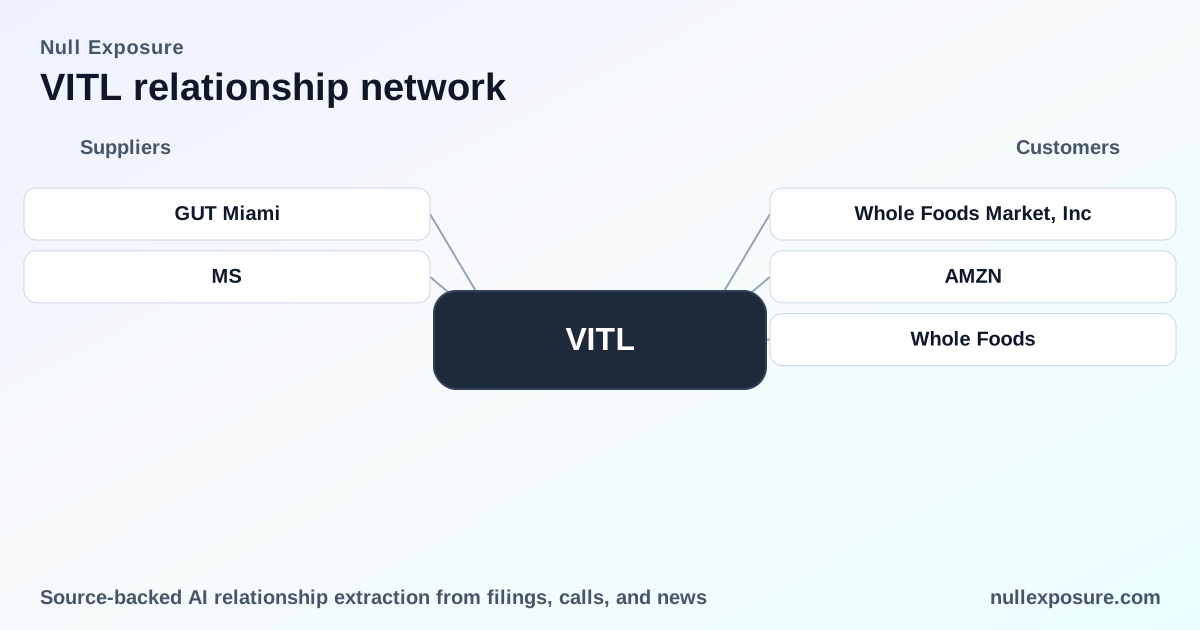
Whole Foods Market, Inc. (FY2024 — 10‑K). The company’s 2024 Form 10‑K explains that Vital Farms serves the majority of its natural‑channel retail customers through food distributors who purchase, store and deliver products to Whole Foods, indicating Whole Foods is reached primarily via distributor flows (FY2024 10‑K, filed Dec 29, 2024).
-
Amazon (AMZN) (FY2026 — Q4 2025 earnings call transcript). Management stated on the Q4 2025 earnings call that “Amazon and Whole Foods continue to be our largest retail partner,” identifying Amazon as a top retail outlet and a growth vector for expanded distribution (Q4 2025 earnings call transcript published on InsiderMonkey, Mar 10, 2026).
-
AMZN — duplicate news mention (FY2026 — Q4 2025 earnings call transcript). The earnings transcript mapping also produced a second machine‑matched reference to AMZN that reiterates the same point: Amazon (and Whole Foods) rank among Vital Farms’ largest retail partners and are central to retail expansion plans (Q4 2025 call transcript, InsiderMonkey, Mar 10, 2026).
-
Whole Foods — duplicate news mention (FY2026 — Q4 2025 earnings call transcript). The Q4 2025 transcript mentions Whole Foods alongside Amazon as one of the company’s largest retail partners, reinforcing that Vital Farms’ top retail exposure includes both Amazon’s retail ecosystem and Whole Foods (Q4 2025 call transcript, InsiderMonkey, Mar 10, 2026).
Each of these references confirms that Vital Farms’ retail footprint is driven by a small set of very large retail partners, often accessed via distributor flows, and that management explicitly characterizes Amazon/Whole Foods as top accounts.
Investment implications and downside vectors
- Concentration risk is real and measurable. Management’s public commentary and the filing references combine to show that Amazon/Whole Foods are large, strategic retail partners; this creates single‑channel sensitivity to promotional programs, slotting decisions and contract renegotiations.
- Pricing and volume are re‑set frequently. The stated prevalence of sub‑one‑year arrangements means that Vital Farms’ near‑term margin and revenue trajectory are exposed to retailers’ trade promotion cycles and distributor margins.
- Distribution intermediaries reduce direct control. The use of food distributors to service natural‑channel retailers delivers shelf reach (roughly 24,000 stores) but also places inventory and logistics control outside the vendor’s direct fleet; that structure reduces operating leverage on fulfillment but increases speed‑to‑market.
- Product concentration limits diversification. With eggs and butter as the core revenue drivers, category shocks (input costs, disease events, volume shifts) transmit directly to the top line and margins.
What to watch next — catalysts and data points that move the thesis
- Monitor sales volumes and merchandising positions at Amazon/Whole Foods in quarterly reports and trade commentary; changes in promotional intensity or shelf space will translate quickly through the short‑term contract cadence.
- Track distributor relationships and coverage metrics (store count and fill rates) to assess execution risk across the 24,000 store footprint cited in filings.
- Watch input cost trends and margin reconciliation in quarterly filings; with short contract terms, gross margin is the first line of defense for profitability.
For analysts and operators who want structured, relationship‑level signals around retail exposure and distributor flows, see the coverage and tools on the platform at https://nullexposure.com/.
Bold takeaways: Vital Farms is a branded, premium‑priced U.S. food company with strong retail placement but clear customer concentration and short‑term contractual exposure that amplify execution risk; investors must watch Amazon/Whole Foods execution and distributor dynamics for the next inflection in revenue and margin performance.