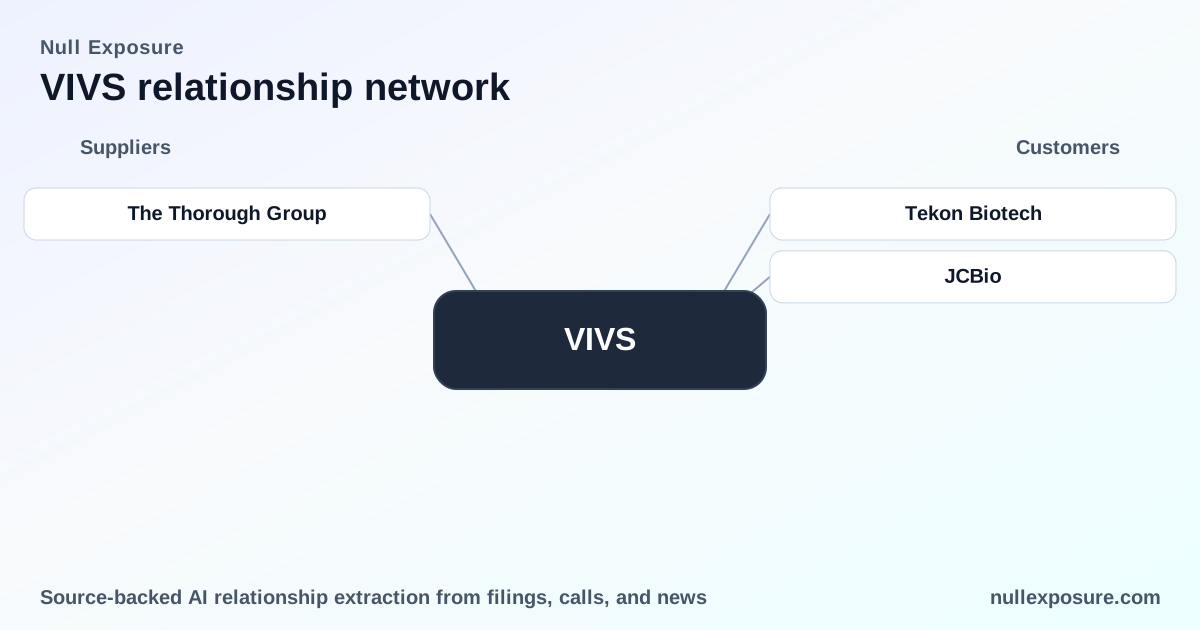
VivoSim Labs (VIVS): Distributor deals extend NAMKind reach into Asia — catalytic but early-stage commercial revenue
VivoSim Labs operates a focused commercial model: it develops human-relevant 3D tissue platforms and monetizes primarily through NAMKind™ toxicology services sold to pharmaceutical and biotech customers, now being distributed through authorized third parties in Asia. The company’s revenue base is nascent—Revenue TTM: $142k—so these distributor appointments are strategically important for market access even though they are not yet large revenue drivers. For investors assessing customer relationships, the key question is how quickly indirect distribution converts into repeat service bookings and scalable revenue.
Learn more on our research hub: https://nullexposure.com/
What VivoSim sells and how the commercial model works
VivoSim commercializes human-based preclinical safety services—predictive liver and small-intestine toxicology—under the NAMKind brand. The product is sold as a service to drug developers at all stages of development rather than as stand-alone hardware or materials sales, which positions the company as a service provider with recurring project-based revenue potential. The latest public filings and reported metrics show a company still in early commercial scale-up: negative gross profit and operating margins reflect investment in platform development and commercialization while top-line traction remains limited (Revenue TTM: $142k).
The company is deploying an indirect sales posture in Asia by appointing authorized distributors, a commercially efficient route to rapid market entry but one that concentrates revenue dependency on a small set of partners until direct sales scale. This contracting posture is a company-level signal rather than a partner-specific condition.
Asia distributor appointments — what happened and why it matters
VivoSim announced authorized distributor agreements in Asia-Pacific to expand access to NAMKind toxicology services. The market reaction shows the perceived strategic value: shares experienced sharp intraday moves following the announcements in late January and the subsequent reporting in March and May 2026.
JCBio — South Korea
VivoSim signed JCBio as an authorized distributor in Korea to distribute NAMKind human-based liver and small-intestine toxicology services, giving the company local commercial representation and a route to Korean biotech and pharma customers. According to VivoSim’s press release on January 29, 2026, the relationship is designed to expand Asia-Pacific access to its services and follows the company’s early commercial push. (GlobeNewswire, Jan 29, 2026; also reported on Yahoo Finance, Mar 10, 2026.)
Tekon Biotech — China
VivoSim appointed Tekon Biotech as an authorized distributor in China to sell NAMKind toxicology services focused on liver and small intestine, targeting China’s large drug development market and CRO networks. The company confirmed the Tekon appointment in the same January 29, 2026 press release and subsequent media reports in March and May 2026. (GlobeNewswire, Jan 29, 2026; Yahoo Finance and StockTitan coverage, Mar–May 2026.)
How these customer relationships change the investment thesis
- Market access acceleration: Authorized distributors in Korea and China provide VivoSim with immediate local sales infrastructure and potential customer introductions without the company bearing full local commercial overhead. This is meaningful for a small-cap biotechnology services provider that reported just $142k TTM revenue.
- Revenue concentration risk: Indirect distribution introduces a dependency pattern—early commercial revenue will be concentrated through a small number of partners until VivoSim builds a broader sales footprint or direct sales capability. That concentration is a company-level operational signal.
- Service-criticality: NAMKind is the core commercial offering; its performance and regulatory acceptance determine VivoSim’s commercial fate. The firm’s positioning as a service provider focused on preclinical toxicology creates a high degree of product criticality for prospective pharma customers.
- Maturity and scalability: The commercial model is early-stage. Negative gross profit and operating losses indicate the company is still investing ahead of scaled sales, so distributor deals are proof points rather than immediate revenue transformers.
These characteristics—an indirect contracting posture, concentrated early commercial channels, high product criticality, and early maturity—define how investors should model revenue growth and operational risk for VivoSim. The constraint signals supplied by the company’s disclosures indicate a services-oriented business model and a supplier role in the preclinical safety ecosystem.
What to monitor next (operational and financial checkpoints)
- Booking cadence from distributors: The single most important near-term metric is whether JCBio and Tekon convert introductions into paid NAMKind engagements and recurring projects. Quarterly updates on distributor-led bookings will move the valuation needle.
- Revenue and margin trajectory: Watch sequential revenue growth and any shift toward positive gross margin as utilization and pricing scale.
- Contract terms and exclusivity: Disclosure of territory exclusivity, minimum purchase commitments, or revenue-sharing will materially affect downside protection and upside capture—look for these terms in future filings or investor communications.
- Regulatory acceptance and reference customers: Positive client case studies from major regional biotech or pharma firms will validate the service and accelerate adoption.
Risks investors should price in
- Distributor appointments accelerate access but do not eliminate execution risk: conversion rates and pricing pressure in local markets will determine economic impact.
- Customer concentration risk until VivoSim either adds more distribution partners or grows direct sales channels.
- The company is at early commercial maturity, carrying operating losses and negative gross profit; timing to profitability is uncertain and dependent on commercial execution.
Relationship-by-relationship takeaways
- JCBio — VivoSim named JCBio its authorized distributor in South Korea to sell NAMKind liver and small-intestine toxicology services, giving VivoSim localized representation and a channel to Korean life-science customers. (GlobeNewswire press release, Jan 29, 2026; Yahoo Finance coverage, Mar 10, 2026.)
- Tekon Biotech — VivoSim appointed Tekon Biotech as its authorized distributor in China to expand access to NAMKind toxicology services focused on liver and small intestine, aiming to penetrate the sizable Chinese preclinical market. (GlobeNewswire press release, Jan 29, 2026; Yahoo Finance and StockTitan reporting, Mar–May 2026.)
Bottom line: catalytic distribution, but revenue proof required
The JCBio and Tekon appointments are strategically positive: they materially expand VivoSim’s addressable market without large fixed-cost investment. However, with minimal current revenue and negative margins, investors should treat these relationships as early commercial milestones rather than definitive revenue drivers. The next several quarters of distributor-sourced bookings and disclosed commercial metrics will determine whether these partnerships are value-accretive or simply informative market-access steps.
For deeper coverage on how these commercial relationships affect small-cap biotech valuations and partner-driven rollouts, visit our research center: https://nullexposure.com/