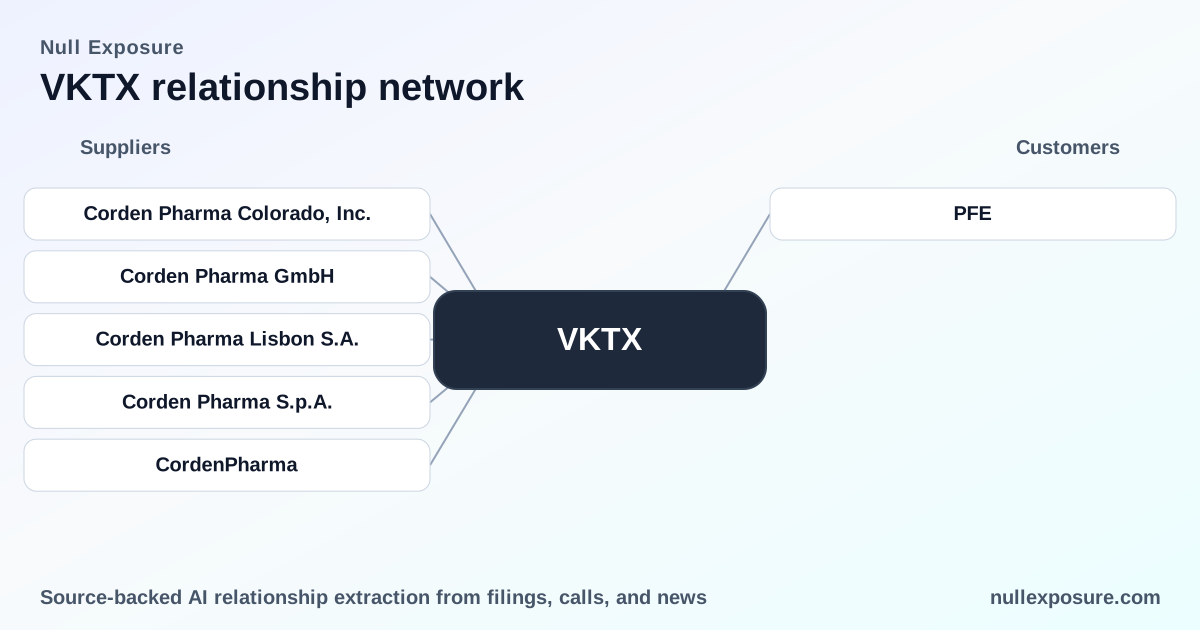
Viking Therapeutics (VKTX): A clinical-stage play driven by pipeline value and deal flow
Viking Therapeutics is a clinical-stage biopharmaceutical company developing therapies for metabolic and endocrine disorders; it generates value through advancing clinical-stage candidates and monetizing those assets via partnerships, licensing arrangements, or outright acquisition rather than product sales today. With no commercial revenue and a market capitalization that reflects future probability of regulatory and commercial success, Viking’s valuation behaves like an option on its pipeline and on potential strategic interest from larger pharma. For a running feed on customer and market relationships, visit the NullExposure homepage: https://nullexposure.com/.
Why investors should think of VKTX as an M&A and partnership arbitrage
Viking operates as a capital-intensive, development-stage biotech where the company’s intrinsic value is concentrated in a small number of clinical assets. That concentrated exposure drives two structural characteristics important for investors and operators:
- Contracting posture: Viking’s operational posture is oriented toward collaboration and exit — licensing, co-development, or acquisition — rather than scale-through-commercialization. This is consistent with clinical-stage firms that lack sales infrastructure and therefore rely on institutional partnerships or transactions to extract value.
- Concentration and criticality: With little to no current revenue, the company’s survival and upside are tied to a handful of programs; the pipeline is the business. That concentration increases binary outcomes and amplifies sensitivity to clinical readouts and strategic interest from larger pharmaceutical firms.
- Maturity and capital profile: Viking is pre-commercial, carrying the risk profile and capital cadence of development-stage biotech: recurrent R&D spend, dilution risk, and dependency on capital markets or partner-funded programs.
- Market signals: Institutional ownership is meaningful and the equity market narrative frequently prices in potential strategic deals and milestone successes as primary drivers of share moves.
These company-level signals explain why news flow about potential acquirers or partners can produce outsized price reactions for VKTX.
News-driven relationship scan: what surfaced in the public record
The relationship results returned two items referencing the same news story about interest from Pfizer. Below are plain-English takeaways from each result pulled from that coverage.
-
PFE Viking’s share price rose on speculation that Pfizer would pursue an acquisition to expand in the weight-loss market, a shift that investors interpreted as increased strategic value for Viking’s metabolic programs. A TradingView news post citing Invezz reported this market reaction on March 10, 2026 (https://www.tradingview.com/news/invezz:b6f8789b3094b:0-will-pfizer-approach-viking-therapeutics-with-a-buyout-proposal/).
-
Pfizer The same March 10, 2026 TradingView/Invezz report framed Pfizer as a potential suitor seeking to broaden its footprint in weight-loss therapies, and the article connected that speculation directly to recent upward movements in Viking’s share price. See the original coverage on TradingView (Invezz) dated March 10, 2026 (https://www.tradingview.com/news/invezz:b6f8789b3094b:0-will-pfizer-approach-viking-therapeutics-with-a-buyout-proposal/).
Both entries reference identical source material and describe market speculation linking Pfizer (PFE) and Viking. The practical takeaway for investors is that external strategic interest — even unverified market conjecture — is a material value driver for VKTX.
For continued tracking of VKTX relationships and market signals, consider the NullExposure homepage: https://nullexposure.com/.
How these relationships translate into investor actions and operational signals
Strategic interest from a large-cap pharma such as Pfizer translates into concrete implications for both investors and Viking operators:
- Valuation sensitivity: News of potential suitors compresses downside and expands upside conditional on transaction likelihood; trading is therefore reactive to M&A chatter.
- Negotiation leverage: For Viking’s management, publicized interest increases bargaining power for licensing or acquisition discussions and can improve terms for minority transactions (upfront payments, milestone structures, royalty rates).
- Catalyst prioritization: Investors should monitor near-term clinical readouts, licensing negotiations, and regulatory milestones, because these events directly affect both transaction probability and deal economics.
- Volatility risk: Reliance on deal flow and market narratives introduces episodic volatility; institutional holders and retail flows will amplify headlines.
Key operational signal: Viking’s business model requires management to maintain outward-facing engagement with potential partners and to position clinical data as a catalyst for non-dilutive financing or strategic transactions.
Risk factors framed by the relationship landscape
- Binary equity outcomes: Without commercial revenue, Viking’s share valuation collapses to the probability-weighted value of future deals or approvals; this binary profile creates large swings around news events.
- Speculation-driven pricing: Market headlines about potential acquirers can temporarily decouple price from fundamental clinical progress, increasing the risk of short-term mispricing.
- Execution dependency: Realizing value from partner interest requires disciplined negotiation and favorable deal terms; poor execution would leave long-term shareholders exposed to dilution or delayed upside.
- Concentration of assets: A small set of programs means that adverse clinical outcomes or competitor advances can materially reduce strategic interest and valuation.
Closing perspective for investors and operators
Viking is a classic clinical-stage biotech where value is derived from clinical progression and strategic interest rather than current cashflows. Recent market coverage linking Pfizer to potential acquisition interest is a reminder that news flow can be the dominant day-to-day driver of returns for VKTX. Investors should prioritize event-driven monitoring — clinical milestones, licensing updates, and reliable reports of partner interest — while operators should treat public strategic signaling as a lever to enhance transaction value.
Bottom line: VKTX is priced as an option on its metabolic pipeline and on the prospect of strategic deals; keep focus on clinical readouts and credible partnership signals as the principal catalysts.