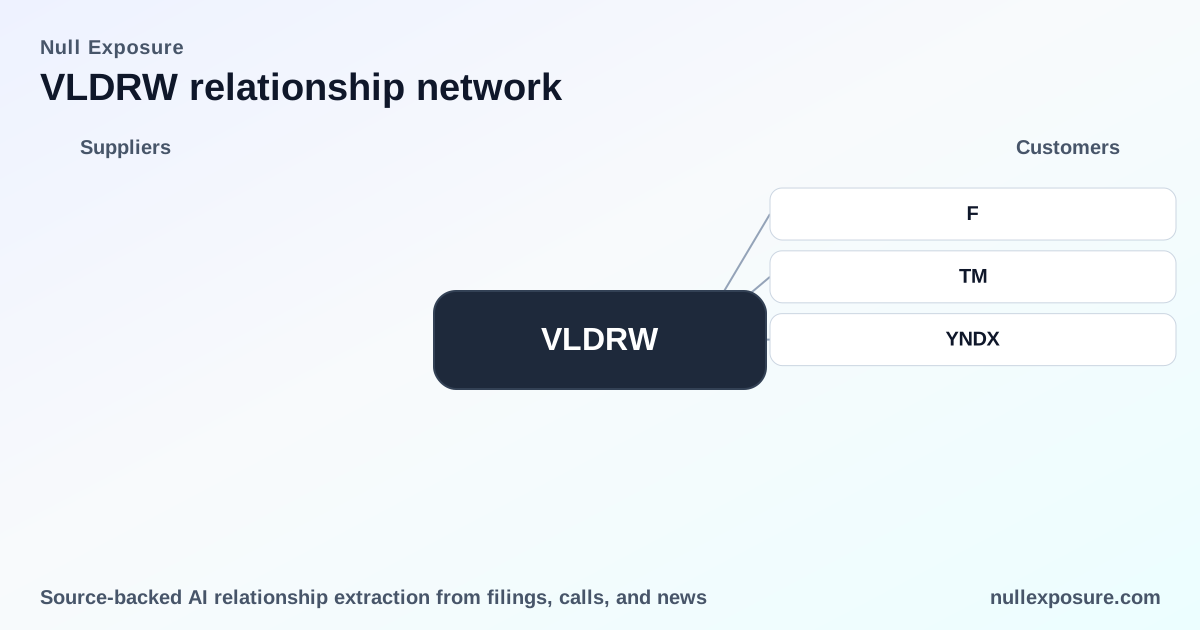
Velodyne (VLDRW) — Customer Relationships That Map Its Commercial Trajectory
Velodyne sells high-performance LiDAR sensors and associated integration services to automotive OEMs, mobility operators, and robotics developers, monetizing primarily through hardware sales and strategic supply agreements that embed its sensors into vehicles and autonomous platforms. These customer relationships convert product design wins into recurring revenue opportunities and provide channel access to large-scale vehicle and robotics programs. Learn more at https://nullexposure.com/.
Why these customer ties matter to investors
Velodyne’s listed customers are not incidental buyers; they are strategic integrators whose programs determine scale, timing, and margin profile for LiDAR suppliers. Large OEM and mobility partnerships drive concentration risk but also accelerate unit volume and validation cycles, while robotics and autonomy deployments validate differentiated sensor performance that supports pricing power. Investors should treat relationship wins as both revenue signals and as operational endorsements that shorten sales cycles for follow-on programs.
Customer snapshots from the record (every relationship covered)
The following entries reflect the available FY2022 reporting captured in public coverage. Each relationship is summarized in plain English with the source cited.
Boston Dynamics
Boston Dynamics selected Velodyne’s high-performance sensors to enhance and extend the capabilities of its automated, highly mobile robots. According to a FY2022 report captured on Quantisnow, this selection positions Velodyne as a sensor supplier to leading industrial robotics developers (Quantisnow, FY2022 / reported 2026).
F
A news report summarized that Ford Motor Co. had sold off its stake in Velodyne while continuing to use Velodyne’s technology. The TTNews article documents Ford’s investor activity and continued technology use (TTNews, FY2022 reporting).
Ford Motor Co.
Ford disclosed that, despite divesting its investment stake, it continued deploying Velodyne’s LiDAR technology in its programs, indicating ongoing procurement or licensed usage from Velodyne (TTNews, FY2022 reporting).
TM
A photograph and caption noted a Velodyne puck sensor installed in the bonnet of a Toyota Prius used in Yandex.Taxi autonomous operations, evidencing Toyota’s use of Velodyne hardware in a field trial context (TTNews / Bloomberg image caption, FY2022 reporting).
Toyota Motor Corp.
Toyota operating in conjunction with Yandex.Taxi deployed a Velodyne puck sensor in a Prius used for self-driving taxi operations, confirming Toyota’s engagement with Velodyne sensors for autonomy testing and integration (TTNews / Bloomberg, FY2022 reporting).
Yandex.Taxi
Yandex.Taxi’s self-driving operations used a Toyota Prius equipped with a Velodyne puck sensor, which demonstrates Velodyne’s role as a supplier into mobility operator pilots and commercial autonomy trials (TTNews / Bloomberg, FY2022 reporting).
What the relationship set implies about Velodyne’s operating model
- Contracting posture: Velodyne operates as an OEM supplier with direct product-sale contracts and program-level integrations, evidencing supplier relationships that are commercial and technical in nature rather than solely one-off sales.
- Customer concentration: The presence of large auto OEMs and lead mobility operators implies revenue concentration toward a few high-value customers; that concentration magnifies the impact of program wins and losses on near-term top-line performance.
- Criticality: Sensor hardware is a critical component in autonomy stacks; these relationships show Velodyne’s products are integral to sensor suites used in robotics and vehicle autonomy programs, elevating negotiation leverage when performance differentiates outcomes.
- Maturity and validation: Engagements with established OEMs and a robotics market leader signal product maturity and external validation that support pathway to scaled deployments.
No explicit contractual constraints were provided in the supplied record; the operating-model inferences above are company-level signals derived from the customer roster.
Upside drivers and structural risks
Velodyne’s path to volume and margin improvement follows predictable lines: securing program-level design wins with OEMs and conversion of piloted fleets into production orders unlocks meaningful revenue scale, while continued adoption by robotics leaders like Boston Dynamics validates technical differentiation. Conversely, customer concentration and reliance on OEM program timing create execution risk—delays or strategic reversals at a single large customer can materially compress near-term revenue.
Key investor takeaways:
- Strategic OEM relationships validate product-market fit and create high-leverage revenue channels.
- Mobility operator pilots (Yandex.Taxi) and robotics integrations (Boston Dynamics) broaden addressable markets beyond passenger vehicles.
- Divestment by an investor customer (Ford sold stake) does not, per the record, imply cessation of technical engagement; Ford continued using Velodyne technology.
Tactical implications for investors and operators
Investors should monitor program conversion signals—firm production contracts, volume commitments, and supply agreements—that turn test deployments into recurring revenue. Operators evaluating supplier risk should weigh Velodyne’s validation by high-profile integrators as evidence of technical suitability while factoring in the concentration risk associated with OEM-dominated revenue.
If you want a concise, ongoing feed of customer-relationship signals and what they imply for revenue cadence and counterparty risk, visit https://nullexposure.com/ for additional coverage and relationship analytics.
Final read: concise thesis and path forward
Velodyne’s customer relationships across automotive OEMs, mobility operators, and advanced robotics firms establish the company as a primary sensor supplier in multiple autonomy ecosystems; these relationships are the principal lever for scaling revenue and defending pricing. Investors should prioritize evidence of program-level commitments and production ramp timing when judging valuation and risk, while operators should treat Velodyne as a validated supplier for autonomy-grade LiDAR hardware.