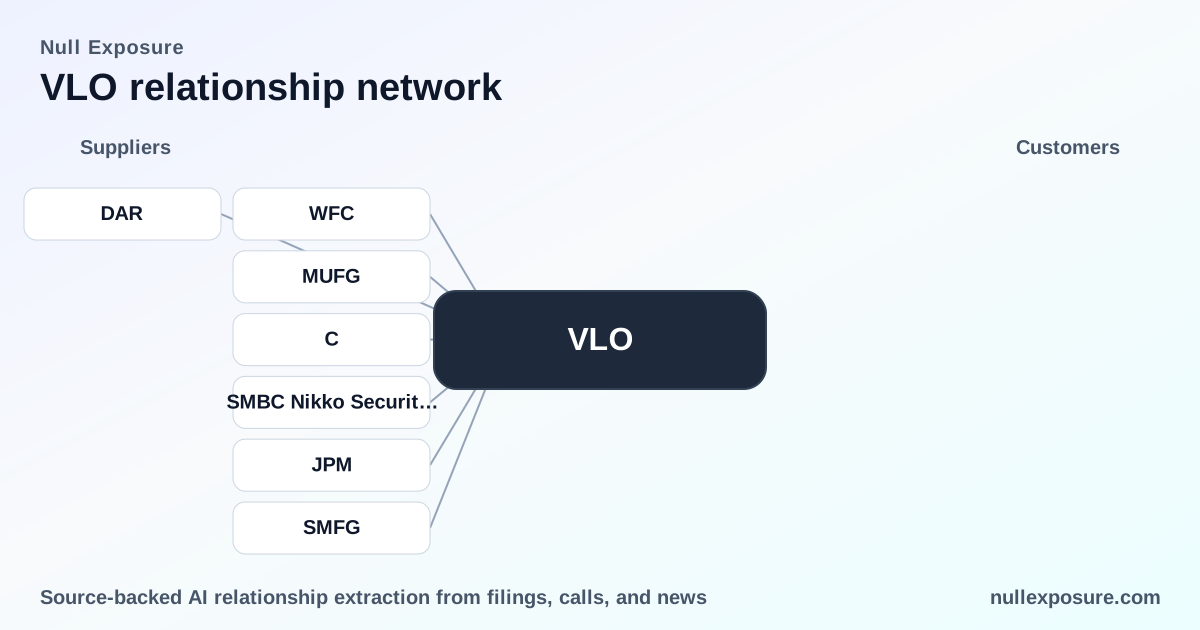
Valero’s customer map: resale-led, spot-driven, and geographically broad — what investors need to know
Valero Energy Corporation refines crude into transportation fuels and petrochemical products and monetizes through high-volume product sales across wholesale and retail channels, with margins driven by crack spreads and scale in refining and logistics. The company sells predominantly into resellers and distributors (wholesalers, retailers and terminal customers) and operates with a majority spot-contract posture, exposing results to cycle-driven price movements but benefiting from operational flexibility. For deeper signals on counterparty footprints and concentration, visit https://nullexposure.com/.
One observed customer relationship: CrossAmerica Partners (CAPL) in plain language
CrossAmerica Partners (CAPL) is reported to have established relationships with major oil brands including Valero, placing Valero-branded product distribution across its convenience-store and rack network spanning 34 states. A StockTitan news item from March 9, 2026, lists Valero among CAPL’s major oil brand relationships, indicating Valero-branded supply flows into CAPL’s retail and wholesale channels (StockTitan, March 9, 2026).
How the documented signals shape Valero’s customer dynamics
The collected evidence paints a consistent operational profile for Valero’s customer base and contracting behavior:
- Contracting posture — spot-dominant with term exposure: Valero discloses that the majority of its customer engagements are spot contracts with no remaining performance obligations, while certain products such as ethanol are sold under both spot and term arrangements. This creates a business model that is responsive to market price moves and inventory/throughput management.
- Channel concentration — reseller-centric distribution: The company sells the bulk of refined products through wholesalers, distributors, retailers and truck-delivered end users, rather than large integrated downstream customers. That channel mix makes Valero’s revenue profile sensitive to dealer/retailer throughput and retail fuel demand.
- Geographic reach — North America core with global tails: Valero reports the U.S. as the dominant market (for the year ended December 31, 2024 U.S. revenues $93,311 million vs. Canada $8,577 million and U.K./Ireland $15,236 million), while also selling in Latin America, APAC feed markets, and EMEA. This footprint provides scale and diversification, but also exposes the company to regional market cycles and FX/transportation considerations.
- Role and product orientation — manufacturer and seller to intermediaries: Valero operates as a manufacturer/refiner that sells core transportation fuels and petrochemical products to downstream resellers and distributors, positioning the company as an upstream product supplier to merchant channels.
- Segment maturity and criticality: Refining and fuel retail are mature, capital-intensive industries whose products are critical to transportation and logistics. That criticality secures persistent demand but does not immunize margins from commodity price swings.
The evidentiary basis for these signals comes from Valero’s public disclosures and business descriptions for the year ended December 31, 2024 and related commercial commentary.
What each signal means for investors and operators
Valero’s combination of spot-heavy contracts and reseller distribution creates a distinct set of commercial and financial characteristics:
- Revenue volatility is elevated but manageable through scale. Spot contracts maximize pricing capture when market spreads widen and allow Valero to redeploy volumes quickly when regional demand shifts. This increases earnings cyclicality relative to a term-heavy seller, but Valero’s large throughput and integrated logistics dampen single-period swings.
- Customer concentration is channel-based rather than single-counterparty-based. The company’s exposure is concentrated in distribution channels (wholesalers/retail), not a handful of corporate customers; operational risk arises from shifts in retail demand, dealer network economics, or distributor insolvency events rather than loss of a single anchor account.
- Geographic diversification is real but U.S.-centric. With most revenue in North America, macro and regulatory trends in the U.S. will disproportionately influence valuation and cash generation. Latin America, Europe and Asia exposure provide optionality and hedges for regional cycles.
- Counterparty credit and logistics are key operational levers. Because sales occur off racks and through distributors, credit practice, inventory management and terminal access determine realized margins as much as refinery operations.
Relationship-by-relationship review (complete list from available results)
- CrossAmerica Partners LP (CAPL): CrossAmerica operates a nationwide convenience-store and fuel distribution network, and a March 9, 2026 StockTitan news piece lists Valero as one of the major oil brands with which CAPL maintains relationships, implying Valero-branded supply to CAPL’s wholesale and retail channels. (StockTitan, March 9, 2026)
This record set includes a single direct relationship mention; the disclosure reflects Valero’s broader reseller and distributor channel strategy rather than signifying outsized dependency on one partner.
Operational and credit implications for portfolio managers
- Spot sales increase sensitivity to commodity cycles. Expect higher earnings variance across quarters tied to crude and product crack spreads; operational hedging and working-capital management are primary risk mitigants.
- Channel concentration implies distribution counterparty risk. Credit diligence on wholesalers and midstream partners is material to stress scenarios—loss of terminal access or distributor failure creates near-term displacement costs.
- Geographic mix constrains regulatory risk exposure. U.S.-centric revenues mean U.S. policy (fuel standards, carbon pricing, renewable mandates) will materially affect long-term margins and capital allocation choices.
- Maturity of the business compresses structural upside. Refining is a mature sector; meaningful EPS growth derives from margin expansion, throughput optimization, and downstream or low-carbon adjacencies rather than disruptive revenue growth.
Investor takeaways and recommended diligence
- Valero’s commercial footprint is broad but fundamentally reseller-driven and spot-exposed. That combination offers flexibility and price capture in favorable markets, with cyclical earnings in stress environments.
- Single observed partner (CAPL) confirms the distributive channel strategy — Valero supplies branded product into large convenience and wholesale networks rather than relying on a small set of captive corporate buyers.
- For investors evaluating customer relationships, primary diligence should focus on: counterparty credit quality of major wholesalers/retailers, terminal and logistics access, and the company’s hedging / working capital practices to offset spot volatility.
For a data-driven view of counterparties and to map supplier-customer exposures for investment or operational diligence, see the coverage at https://nullexposure.com/.
In short: Valero sells fuel into broad reseller channels, predominantly on spot terms, with U.S. markets driving performance; monitoring distributor credit, terminal access and crack spreads is essential for forecasting near-term earnings.