Valley National Bancorp B Pref (VLYPO): Customer Relationships and Strategic Implications
Valley National Bancorp operates as a regional banking and financial services group that monetizes through net interest margin on commercial and consumer lending, fee income from wealth, insurance and servicing, and trading/loan-sale activities. The preferred stock ticker VLYPO reflects the bank’s capital structure; Valley grows revenue both organically across consumer and middle‑market commercial lending and through portfolio sales and strategic asset dispositions. For primary customer-relationship intelligence and counterparty risk, the firm’s loan sales and counterparty mix are most consequential — investors should monitor concentration in CRE dispositions, middle‑market lending exposure, and the degree to which Valley uses loan sales to manage balance‑sheet and capital efficiency. For more structured exposure analysis and relationship mapping, visit the Null Exposure homepage: https://nullexposure.com/.
How Valley’s customer model converts activity into cash flow
Valley National earns core cash flow from lending across geographic cores in New Jersey, New York and Florida, supplemented by wealth management, insurance brokerage and transactional banking services. Commercial lending and consumer mortgage origination drive interest income; insurance and wealth services provide higher‑margin fee income. The bank also converts credit risk into liquidity via loan sales — an explicit monetization channel the company has used for commercial real estate. Market data through the latest quarter (2026-03-31) shows $1.94 billion in trailing twelve‑month revenue and a profit margin of 33.8%, reflecting the combined return profile of interest and non‑interest operations.
Customer relationships disclosed in the open record
Below are the customer relationships surfaced in the sourced results. Each entry is described plainly with its provenance.
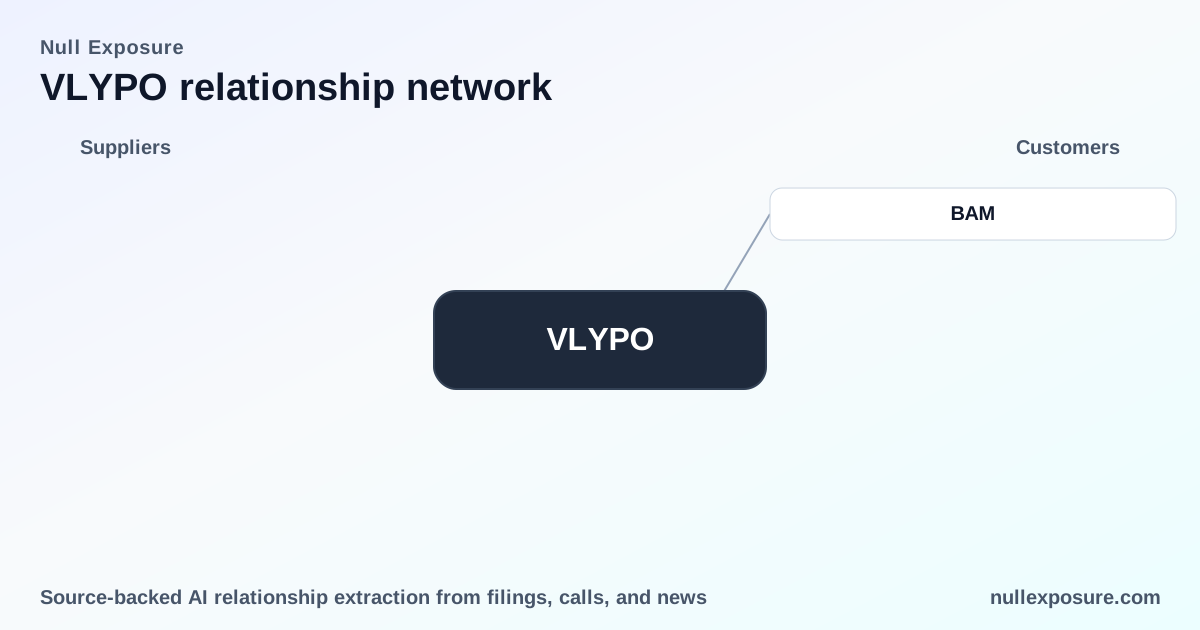
BAM (inferred symbol: BAM)
Valley sold net commercial real estate (CRE) loans totaling $925 million to BAM as part of a December 2024 transaction, reflecting an active loan‑sale monetization strategy to reshape the CRE book and manage capital. This disposition was reported in a TradingView item summarizing Zacks coverage on March 10, 2026.
Source: TradingView summary of Zacks research, March 10, 2026, referencing a December 2024 sale.
Brookfield Asset Management
Brookfield Asset Management is the named acquirer of the same $925 million of net CRE loans sold by Valley in December 2024, signaling that Valley uses large institutional counterparties to offload CRE exposure and redeploy capital. The transaction indicates both the bank’s willingness to transact sizable CRE packages and the presence of institutional buyers for those assets.
Source: TradingView summary of Zacks research, March 10, 2026, referencing December 2024 loan-sale activity.
What the relationship set implies about Valley’s operating posture
Valley’s public relationship signals and constraints paint a coherent operating model: the bank runs a hybrid origination-and-distribution strategy, serving individuals, small and middle‑market businesses, and institutional counterparties. From the company’s disclosures:
-
Contracting posture: Valley’s lending spans both long‑term amortizing structures (up to 30 years) and short‑term commercial business loans that can be collateralized by receivables, inventory or equipment. This mix produces predictable long‑duration assets alongside more actively managed, shorter‑tenor commercial exposure, implying active balance‑sheet management and interest‑rate sensitivity. Evidence comes from Valley’s lending descriptions in recent company filings (December 2024 disclosures).
-
Counterparty concentration and criticality: The firm serves individuals, small businesses and middle‑market firms, with middle‑market and specialty lending emphasized as a growth vector in 2024. Geographic concentration is material: retail and commercial activity is concentrated in New Jersey, New York and Florida, with additional branches and services across several other states. These are company‑level signals drawn from Valley’s 2024 disclosures.
-
Relationship roles and maturity: Valley operates both as a service provider (deposit, payment, wealth and insurance services) and as a seller of originated loans (notably residential mortgages to agency buyers and CRE to institutional buyers). Relationships are generally active and performing as stated in the company’s year‑end disclosures, and the bank executes interest‑rate swaps and other risk‑management services for commercial clients.
-
Segment orientation: The firm’s revenue mix is services plus lending, with consumer banking (mortgages, auto, home equity) integrated with insurance and wealth management operations — a diversified services profile that supports fee income stability.
Investment implications: what investors should prioritize
-
Capital management through loan sales is a core lever. The December 2024 $925 million CRE sale to Brookfield demonstrates Valley’s readiness to shrink particular risk pools while preserving liquidity and regulatory capital. That dynamic can reduce credit concentration but also limits future yield if higher‑margin assets are sold.
-
Geographic concentration concentrates macro risk. The bank’s heavy footprint in New Jersey, New York and Florida concentrates exposure to local economic cycles, commercial real estate markets, and state regulatory regimes. Investors should track CRE valuations and regional employment indicators.
-
Counterparty mix supports diversified fee streams but retains credit exposure. Serving individuals, small businesses and middle‑market clients provides diversified deposit and fee flows, yet the loan book still exposes Valley to sectoral shocks; the firm’s use of both long‑term and short‑term loan structures creates mixed duration risk.
-
Active servicing and product breadth are competitive advantages. Valley’s insurance and wealth services give recurring fee income and deepen client relationships, improving cross‑sell and retention metrics versus a pure lending institution.
Risk flags and monitoring checklist
- Monitor CRE valuations in Valley’s primary markets and the pace of further institutional loan sales; institutional buyers like Brookfield are active counterparties for CRE dispositions (TradingView/Zacks, March 2026).
- Watch asset‑quality metrics and the performance of related‑party loans — company filings state related‑party loans were performing as of December 31, 2024.
- Track funding costs and deposit behaviors across the 200+ branch footprint spanning multiple states; regional deposit re‑pricing will affect net interest margin.
- Evaluate the tradeoff between liquidity/capital relief from loan sales and the long‑term yield erosion from selling higher‑yielding assets.
Conclusion and next steps
Valley National operates as a diversified regional bank that actively uses loan sales and a broad service offering to manage capital and diversify revenue. The publicized $925 million CRE sale to Brookfield/BAM is a clear illustration of that operating model and highlights institutional demand for packaged CRE paper. For investors assessing counterparty exposure and revenue durability, focus on CRE trends, regional economic indicators, and the evolution of Valley’s loan‑sale cadence as leading indicators of portfolio and capital strategy.
Explore structured relationship maps and ongoing monitoring at Null Exposure: https://nullexposure.com/.