Vision Marine Technologies (VMAR): Customer relationships driving a commercial inflection
Vision Marine Technologies designs, manufactures and sells electric boats and high-voltage propulsion systems and monetizes through unit sales, fleet contracts, and an owned retail and service network. The company combines hardware sales (E-Motion™ outboards and powertrains), integrated vessel platforms, and aftersales/retail revenue via its Nautical Ventures dealerships to push customers from single-unit purchases into recurring service and parts revenue. Investors should treat VMAR as an early-stage, vertically integrated marine OEM that is converting proof-of-concept deployments into repeatable commercial channels. For deeper tracking of VMAR’s customer signals visit https://nullexposure.com/.
Why customers are the strategic lever now
Vision Marine’s customer relationships are not marginal marketing wins; they are the distribution architecture for a product-led scaling strategy. The company pairs proprietary propulsion IP with direct retail control and targeted commercial sales to hospitality and OEM partners. That combination gives Vision Marine control over installation, service and pricing, and it shortens the path from demonstration to fleet adoption — critical for a capital-intensive, performance-sensitive product.
Financial context reinforces the strategic importance of customers: TTM revenue $43.9M, negative EBITDA ($10.4M), and rapid revenue growth (quarterly revenue growth YOY +192.7%). The business is small by market cap (~$1.95M) and operating at a loss while commercial channels mature, so customer retention and scale are the immediate drivers of valuation upside.
Customer-by-customer: what investors need to know
Keweenaw Waters Resort — first hospitality fleet deployment in Michigan
Vision Marine completed a small fleet sale of four Fantail 217 electric boats to Keweenaw Waters Resort, representing an early hospitality deployment that converts product demonstration into an operational fleet account. The Globe and Mail reported the sale in early May 2026, and the transaction was reiterated across multiple press outlets in April–May 2026. (The Globe and Mail, May 4, 2026; Sahm Capital / press releases, April–May 2026)
Nautical Ventures — owned retail network and distribution backbone
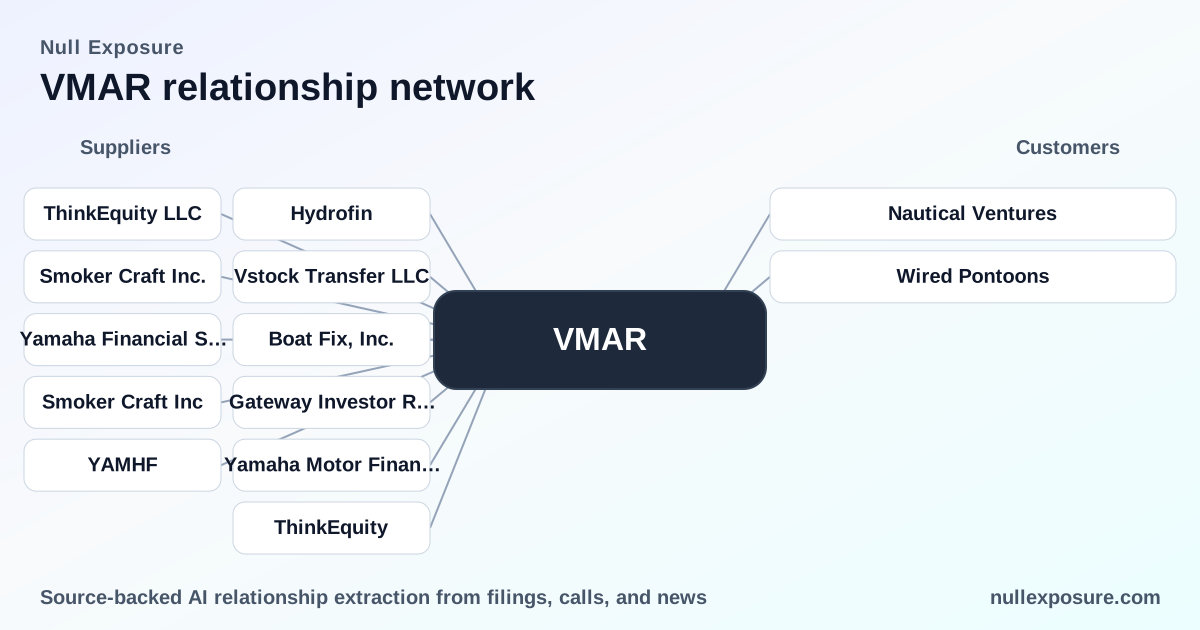
Nautical Ventures is Vision Marine’s recently acquired Florida-based dealership group and functions as the primary retail and service channel for the company’s tenders and E-Motion platforms; Nautical Ventures is explicitly the distribution and aftersales arm for flagship products such as the Specter tritoon. Company announcements in February–March 2026 describe Nautical Ventures as the integrated sales, service and support network for distribution and rigging operations. (PR Newswire / Morningstar syndication, Feb–Mar 2026)
Nautical Ventures Group — retail execution driving web-originated and in-store sales
Operational reporting credits Nautical Ventures Group’s Florida dealerships and web-originated leads with a meaningful share of contracted sales growth ahead of the 2026 season, demonstrating that the retail rollout is producing convertible demand both in-store and online. TipRanks and Sahm Capital coverage in March 2026 highlighted a sharp rise in contracted electric-boat sales attributed to this combined retail-plus-digital channel. (TipRanks / Sahm Capital, March 2026)
Wired Pontoons — OEM channel for E-Motion™ 180E systems
Vision Marine received an initial purchase order from Wired Pontoons for 25 units of the E-Motion™ 180E outboard and powertrain systems, representing a supplier/OEM relationship that scales product placement through third-party boatbuilders. The OEM purchase order was reported via Powerboat World, with the order noted as an initial commercial commitment to the powertrain product. (Powerboat World, Nov 2023 / cited in 2026 rollups)
Sterk Boats — bespoke high-performance integration
Vision Marine completed a joint engineering integration with Sterk Boats to outfit the Sterk 31 performance vessel with dual E-Motion™ 180E outboards and a battery system exceeding 170 kWh, signaling the company’s ability to support high-performance, custom OEM integrations. This development shows the propulsion system’s adaptability to premium-engineered platforms. (Sterk / SJ-R press release, May 2026)
NVG (NVGC) — concentrated revenue contributor cited in financial reporting
Third-party financial reporting indicates NVG (ticker NVGC) accounted for a very large share of reported sales — 97.4% of total sales, listed as CAD 14.15M in the referenced financial summary — identifying a material revenue concentration that investors must monitor for counterparty and collection risk. (Intellectia.ai financials summary, May 2026)
Operating characteristics and company-level constraints
Use the following operating signals to frame risk and upside; these are company-level characteristics, not claims about any single customer.
- Vertical integration is core to the monetization model. Ownership of Nautical Ventures gives Vision Marine control of retail, rigging and aftersales workflows, which is essential for complex electric propulsion adoption.
- High customer concentration is material. Reported top-line concentration metrics indicate outsized revenue dependency on a single channel or account, increasing counterparty and timing risk for the P&L.
- Commercial channel maturity is early but accelerating. Fleet deployments, initial OEM orders and a growing retail footprint show a shift from R&D/demo to commercial execution, but scale remains nascent relative to market opportunity.
- Contracting posture is a mix of unit sales and small fleet deals. Public disclosures highlight both single-unit retail activity and targeted fleet/hospitality purchases; this hybrid revenue mix supports higher average sale prices but increases working-capital complexity.
- Service and aftermarket are critical to margins. Long-term gross-margin expansion depends on parts, service and repeat business through the Nautical Ventures network.
- Capital and scale constraints persist. Negative EBITDA, minimal market capitalization and thin institutional ownership mean near-term financing and execution risk influence valuation more than unit economics.
Investment implications — what moves the stock
Vision Marine’s valuation will be driven by three operational outcomes: (1) converting Nautical Ventures into a self-sustaining revenue and service engine, (2) replicating hospitality/fleet wins into repeatable multi-unit contracts, and (3) securing and scaling OEM relationships that embed E-Motion systems into third-party vessels. Positive evidence on any of these fronts—repeat orders from fleets, meaningful retail same-store sales, or multi-year OEM contracts—will de-risk current concentration and materially re-rate the company.
Key risk factors to watch are quarterly revenue seasonality, counterparty concentration, and the company’s ability to convert press announcements into booked, collectible revenues. Management disclosures show fast revenue growth but negative profitability, so execution and cash management dictate the near-term outlook.
For regular updates and to visualize customer relationship changes over time visit https://nullexposure.com/.
Bold takeaway for investors: VMAR is a vertically integrated electric-marine OEM trading at the intersection of rapid commercialization and concentration risk; its customer wins validate product-market fit but require scaling and diversification to justify a higher valuation.