Vulcan Materials (VMC): Customer Relationships and What They Signal for Investors
Vulcan Materials (NYSE: VMC) is the largest U.S. supplier of construction aggregates and related downstream products; it monetizes by selling crushed stone, sand and gravel, asphalt mix and ready-mixed concrete into public and private construction markets. The company earns the bulk of revenue through near-term product sales and project work tied to U.S. infrastructure and heavy industrial construction, with sizeable exposure to publicly funded projects and metropolitan growth corridors. (See corporate filings and recent earnings commentary for transaction specifics.) For a concise look at how these customer relationships translate into revenue durability and risk, read on or visit https://nullexposure.com/ for ongoing coverage.
How Vulcan’s commercial model actually operates and what that means for investors
Vulcan’s operating model is transactional, geographically concentrated in North America, and centered on a core product—aggregates—supported by asphalt and concrete activities. Company disclosures show the Aggregates segment drives the majority of sales: segment sales were $5,949.6 million against total revenues of $7,417.7 million in the cited period, underscoring that aggregates are the firm’s revenue engine. Revenue recognition language—sales recorded when control passes at shipment or delivery—reflects a predominantly spot-contracting posture rather than long-term subscription-style contracts. Company statements also disclose that publicly funded construction accounted for roughly 40% of aggregates shipments in 2024, signaling significant counterparty exposure to government procurement cycles.
These facts produce a clear set of investor-relevant operating characteristics:
- Contracting posture: spot sales with project-level fulfillment, which supports near-term cash flow visibility on active projects but creates sensitivity to construction activity cycles.
- Counterparty mix: material exposure to government/public sector demand, providing structural demand support via infrastructure budgets.
- Concentration: low single-customer concentration, since filings state no single customer represents a material portion of business.
- Criticality: aggregates are critical to the business and to customers’ projects, but the business is not dependent on any single counterparty.
- Geographic focus: North America-dominant, serving 23 U.S. states and select adjacent markets.
- Maturity: established, defensive-industrial supplier with asset intensity and long-lived reserves.
These company-level signals shape how investors should evaluate specific customer engagements and project wins.
What public sources show about individual customer relationships
Below I cover every customer mention surfaced in the available results. Each listing is a plain-English summary with its supporting source.
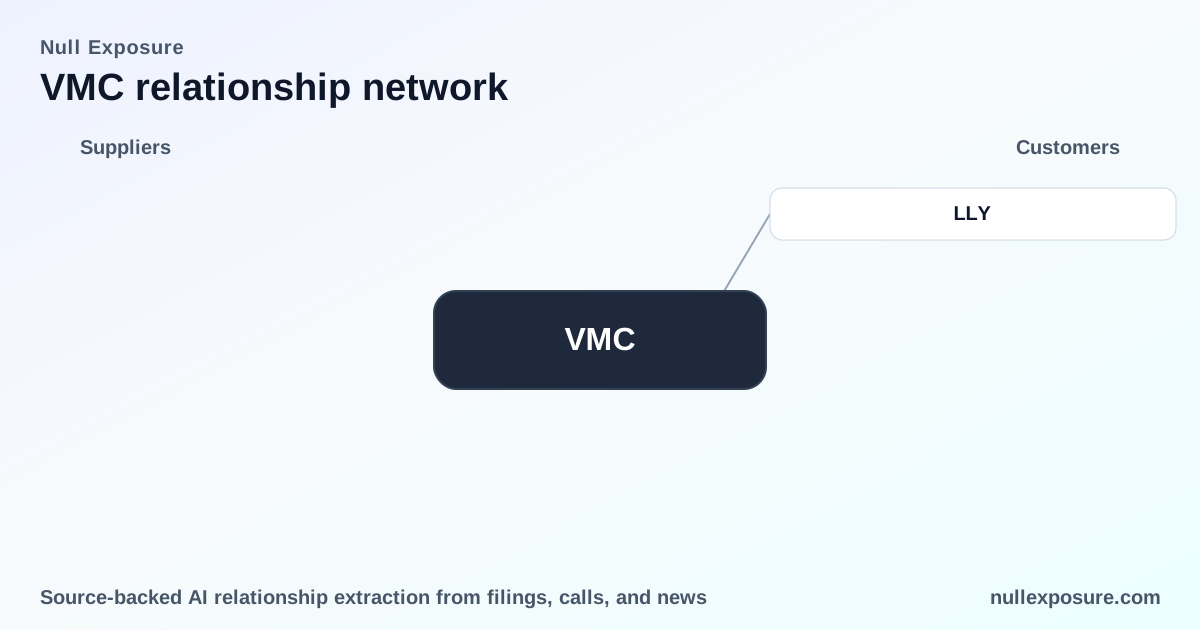
Eli Lilly (LLY) — Q4 2025 earnings mention (entry 1)
Vulcan cited a large Eli Lilly project under way in Alabama, described in earnings commentary as a roughly $6.0 billion Eli Lilly project kicking off, implying aggregate and construction materials demand associated with a major biopharma campus buildout in the region. According to Vulcan’s Q4 2025 earnings transcript reported via The Globe and Mail on March 10, 2026, the project represents significant localized demand for aggregates and related services.
Source: Vulcan Q4 2025 earnings transcript reported on The Globe and Mail, March 10, 2026.
LLY — duplicate mention in the same earnings transcript (entry 2)
The transcript contains a second indexed reference to the Eli Lilly engagement with the same language, reinforcing that Vulcan management highlighted the project as a notable demand driver in Alabama during FY2026 commentary. The repetition in public remarks signals management wants investors to track large industrial project contributions to local volumes and revenue.
Source: Vulcan Q4 2025 earnings transcript reported on The Globe and Mail, March 10, 2026.
Why these customer mentions matter for valuation and risk
Large, named projects such as the Eli Lilly campus have outsized local impact on volumes and margins because aggregates are heavy, high-transport-cost commodities where proximity to demand materially affects profitability. A single multi-billion-dollar industrial buildout can lift regional volumes and utilization of nearby quarries and asphalt plants, translating into meaningful incremental margin for Vulcan’s local operations. At the same time, the company’s disclosure that no single customer is material preserves its diversified counterparty risk profile at the enterprise level.
Public sector demand composition is another critical input: with about 40% of aggregates shipments tied to publicly funded construction in 2024, Vulcan’s revenue mix benefits from the relative stability and size of government-backed projects, but it also links results to public budget cycles and policy-driven infrastructure programs.
Practical investor implications — what to underwrite and what to watch
- Revenue quality: Spot sale recognition and shipment-based revenue recognition produce visible near-term revenue flows for active projects, but they do not create embedded recurring revenue. Evaluate backlog, regional utilization, and transport margins to assess sustainable earnings contribution from large projects.
- Concentration vs. criticality: Enterprise-level customer concentration is low (no single customer is material), yet the aggregates product is critical—loss of regional demand can quickly depress plant utilization and margins. Underwrite scenarios that stress local demand when modeling regional cash flow.
- Geographic risk: The business is North America-centric, exposing VMC to U.S. construction cycles and state-level fiscal policy; international operations are small in scale versus domestic operations.
- Contracting risk: Spot-oriented contracts reduce counterparty credit risk from long-term commitments but increase sensitivity to demand swings and competition for project supply.
Monitoring checklist — catalysts and triggers investors should track
- Track announcements of major industrial or infrastructure projects (example: Eli Lilly buildouts) and corresponding regional volume/margin disclosures from Vulcan.
- Monitor U.S. federal and state infrastructure spending profiles; changes to public funding materially affect 40%+ of aggregates demand.
- Watch quarterly commentary for regional utilization rates and any shift toward longer-term supply agreements that would change the current contracting posture.
- Review capital allocation around reserves and new quarry development, since proximity to demand determines margin resilience.
For further depth on customer-level exposures and portfolio analytics, visit https://nullexposure.com/ to access continuous coverage and structured company relationship intelligence.
Bottom line
Vulcan’s commercial model is clear and investable: a capital- and asset-intensive supplier of aggregates that monetizes via spot and project sales into a mix of public and private construction markets, with North America as the primary theater. Large industrial projects such as the Eli Lilly development in Alabama are meaningful near-term volume drivers at the regional level, but enterprise risk remains diversified with no single customer representing a material share of revenue. Investors should value Vulcan for its critical role in construction supply chains while underweighting claims of revenue stickiness absent evidence of longer-term supply contracts or material changes in contracting posture.