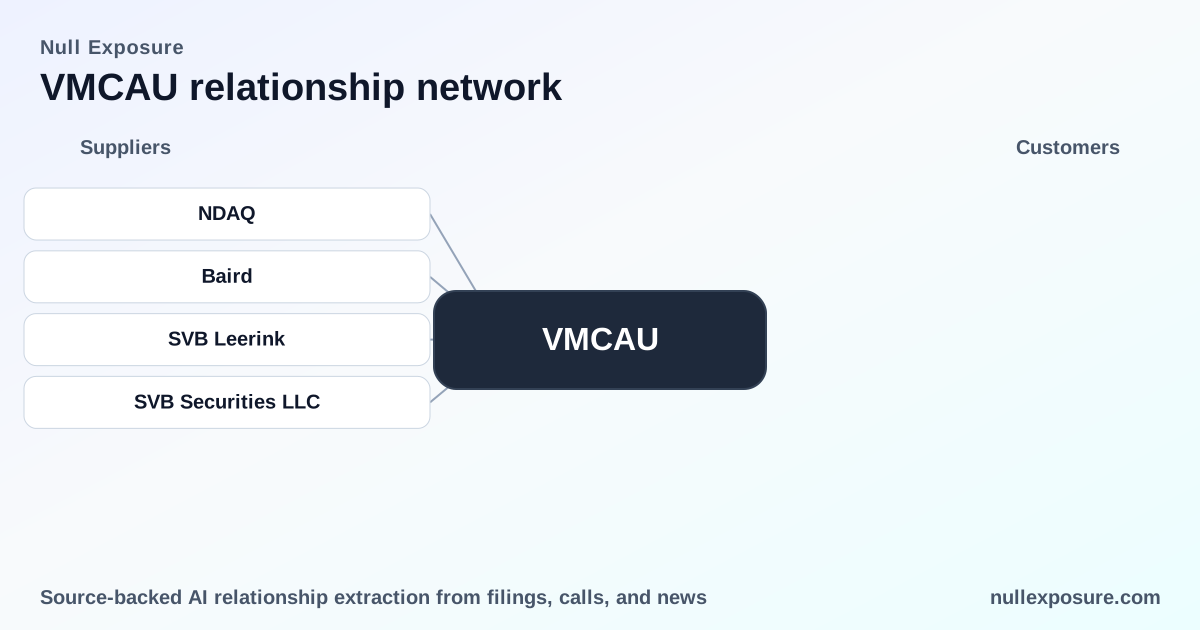
VMCAU Customer Relationships: Sponsor and Anchor Investor Dynamics Every Investor Should Track
Valuence Merger Corp I (VMCAU) operates as a classic blank‑check vehicle: it raises sponsor and public capital through units and private placement warrants and monetizes by completing a business combination or returning capital to holders. Value creation for investors hinges on the sponsor and initial warrant purchasers who provide committed capital and alignment through private placement purchases; VMCAU itself reports no operating revenue and functions as a capital formation and deal‑execution platform. For a concise, ongoing feed of documents and relationship signals, visit https://nullexposure.com/.
What VMCAU is and how that shapes its commercial posture
VMCAU is registered as a shell/Special Purpose Acquisition Company headquartered in Orinda, California. The corporate profile shows zero reported operating revenue, a negative book value (-1.854), and return‑on‑assets modestly negative (-0.0145), which are consistent with a pre‑combination SPAC with primarily financial activities and holding‑period economics. The security is a Unit on NASDAQ; public float and unit reporting indicate a structure where equity, public warrants, and sponsor warrants together create the capital base for pursuing a merger.
Company‑level operating signals worth noting:
- Contracting posture: VMCAU executed a simultaneous private placement warrant sale at IPO, demonstrating a standard SPAC contracting model that locks in sponsor and anchor commitments at formation.
- Ownership concentration: The private placement allocated a material block of warrants to the sponsor and a single limited partner, indicating concentrated early economic exposure and governance influence.
- Criticality of counterparties: Sponsor and anchor investors supply the initial $10.0 million of warranted proceeds, making them operationally critical to VMCAU’s capitalization and its ability to pursue a transaction.
- Maturity: This is an early, pre‑combination vehicle — investors should treat VMCAU as a financing and transaction platform rather than an operating enterprise.
There are no explicit additional constraints in the relationship feed; that absence itself is a signal that disclosed relationships are limited and concentrated at company formation.
Two relationships that define VMCAU’s early capital map
Valuence Partners LP — the anchor limited partner
Valuence Partners LP purchased 4,000,000 Private Placement Warrants at $1.50 each, contributing $6,000,000 of the gross $10,000,000 raised in the private placement conducted alongside the IPO. This anchor investment establishes a significant economic stake and is documented in the company’s MD&A and IPO disclosures reported for FY2022 on MarketScreener (posting dated 2026‑05‑04). According to that filing, the private placement is described in Note 4 of the MD&A and generated the stated proceeds. (Source: MarketScreener, Management’s Discussion & Analysis of Financial Condition and Results, FY2022, posted 2026‑05‑04.)
VMCA Sponsor, LLC — the sponsor’s commitment and alignment
VMCA Sponsor, LLC (formerly Valuence Capital, LLC) purchased 2,666,667 Private Placement Warrants at $1.50 each for $4,000,000, constituting the sponsor’s direct economic commitment at IPO and creating the sponsor warrant position common to SPAC formations. The MD&A for FY2022 reports this transaction as part of the IPO closing mechanics that completed the private placement and established sponsor alignment with public investors. (Source: MarketScreener, Management’s Discussion & Analysis of Financial Condition and Results, FY2022, posted 2026‑05‑04.)
Why these relationships matter to investors and operators
The private placement structure and its two counterparties set the governance and liquidity dynamics of VMCAU. Sponsor and anchor warrant holders collectively acquired all 6,666,667 private placement warrants at $1.50 each, generating $10.0 million in gross proceeds at formation — a salient capital anchor for transaction sourcing, due diligence, and bridge funding needs. This arrangement produces three practical implications:
- Alignment and governance: Sponsor ownership and the anchor limited partner’s warrant position create durable alignment on deal selection and post‑combination economics, but also concentrate voting and economic power.
- Dilution and optionality: Warrants convert to equity upside if a business combination occurs and the stock appreciates, but they also represent potential dilution and a structural lever that will affect post‑combination capital structure.
- Execution risk concentrated in a few parties: Because VMCAU reports no operating cashflows, the entity is operationally dependent on sponsor and anchor capital and their willingness to proceed with a transaction.
For a deeper look at the company’s disclosures and deal mechanics, the NullExposure platform aggregates filings and relationship signals for subscribers — visit https://nullexposure.com/ to explore the primary source documents and structured relationship views.
Risk checklist for investors evaluating VMCAU exposure
- Concentration risk: A small number of counterparties hold the initial private placement warrants and thus wield outsized influence.
- Liquidity and float characteristics: Public float measures and reported shares figures reflect unitized securities; investors should review the prospectus for mechanics around units, shares on conversion, and redemption.
- No operating revenue: VMCAU is not generating operating cashflow; value realization is binary and tied to a successful business combination or liquidation mechanics.
- Sponsor incentives: Standard SPAC economics (sponsor promote, private placement warrants) align sponsors to complete transactions, but they also create a tension between deal quality and deal completion.
Bottom line: trade the structure, not the operations
VMCAU is a financing and deal‑execution vehicle whose value depends on sponsor and anchor investor behavior, not on operating performance. The two relationships disclosed — Valuence Partners LP and VMCA Sponsor, LLC — together underpinned the $10.0 million private placement at IPO and therefore define the vehicle’s initial capital and governance stance. Investors should prioritize monitoring sponsor disclosures, the timetable for a business combination, and any subsequent transfers or exercises of warrants that will materially change ownership and dilution dynamics.
For trackers of sponsor behavior and sponsor‑anchor alignments across SPACs, NullExposure maintains a curated feed of filings and relationship intelligence to help underwriters, operators, and investors evaluate counterparty concentration and execution risk: https://nullexposure.com/.