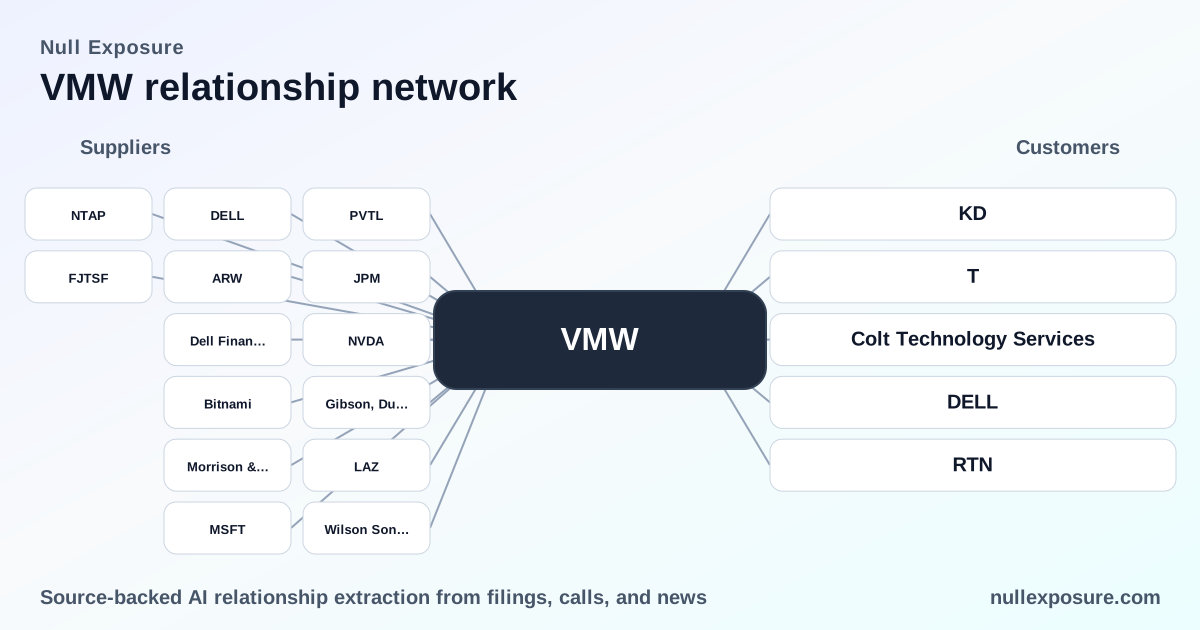
VMware (VMW) — Customer Map and Commercial Takeaways
Thesis — VMware monetizes by licensing and supporting its virtualization, cloud infrastructure and application platforms through enterprise contracts, channel partners, and managed-service integrations; revenue is driven by recurring support/subscription arrangements and deep OEM and services relationships that make VMware technology embedded in customer datacenters and service-provider stacks. Investors should evaluate how the customer mix, channel concentration, and partner integrations influence renewal economics and transition risk as VMware moves under Broadcom’s stewardship. For a concise company-level view and ongoing relationship monitoring, visit https://nullexposure.com/.
Market signal: what these relationships reveal about VMware’s commercial posture
- Enterprise-critical installs and long-term service relationships dominate: Customers and systems integrators cited here use VMware for control-plane, virtualization and multicloud orchestration, indicating high technical stickiness and long contract lifecycles.
- Channel and services partners are strategic revenue multipliers: Firms such as Dell, DXC, Kyndryl and Rackspace act as distribution, integration, and managed-service channels that expand VMware’s reach beyond direct enterprise sales.
- Competitive churn and legal friction exist: The move by some customers to alternative architectures and at least one prominent contract dispute signal renewal and pricing risk that investors must monitor.
Customer and partner relationships — concise takeaways
-
Western Union (WU) — In FY2026 Western Union elected to migrate some cloud services away from VMware toward Nutanix, a deliberate strategic shift that signals selective customer churn on legacy virtualization footprints. This move was reported in SDxCentral in May 2026 and underscores that longstanding customers will switch platforms when total cost or operational models change. (Source: SDxCentral, FY2026)
-
DXC Technology (DXC) — DXC has relied on VMware technologies for more than two decades to modernize data centers and integrate public-cloud offerings, positioning DXC as a large-scale systems integrator that sells VMware-enabled modernization services. This relationship indicates ongoing partner-led revenue capture for VMware via implementation and managed services (DXC corporate materials, FY2025).
-
Rackspace Technology (RXT) — Rackspace publicly states VMware Cloud Foundation powers its control plane, unifying compute, storage, networking and security while supporting AI workloads and sovereign data residency controls; Rackspace’s Q4 FY2025/2026 commentary emphasizes VMware as a foundational service in its cloud portfolio. This highlights VMware’s role inside third-party managed-cloud stacks and the importance of service-provider scale customers (Investing.com transcript; TradersUnion, FY2026).
-
Absolute Software (ABST) — Absolute’s endpoint resilience offering added support for VMware Carbon Black EDR as of FY2023, demonstrating an ecosystem where VMware security products are integrated by third-party endpoint vendors. This is emblematic of VMware’s product-level embedding across security and endpoint toolchains (Absolute blog, FY2023).
-
Kyndryl (KD / Kyndryl) — Kyndryl expanded its partnership with VMware to deliver multicloud advisory, implementation and management services including VMware Tanzu and vSphere deployments across public clouds, making Kyndryl a strategic delivery partner for enterprise cloud migrations. The partnership reflects channel-led adoption and an emphasis on multicloud managed services (Kyndryl press release, FY2021).
-
ePlus (PLUS) — ePlus uses VMware’s private cloud suite as a foundational element in its consulting and engineering engagements, showing how resellers and integrators translate VMware software into customer outcomes; ePlus was recognized by Broadcom for partner growth in FY2025. This underlines the commercial leverage VMware gains through certified reseller partners (PR Newswire, FY2025).
-
AT&T (T) — AT&T has been a VMware customer and was involved in litigation related to renewal options after Broadcom eliminated perpetual licensing, illustrating contractual and renewal frictions created by licensing model changes that can expose reputational and revenue risk. The dispute received coverage in technology press in FY2024 (The Register, FY2024).
-
Raytheon (RTN) — Raytheon referenced working with Pivotal and VMware to transform software delivery for government and defense customers, indicating VMware’s entrenchment in regulated and mission‑critical environments where long-term relationships and integration matter. Such customers contribute to high stickiness and longer contract horizons (HSToday, FY2020).
-
Broadcom Inc. (AVGO) — Broadcom led the acquisition of VMware and continues to integrate VMware products with its platform initiatives, including the VMware Telco Cloud Platform and Cloud Foundation integrations announced across FY2022–FY2026; Broadcom’s ownership materially changes strategic priorities, sales motions, and licensing posture. This is a central governance and business-model signal for investors assessing future revenue mix (Bloomberg Law; Yahoo Finance, FY2022–FY2026).
-
Dell / Dell Technologies (DELL) — Historically, Dell channeled a significant portion of VMware revenue—Dell accounted for a material share of VMware’s bookings in earlier fiscal periods—and continues to be a certified commercial and technology partner under framed agreements that sustain co-selling and OEM pathways. This long-standing partner relationship sustains indirect revenue flows (SiliconANGLE; CRN, FY2021).
-
Rimini Street (RMNI) — Rimini Street is identified as a third‑party support provider for Oracle, SAP and VMware software, which illustrates the aftermarket and third‑party support ecosystem around VMware products for customers seeking alternative support economics. This dynamic can influence renewal behavior and support-margin trajectories (InsiderMonkey, FY2025).
-
Colt Technology Services — Colt announced a partnership with VMware to deliver global managed SD‑WAN services, showing how network-service providers incorporate VMware networking and edge capabilities into their commercial managed offerings, expanding VMware’s presence in SASE/SD‑WAN wholesale markets (Financial IT, FY2025).
Operating-model constraints and company-level signals
- Contracting posture: The mix of direct enterprise customers, telecom/service-provider integrations and large systems integrators points to a dual contracting posture—direct enterprise agreements for large customers and volume-driven channel/OEM deals for broader distribution.
- Concentration and counterparty risk: Historical concentration through channels such as Dell and Broadcom’s acquisition reshape concentration dynamics; partners like Dell and Rackspace function as both revenue drivers and concentration points for renewal risk.
- Criticality and maturity: Several customers operate VMware as a control plane for production workloads and telco platforms, indicating high criticality and mature deployments that favor sticky renewal behavior but raise the stakes if customers elect platform migrations.
- Transition friction: Litigation and public customer migrations (AT&T and Western Union references) signal pricing and licensing headwinds that can suppress renewal elasticity and accelerate customer evaluation of alternatives.
Investment implications and risks
- Upside: Embedded channel partnerships and managed-service integrations provide recurring revenue leverage and multi-year support contracts that support predictability.
- Risk: Licensing model changes, customer migrations to alternative platforms, and legal disputes are active risks that could pressure retention and services revenue.
If you want a structured export of these relationships for portfolio monitoring or to model counterparty risk, explore the curated relationship intelligence at https://nullexposure.com/.
Bold takeaway: VMware’s ecosystem — partners, telco providers, and long-standing enterprise customers — is its primary moat, but licensing changes and select customer migrations are clear, actionable risks that investors must price into renewal and margin scenarios.