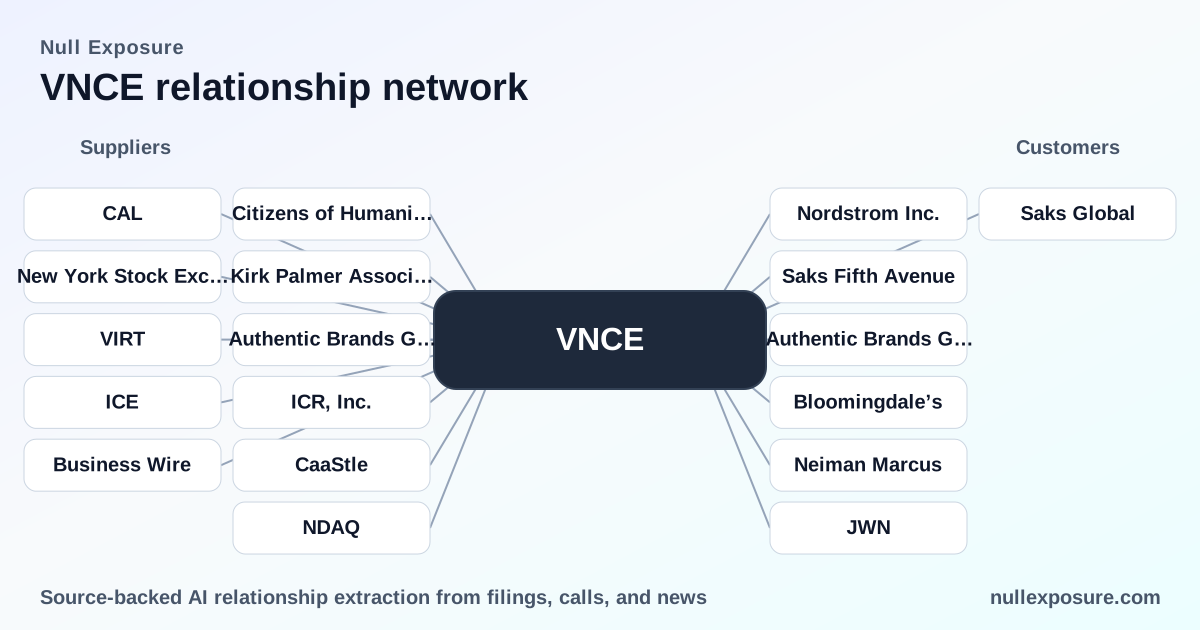
VNCE customer map: what wholesale relationships tell investors about Vince Holding
Vince Holding Corp. operates and monetizes a two‑pronged model: direct-to-consumer retail and a wholesale distribution business that supplies premium department and specialty stores. Revenue comes from full‑price and outlet retail, an e‑commerce channel (vince.com and the Vince Unfold subscription), and wholesale orders sold on an order‑by‑order basis to major U.S. and select international partners. For investors, the key dynamics are wholesale concentration, spot contracting posture, and partner operational risk, each of which drives near‑term revenue volatility and margin sensitivity. For raw access to the research behind this piece, visit https://nullexposure.com/.
Quick take — why customers matter to VNCE
- Wholesale concentration is material: one wholesale partner historically represented double‑digit percentages of sales, creating a structural revenue dependency.
- Contracts are largely spot: the company sells on an order‑by‑order basis rather than long‑term purchase agreements, amplifying demand volatility.
- Wholesale disruptions are consequential but manageable: recent partner operational problems produced a measurable headwind that management offset through DTC and other channels.
Read on for a relationship‑by‑relationship summary drawn from filings and contemporaneous reporting.
How Vince runs its wholesale business and what that implies
Vince’s public disclosures state that wholesale is run as a distribution channel supplying major department and specialty stores; sales are recognized on transfer or receipt and the company does not maintain formal long‑term purchase agreements with wholesale partners, so relationships are transactional and demand‑sensitive. Vince also runs 43 full‑price stores, 14 outlet stores, an e‑commerce site and a subscription product, Vince Unfold, which provides recurring revenue that partially offsets wholesale cyclicality. These are company‑level characteristics: spot contracting posture, U.S. revenue concentration, and a mix of retail subscription and wholesale distribution.
Customer relationships (every recorded mention)
Nordstrom Inc.
Nordstrom is a material wholesale partner, historically representing over 10% of net sales; the 10‑K noted that sales to Nordstrom accounted for more than ten percent of net sales in fiscal 2023 and 2024. According to Vince’s FY2025 10‑K filing, Nordstrom is one of the company’s top wholesale accounts and a core distribution channel.
Nordstrom (earnings and marketing activity)
Management highlights active promotional and experiential collaboration with Nordstrom — for example, an immersive event tied to the 2025 holiday collection — signaling close commercial merchandising coordination that supports brand positioning in the contemporary channel. This detail comes from Vince’s Q3 2025 earnings call transcript published in March 2026.
JWN (listed as inferred symbol for Nordstrom)
Earnings call and news transcripts reference JWN as the exchange symbol tied to the Nordstrom relationship, underscoring the company’s public wholesale reporting and investor communications about performance at Nordstrom during FY2025. See investor call coverage in March 2026.
Bloomingdale’s
Vince temporarily withdrew from Bloomingdale’s in earlier years and subsequently re‑entered with a limited retail and online presence; management references Bloomingdale’s as a driver of wholesale performance during FY2026. Reporting on the company’s retail placements and a return to Bloomingdale’s comes from a March 2026 Yahoo Lifestyle report and FY2026 earnings commentary.
Saks Fifth Avenue
Vince historically exited and later adjusted its approach to Saks Fifth Avenue as part of a broader wholesale strategy shift focused on other premium partners such as Nordstrom and Neiman Marcus, according to a Yahoo Lifestyle article summarizing the company’s merchandising moves in FY2021.
Saks Global
Saks Global is identified as a key wholesale partner undergoing operational disruption that created a reported $2 million headwind to Vince’s business in FY2026; management stated the partner represented less than 7% of sales during the period while the company continued to service the account. These operational dynamics and the headwind are documented in earnings transcript coverage and trade reporting in early 2026 (Investing.com, FashionUnited, and related investor news).
Saks (alternate reporting)
Industry coverage and financial press noted that Vince took bad‑debt charges related to the Saks reorganisation, contributing to elevated SG&A and receivable risk in FY2026; this was reported in a May 2026 retail industry summary. Fibre2Fashion and other outlets flagged a $6.5 million bad‑debt impact linked to Saks‑related issues.
Neiman Marcus
Vince shifted wholesale attention toward Neiman Marcus earlier in the decade and continues to reference Neiman Marcus among its premium partners; reporting from FY2021 cited the company’s decision to concentrate distribution on Neiman Marcus and Nordstrom. More recent earnings comments in FY2026 mentioned Neiman’s in the context of partner recovery expectations.
Neiman’s (alternate reference)
In FY2026 investor commentary, management grouped Neiman’s with other premium partners when describing cautious optimism about wholesale recovery, as noted in earnings call transcripts covered in May 2026.
Bergdorf’s
Bergdorf Goodman was mentioned alongside other luxury partners in FY2026 earnings commentary, where management expressed cautious optimism about wholesale channel momentum as reported in May 2026 earnings transcripts.
Authentic Brands Group
Authentic Brands Group announced the acquisition of the Vince brand in a FY2023 transaction covered by trade press, signaling a corporate ownership change that materially affects strategic direction and brand stewardship compared to the pre‑acquisition period; industry reporting in 2026 recounts ABG’s acquisition in earlier filings and coverage.
Constraints and operational signals investors should price in
- Contracting posture (spot): Vince explicitly states wholesale purchases are order‑by‑order with no formal long‑term written agreements, a structural condition that increases revenue sensitivity to partner ordering patterns.
- Subscription revenue presence: The company operates a subscription service, Vince Unfold, alongside retail and outlet stores, introducing a modest recurring revenue stream that partially mitigates wholesale volatility.
- Geography: U.S. dominance with premium global distribution: Vince is domiciled in the U.S. and reports that substantially all sales originate domestically, while the brand is carried through premium wholesale channels globally.
- Materiality of wholesale partners: Wholesale concentration is confirmed — sales to a single wholesale partner represented 26% of fiscal 2024 net sales and 20% in fiscal 2023 — making partner health a driver of company performance.
- Role and segment: The company’s wholesale unit operates as a distribution channel for the core ready‑to‑wear product line; management treats wholesale as an active, operationally significant segment.
These constraints are company‑level signals derived from Vince’s filings and public remarks and should be incorporated into risk‑adjusted forecasts for topline variability and working capital exposure.
Investment implication and next steps
Bottom line: Vince is a premium lifestyle brand with visible wholesale concentration and a predominantly spot commercial structure; the company’s recent management commentary shows the business can offset partner disruptions with DTC strength, but partner operational issues (Saks Global) and the materiality of a single large wholesale account (Nordstrom) are clear downside risks. For a deeper read and periodic updates on partner‑level developments, visit https://nullexposure.com/.
For modelers: stress test receivables and order cadence from Nordstrom and Saks Global, and assume subscription and DTC growth moderate wholesale declines in downside scenarios.