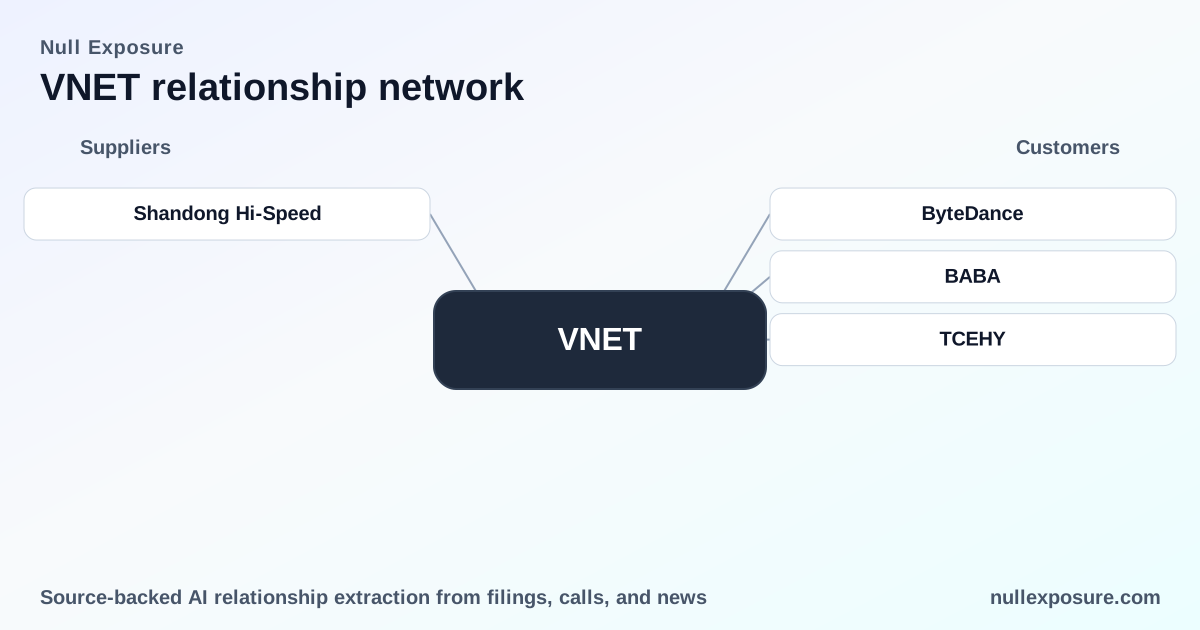
VNET’s customer map: why hyperscaler contracts define the investment case
VNET Group Inc. (VNET) operates China-focused data center and hosting infrastructure, monetizing through colocation, managed Internet data center (IDC) services, and cloud partnership contracts with large internet platforms, government and enterprise accounts. Revenue is driven by long-duration capacity commitments and large discrete orders from hyperscalers that can materially shift quarterly top-line; recent press coverage ties VNET to several of China’s largest cloud and internet companies and highlights both substantial upside and concentration risk. For a concise primer on how we source and track customer signals for investment research visit https://nullexposure.com/.
How customer relationships translate into value
VNET’s business model is asset-heavy and contract-sensitive. Large customers contracting for rack space, power and managed services produce predictable recurring revenue, but the company’s economics are also tightly linked to the timing of hyperscaler deployments. That means two investment consequences are unavoidable: a single large order can meaningfully accelerate revenue and margins, and concentration among a handful of hyperscalers increases downside volatility if deployments shift.
- Contracting posture: revenue is primarily derived from multi-year hosting and IDC contracts with staged capacity deliveries rather than short-term spot sales.
- Concentration: public reporting repeatedly names the same hyperscalers as top customers, which creates customer concentration as a core risk and a driver of episodic upside.
- Criticality: these contracts are mission-critical for hyperscalers’ China operations, making VNET a strategic supplier when execution and regulatory alignment are intact.
- Maturity and capital intensity: the model is mature but capital-intensive, requiring steady capex to match hyperscaler demand and preserve performance economics.
The customer list, one relationship at a time
Below are each of the relationships surfaced in recent coverage, with concise plain-English takeaways and source references.
Alibaba
VNET is reported to count Alibaba among its customers, and quarterly disclosure noted that internet data center services comprised a large portion of net revenue in a recent quarter, underscoring Alibaba’s role as a revenue contributor. According to an InsiderMonkey write-up referencing VNET’s July–September quarter, net revenue rose about 22% year-over-year to 2.58 billion yuan, of which 1.95 billion came from IDC services (InsiderMonkey, May 4, 2026).
BABA (as listed in market commentary)
Market commentary positions BABA (Alibaba’s ticker) as one of the hyperscalers from which VNET can capture outsized demand, framing Alibaba as a strategic growth lever alongside other large cloud players. This view was articulated in a Finviz piece discussing upside catalysts for VNET (Finviz, March 10, 2026).
Alibaba Cloud
Analysts and commentators explicitly name Alibaba Cloud as part of the addressable hyperscaler cohort that VNET targets, implying strategic alignment for cloud hosting and managed services rather than only retail or e‑commerce workloads. Finviz’s market narrative included Alibaba Cloud among the hyperscalers referenced as catalysts for VNET’s growth (Finviz, March 10, 2026).
ByteDance
Press reports attribute a record data center order to VNET from TikTok owner ByteDance — a contract described as approximately 500 megawatts of capacity, representing a potentially material multi-period revenue stream and a near-term tailwind when recognized. InsiderMonkey summarized a March 5, 2026 Star/Bloomberg report that VNET secured this large order, and other market notes suggest accelerated ByteDance deployments could pull forward RMB 400–600 million in revenue (InsiderMonkey and Finviz, March 2026; MarketScreener, March 10, 2026).
JD.com
VNET’s customer roster also includes JD.com, listed alongside Tencent and Alibaba in coverage that highlights the concentration of large Chinese internet firms among VNET’s client base. InsiderMonkey referenced JD.com as a named customer in the same quarterly recap discussing IDC revenue composition (InsiderMonkey, May 4, 2026).
Tencent
Tencent is identified repeatedly as a VNET customer, reinforcing the company’s exposure to major domestic platforms that require substantial colocation and managed hosting capacity. The InsiderMonkey coverage that cited Tencent as a customer corresponded to the quarter in which IDC services drove most of VNET’s net revenue (InsiderMonkey, May 4, 2026). Finviz commentary also grouped Tencent among the hyperscalers driving VNET’s strategic positioning (Finviz, March 10, 2026).
Microsoft
Market commentary credits VNET with exclusive partnership arrangements in China for Microsoft Azure and Microsoft 365, positioning VNET as a local host and channel for Microsoft cloud services—an important strategic relationship with global name-brand impact. InsiderMonkey’s company overview highlighted these partnerships alongside institutional support such as Blackstone backing (InsiderMonkey, May 4, 2026).
What the relationship map implies for investors
- Upside is concentrated and lumpy. Large hyperscaler orders — ByteDance’s reported 500 MW contract is the prime example — can accelerate revenue and margins materially in a short window. Market commentary has quantified potential revenue pull-forward in the low hundreds of millions of RMB from such deployments (Finviz; MarketScreener, March 2026).
- Concentration risk is the counterweight. When a handful of hyperscalers generate the bulk of hostable demand, delivery delays or changes in deployment strategy can depress growth; conversely, one large contract can create outsized positive surprises.
- Strategic partnerships provide defensive value. Relationships with Microsoft and other international brands deepen VNET’s product mix beyond raw colocation and add resilience through diversified contract types (partner-hosted cloud services vs. pure colocation).
- Capital intensity and execution matter. The business requires substantial capex and project execution discipline to convert signed orders into revenue; investors must watch capacity buildouts, power agreements and operational milestones alongside headline order announcements.
Company-level signals and constraints investors should watch
The relationship dataset provided no explicit constraints clauses, so treat the following as firm-level operating signals to track: high customer concentration among hyperscalers, contract-driven revenue recognition, capital-intensive capacity expansion, and strategic tie‑ups with global cloud vendors. These characteristics define VNET’s contracting posture (long-term, staged), criticality (high for customers), and maturity (established IDC operator scaling with hyperscaler demand).
Practical next steps for research
- Verify the timing and revenue recognition schedule for any reported hyperscaler orders — a large signed contract does not always translate into immediate revenue.
- Monitor VNET’s quarterly disclosures for customer concentration metrics and segment-specific margin trends, especially IDC services.
- Track capex guidance and completion schedules tied to large hyperscaler commitments.
For additional curated relationship intelligence and model-ready signals for investment teams, visit https://nullexposure.com/ — our research portal consolidates these customer signals with verifiable source links and time-stamped coverage.
Bold takeaway: VNET’s valuation is fundamentally a hyperscaler story — upside is large and concentrated, and due diligence should prioritize contract timing, capex execution, and customer concentration metrics.